Down Payment Amount Calculator
Turn a target percentage into the exact dollar down payment on any home price. Enter the price and the percent you plan to put down, and this tool returns the down payment in dollars, the resulting loan amount, the loan-to-value ratio, and whether private mortgage insurance applies because the down payment falls below 20 percent.
🎯Real Buyer Scenarios
📝Home and Down Payment Inputs
The agreed contract price of the home.
Share of the price you plan to pay upfront.
Choosing a type fills the typical minimum percent.
Used only if down payment is under 20%. Typical 0.3-1.5%.
Controls how dollar amounts are displayed.
Threshold to drop PMI, standard is 20%.
🔢Formula Snapshot
💵Down Payment at Standard Percents
| Down Percent | Down Payment | Loan Amount | Resulting LTV |
|---|---|---|---|
| 3% | $0 | $0 | 0% |
🏦Minimum Down Payment by Loan Type
| Loan Type | Typical Minimum | PMI or Insurance | Best For |
|---|---|---|---|
| Conventional | 3% to 5% | PMI under 20% | Good credit buyers |
| FHA | 3.5% | MIP required | Lower credit scores |
| VA | 0% | No monthly PMI | Eligible veterans |
| USDA | 0% | Guarantee fee | Rural, income limits |
| Jumbo | 10% to 20% | Varies by lender | High-price homes |
| Conventional no PMI | 20% | None | Skipping insurance |
📊PMI Cost by Down Payment Size
| Down Percent | Resulting LTV | PMI Applies | Typical Annual Rate |
|---|---|---|---|
| 3% | 97% | Yes | 0.75% to 1.5% |
| 5% | 95% | Yes | 0.55% to 1.1% |
| 10% | 90% | Yes | 0.40% to 0.8% |
| 15% | 85% | Yes | 0.30% to 0.6% |
| 20% | 80% | No | 0% none |
| 25% | 75% | No | 0% none |
🗃Percent Tier Comparison Grid
| Home Price | Down % | Down $ | Loan Amount | LTV | PMI Status |
|---|---|---|---|---|---|
| $200,000 | 3% | $6,000 | $194,000 | 97% | Required |
| $250,000 | 3.5% | $8,750 | $241,250 | 96.5% | Required |
| $300,000 | 5% | $15,000 | $285,000 | 95% | Required |
| $350,000 | 10% | $35,000 | $315,000 | 90% | Required |
| $400,000 | 15% | $60,000 | $340,000 | 85% | Required |
| $400,000 | 20% | $80,000 | $320,000 | 80% | None |
| $500,000 | 20% | $100,000 | $400,000 | 80% | None |
| $600,000 | 10% | $60,000 | $540,000 | 90% | Required |
| $750,000 | 20% | $150,000 | $600,000 | 80% | None |
| $180,000 | 0% | $0 | $180,000 | 100% | VA/USDA |
⚙Formula Breakdown
💡Smart Down Payment Tips
Enter any purchase price and desired percent of down payment into the calculator on this page to see exactly how much that means in dollars and cents. That’s the down payment, the numbers shows you exactly what it will be, based off your desired percent. They also reveal the corresponding loan balance, the loan-to-value ratio and if you’ll need to buy private mortgage insurance.
This is the link from fuzzy goal-setting to real-world action.
How to Calculate Your Down Payment
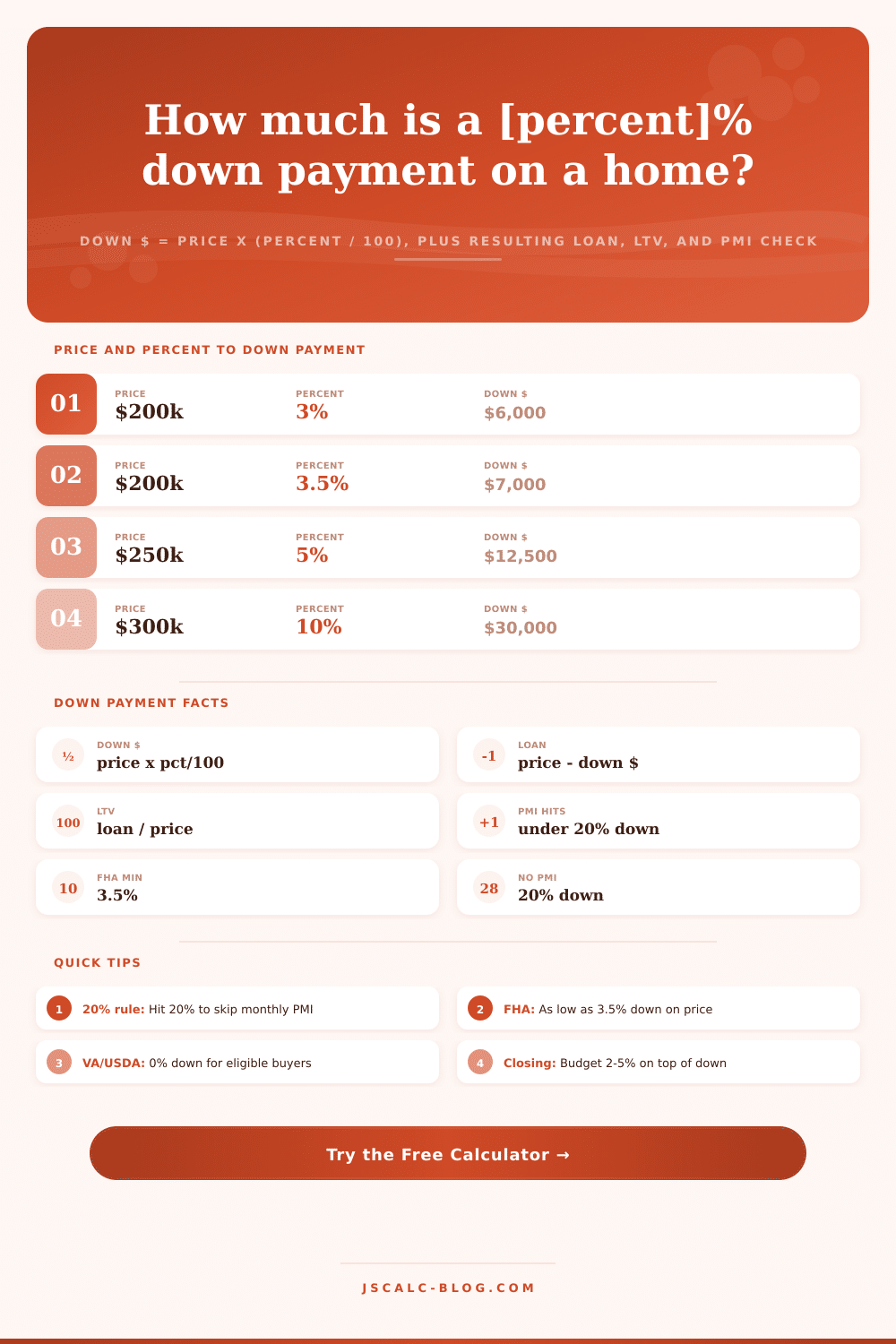
Down Payments: Lenders talk about down payments as a percentage because comparing them among homes of varying price points is simpler than trying to compare dollar amounts. But you can’t write a cashier’s check for “five percent.” The math behind this is just multiplication. You multiply the purchase price by the percentage of down payment you want. For example, if you want to borrow $300k and put 5% down, then you do: $300k x 0.05 = $15,000 And if you wanted to bump up that percentage from 5 to 20, then your cash outlay increase to $60,000.
This is why I find it often helpful to show buyers these two numbers next to each other, so they see with their eyes what an extra percentage point realy costs. And that brings us directly to our loan figure. Your down payment covers what the mortgage does not. When you buy a three-hundred-thousand-dollar house with a fifteen-thousand-dollar down payment, you’re left with a two-hundred-eighty-five-thousand-dollar loan. From there, lenders divides your loan balance by the purchase price and call it your loan-to-value (LTV). Doing the math in this case produces an answer of ninety-five percent.
Here’s a convenient trick: LTV = 100%, Down Payment Percentage. This means a five-percent down payment is the same as a ninety-five-percent LTV. We show you both metrics here for comparison. The bigger the down payment, the smaller the mortgage. Here is the math: Your down payment is $15,000. Purchase Price: $300,000
Hidden private mortgage insurance is triggered by a down payment lower than twenty percent for a conventional loan. The rule of thumb is simple: twenty percent down equals an LTV of eighty percent. Below that? You’ll get charged PMI. This is marked as such right away in the calculator, which also calculates the approximate impact (based on your loan amount and rate) on your monthly budget. A common rate here is zero point six percent; at that rate, a two hundred eighty-five thousand dollar mortgage result in about one hundred forty-two bucks each month going towards paying off your insurer… instead of yourself. This is money lost to safeguarding the bank’s interest, not yours.
To make things even more complicated, various mortgage programs has wildly different entry requirements. Conventional loans typically begin around three to five percent down. FHA loans tend to be just under that (three and a half percent), but carry their own form of mortgage insurance that’s difficult to drop. For rural buyers or eligible veterans, there are zero-down VA and USDA loans. In this case, you’re financing the full purchase price. High-priced homes might attract jumbo loans that typically requires a down payment of 10 to 20 percent.
On the chart below, we break down those minima by the specific structure of each program’s mortgage insurance. Knowing these differences allow you to select a loan based on your cash reserves and your credit profile, instead of making a square peg fit in a round hole.
Most people fail to account for the entire amount of cash required at closing. It’s not just the downpayment. In addition to the down payment there are usually two to five percent of the purchase price paid as “closing costs.” These include prepaid taxes, title work, and lender fees. That’s anywhere from six to fifteen thousand dollars on top of mortgage on a three hundred thousand dollar house. This needs to be in your hands come closing day.
You’ll need to cover closing costs regardless of your down payment size. So many buyers fixate on their percentage down that they overlook the extra costs. They show up to the closing table with enough for the down payment, but not enough for closing.
For learning purposes, the tool loads some preset scenarios with realistic combinations of percentage & price that will teach you by example. Try out a $400K purchase at 20 percent (no PMI) or a $300K purchase at five percent. The tool immediately recalculates the tradeoff between monthly obligations versus cash on hand for each scenario. Then you’ll be able to sanity check your assumptions before meeting with a lender. Turning what’s usually a stressful negotiation into a clear arithmetic exercise.
The decision between how large a down payment is right for you comes down to short term liquidity versus long term interest savings. More money down means lower loan principal, meaning less house payments (and potentially no more PMI). However, the bigger down payment is a pile of cash tied up that you might of want for something else: An emergency fund, or investing in another property.
The calculator does all the math, leaving you to worry about the strategy. And it provides the information you need to make a confident decision without guessing at the numbers. When you see it spelled out in front of you, it becomes far easier to understand how one percentage point gets you closer to owning a home, and far less intimidating. That’s because it stops being an abstract ratio, and instead, becomes real dollar amounts and cents. This is where decisions should be made.