Semi-Major Axis Calculator
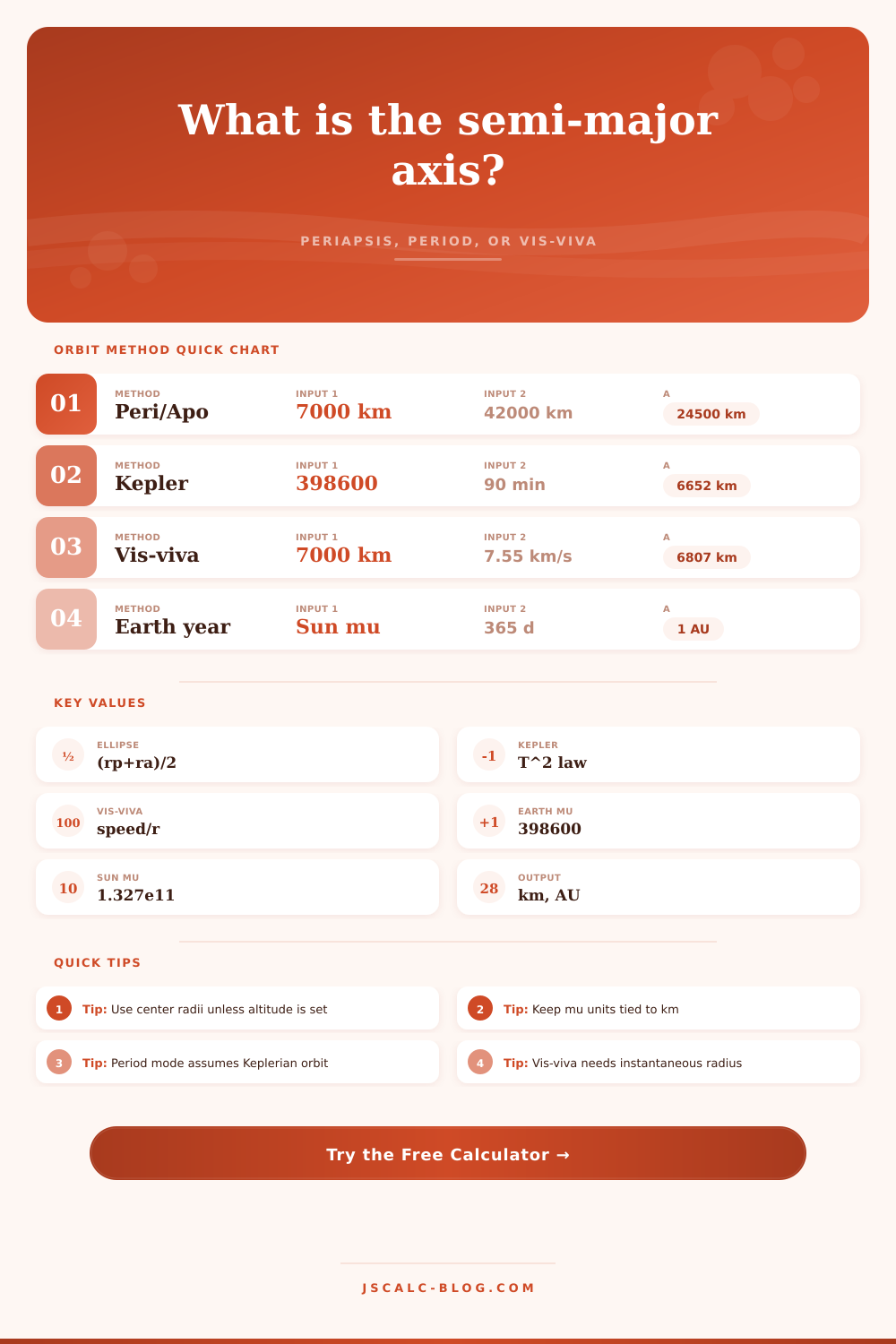
Find orbital semi-major axis from periapsis and apoapsis, from Kepler's period equation, or from the vis-viva equation using radius and speed.
Orbit presets
Calculation method
Orbit inputs
Semi-major axis result
Reference values
| Central body | mu (km^3/s^2) | Mean/equatorial radius | Common semi-major axis use |
|---|---|---|---|
| Earth | 398600.4418 | 6378.137 km | LEO, MEO, GEO, lunar transfer |
| Sun | 132712440041.939 | 695700 km | planet, asteroid, comet orbit |
| Moon | 4902.800066 | 1737.4 km | low lunar orbit |
| Mars | 42828.375214 | 3396.19 km | Mars satellite and spacecraft orbit |
| Jupiter | 126686534.0 | 71492 km | Jovian moon and probe orbit |
For two-body calculations, r peri, r apo, and r in the vis-viva equation are measured from the central body's center of mass, not from the surface, unless altitude conversion is explicitly applied.
An elliptical orbit is defined by its size: the semi-major axis. This are the average distance of a satellite to the body around which it orbits. From rocket fuel to GPS signal delays, you’d never guess that such a notion governs so much of what happens up there.
Whenever you hear mission planners talking about orbital mechanics, know that they’re talking about energy budgets. The semi-major axis is the record in which those budget are balanced.
What Is the Semi-Major Axis?
Everyone thinks they know what an orbit looks like: it’s a perfect circle. Textbooks use it because it makes sense, and it would of been convenient if it were true. But it isn’t. Orbits is actually ellipses. The initial velocity and gravity distort them into squashed and stretched shapes.
So how do you describe an ellipse? Input the semi-major axis, which cuts through all of that. Take the distance from the central body to nearest point (called periapsis) and add it to the distance from the central body to the farthest point (apoastron or apoapsis). Divide that sum by 2 to get that mean value. The calculator at the top will do this simple math for you, but knowing where that mean comes from gives you the meat of it all.
That number represent the total energy in the system. The bigger the axis, the higher the object is and the slower it moves on average. The smaller the axis, the closer, faster, and more luxurius its interaction with gravity becomes.
Or you can search for the same number in terms of time, not distance: If you’re told an object makes one orbit every ninety minutes, for instance, you can flip Kepler’s Third Law around and figure out just from that number what size orbit it is on. That’s because the semi-major axis are directly linked to orbital period, and it comes in handy whenever you don’t have a ruler but do have a stop watch. With a little math, you could find a satellite’s approximate altitude simply by being given the fact it completes one circle every ninety minutes, no measuring required. The reference table on the page explain this.
You need a gravitational parameter, or mu value, for each central body like Sun or the Earth to scale these relationship differently. That number for Earth is about 398,600 cubic kilometers per second squared; it’s the constant that grounds all terrestrial satellite calculations. Replace it with the enormous value for the Sun, and now you’re working with planetary orbits, not satellite ones.
The other great one is the vis-viva equation that ties position to speed. At any point along the orbit, not merely at its extremes, this equation provide a way to relate the two. And so it becomes the main tool for designing trajectories. Knowing the velocity of a spacecraft at some given radius lets you figure out the semi-major axis from there, and thereby the whole shape of the orbit. (It’s used by engineers to decide whether a rocket engine burn has sent the spacecraft off on its way to deep space or if perhaps a slingshot maneuver has worked.)
The tricky bit here is that tiny changes in measured speed produce enormous differences in the eventual size of the orbit. Velocity isn’t just something you do; it’s something you are. That’s what many folks miss. “How much thrust does the rocket generate?” Yes. But then they ignore that velocity is something else than too.
Units: It doesn’t matter what units you put in. Meters vs. Feet, hours vs. You can use any units, such as days, as long as you are consistent within each category. That is, don’t mix seconds with minutes, or miles with kilometers; it’s the quickest way to screw up a mission. Fortunately, the tool will convert them for you if necessary. Just make sure to note which units represent radius (from center of mass) versus altitude (above the surface). Radius is an absolute unit (distance from the center), whereas altitude is relative to the surface. Since gravity doesn’t care about the ground under your feet, get this wrong and you’ll often end up with an orbit intersecting the planet’s surface.
Once you’ve got your semi-major axis, however, the eccentricity reveals itself and describes the shape of your elliptical orbit. High eccentricity mean a swooping, wild ride. A low one makes it close to a circle.
But really, the semi-major axis isn’t just a mathematical expression; it’s a sign of commitment. If your axis is small, then you’re tied down close to Earth, you have to get a boost regularly because you’re losing altitude to atmospheric drag. But if your axis is large, then you’ve got long life and freedom in space; it just takes a lot of energy to get there.
So whether it’s a comet racing through the inner solar system or a communications satellite circling low on Earth, the one number will tell you everything you need to know about their journey. It’s the bookend between launching with sheer brute force and waiting patiently for orbital momentum. And ultimatly, learning to use this number is recognizing that gravity is money, and the semi-major axis is your balance sheet.