Orbital Velocity Calculator
Calculate circular orbital speed with v = sqrt(mu/r), elliptical speed with the vis-viva equation, altitude above a body, and orbital period.
🛰Orbit presets
⚙Orbit inputs
Orbital velocity results
🌍Body presets used by the calculator
📊Central body reference table
| Body | mu (km^3/s^2) | Radius (km) | Surface circular speed | Notes |
|---|---|---|---|---|
| Earth | 398600.4418 | 6378.137 | 7.91 km/s | Common LEO, MEO, GEO reference body. |
| Moon | 4902.8001 | 1737.4 | 1.68 km/s | Useful for low lunar orbit estimates. |
| Mars | 42828.3752 | 3396.19 | 3.55 km/s | Lower mu than Earth, lower orbital speeds. |
| Sun | 132712440041.94 | 695700 | 436.8 km/s | Use heliocentric radius, often near 1 AU. |
| Jupiter | 126686534.0 | 71492 | 42.1 km/s | Very high speeds close to the cloud tops. |
| Saturn | 37931187.0 | 60268 | 25.1 km/s | Use with care for ring-plane spacecraft cases. |
| Venus | 324858.592 | 6051.8 | 7.33 km/s | Similar scale to Earth but slightly slower. |
| Mercury | 22031.86855 | 2439.7 | 3.01 km/s | Compact body with modest orbital speed. |
Values are rounded display references. The JavaScript object stores the same mu and radius values used for the live calculation.
📐Orbit examples and formula checks
| Orbit case | Body | Input used | Formula path | Expected scale |
|---|---|---|---|---|
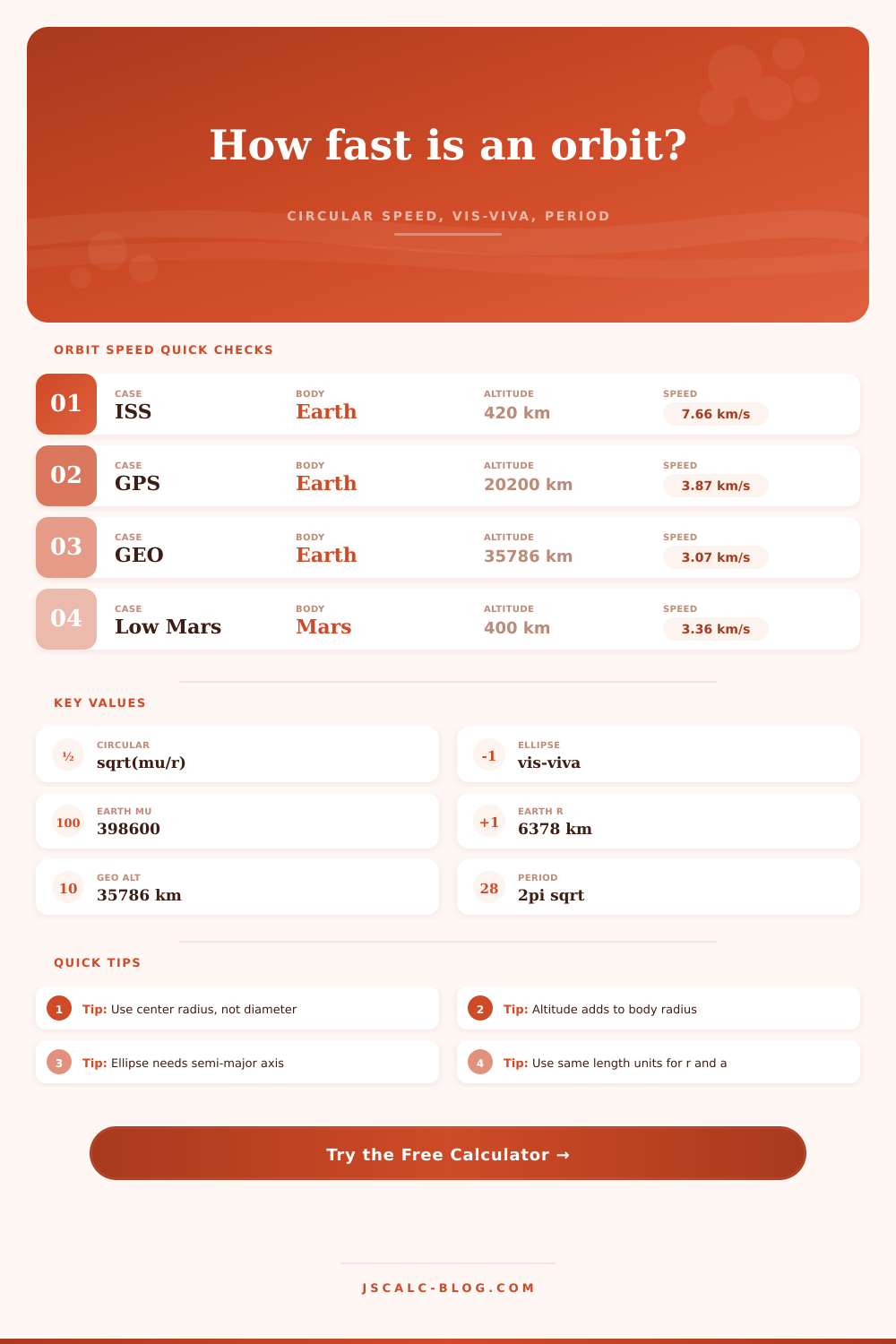
| ISS-like LEO | Earth | 420 km altitude | sqrt(mu/r) | About 7.66 km/s |
| GPS navigation orbit | Earth | 20200 km altitude | sqrt(mu/r) | About 3.87 km/s |
| Geostationary orbit | Earth | 42164 km radius | sqrt(mu/r) | About 3.07 km/s |
| GTO perigee | Earth | r near 6578 km, a near 24371 km | vis-viva | About 10.2 km/s |
| Low Mars orbit | Mars | 400 km altitude | sqrt(mu/r) | About 3.36 km/s |
| Earth heliocentric orbit | Sun | 1 AU radius | sqrt(mu/r) | About 29.8 km/s |
🧮Formula method
Imagine how an object orbits. Think off throwing a baseball. Throw it hard, and it arcs to the ground. Throw it even harder, and it goes farther before plopping into dirt. Realize with Isaac Newton that if you throw it fast enough, the curve of Earth will drop out from under ball as fast as the ball falls down. Because it continues to fall around planet, it never touches the ground. That’s what orbiting is: Not floating, but falling with style.
Whether you’re trying to design a satellite, or simply interested in why International Space Station doesn’t crash down, understanding the rate at which it has to fall can help. And while the calculator above will do the math for you, knowing what the number mean helps you understand the answer. So what does it mean? Where should you begin? That depends on the answer to one question: What’s going to make you think about how high something is?
Understanding How Orbits Work
Altitude is a naturaly starting place. Of course, you’d like to know how high you’ll get. But altitude isn’t where gravity wants you. Gravity want you closer to the center of mass. This is actualy the most common error made when people try to calculate orbits around planets. Four hundred kilometers, they type that into computer, and add it to the planet’s radius, which becomes real distance away from the center. Without that, though, they would of have no idea how fast to make things move.
The physics is easy for a simple circle: You fight gravity with your own circular motion (the “centrifugal” effect), and there’s a particular speed that maintains stable distance. That’s a tidy equation; it is elegant, simple, and clean. Unfortunately, real-world orbits aren’t perfect circles; they’re ellipses. Your path stretches out. Your speed vary along the way. You zoom past the closest part (called perigee) and then crawl painfully slow by the farthest part (apogee).
Here’s where the vis-viva equation enters the picture. It takes into account both how big whole orbit is and exactly how close or far away you currently are. It’s a complicated equation, and the calculator deal with it for you. (But it’s nice to understand that on an elliptical path, speed isn’t constant.)
As the table on the page shows (with the warning that this applies for various bodies), it’s an interesting trade-off. On Earth, you’ve got a lot of mass. To be in a low orbit, you have to go fast. Mars, as we know, is light. You can circle that body low with a fraction of our speed. That has some huge consequences when designing a mission. Because you don’t need much speed, your orbital maneuvers requires less fuel. However, you do spend longer periods of time in radiation belts unless you are careful about how you does things.
And then there’s Jupiter: where the gravity well is so deep that orbital velocities around the cloud tops are blisteringly high. Sometimes surviving the approach is easier problem than surviving in orbit once you get there.
And don’t forget: the period (time) does tell you something. It is not the shape, but the size of the orbit. For example, a circular orbit and a highly elliptical orbit of equal average radii would both requires the same time to go around once. That’s counterintuitive, but important when planning when something will happen so that you can schedule communication or scientific observations. You can’t choose any velocity; if you want to pass over some particular city each day, you must adjust the orbit size so it match your chosen period.
Consider what that tells us about escape velocity. It’s telling you how close you are to breaking free from the body entirely. Seventy percent of the speed you need to go to escape once and for all? You’re doing that at circular orbit. The other thirty percent is the difference between being trapped and becoming an interstellar citizen. A precipice of energy.
So ultimately there’s this give-and-take of distance versus mass: how much do I need to travel versus how high up do I want to be? How far away am I from gravity? Trade one for the other. Being close means traveling fast. The higher you go, the slower you can go. Whether you’re considering the ISS streaking by at four hundred kilometers, or GPS satellites orbiting at twenty thousand, it’s all the same. Velocity is like the rope; gravity is the anchor. Hold the tension just so and you remains aloft. Mess with it, and down you go. It is that simple. It is exactly that.