Escape Velocity Calculator
Calculate v escape = sqrt(2GM/r) for planets, moons, stars, or custom bodies, with altitude above the surface, mass and radius unit conversion, km/s, mph, and payload energy.
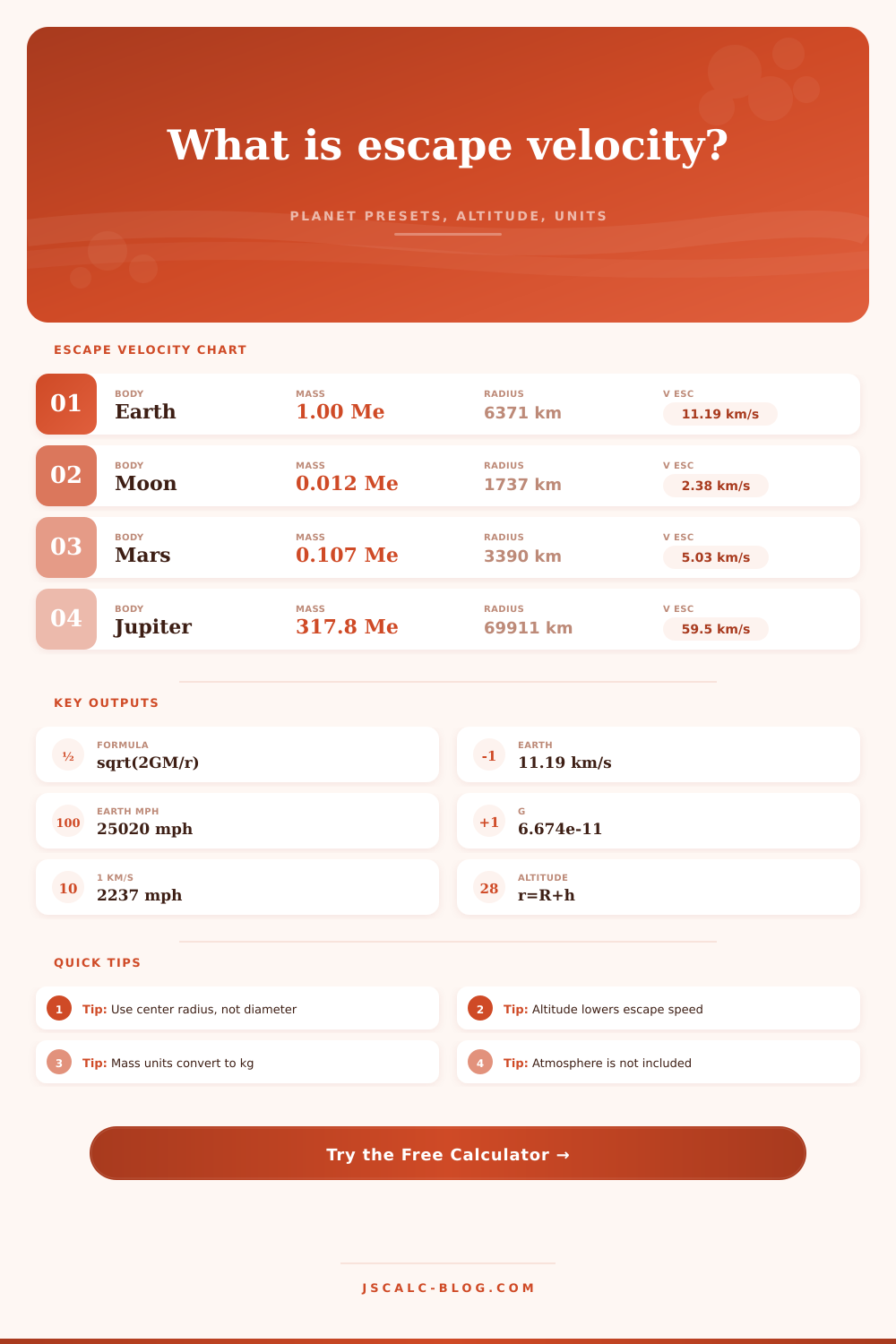
| Body | Mass kg | Mean radius | Surface escape speed | mph |
|---|---|---|---|---|
| Mercury | 3.3011e23 | 2,439.7 km | 4.25 km/s | 9,500 mph |
| Venus | 4.8675e24 | 6,051.8 km | 10.36 km/s | 23,170 mph |
| Earth | 5.9722e24 | 6,371.0 km | 11.19 km/s | 25,020 mph |
| Moon | 7.342e22 | 1,737.4 km | 2.38 km/s | 5,330 mph |
| Mars | 6.4171e23 | 3,389.5 km | 5.03 km/s | 11,250 mph |
| Jupiter | 1.8982e27 | 69,911 km | 60.2 km/s | 134,600 mph |
| Saturn | 5.6834e26 | 58,232 km | 36.1 km/s | 80,800 mph |
| Uranus | 8.6810e25 | 25,362 km | 21.4 km/s | 47,900 mph |
| Neptune | 1.0241e26 | 24,622 km | 23.5 km/s | 52,600 mph |
| Sun | 1.9885e30 | 695,700 km | 617.7 km/s | 1,381,700 mph |
| Start point | Altitude | Center radius | Escape speed | Change from surface |
|---|---|---|---|---|
| Earth surface | 0 km | 6,371 km | 11.19 km/s | baseline |
| Low Earth orbit height | 400 km | 6,771 km | 10.85 km/s | about 3.0% lower |
| GPS orbit height | 20,200 km | 26,571 km | 5.48 km/s | about 51% lower |
| Geostationary height | 35,786 km | 42,157 km | 4.35 km/s | about 61% lower |
| Moon distance | 384,400 km | 390,771 km | 1.43 km/s | about 87% lower |
| One Earth radius up | 6,371 km | 12,742 km | 7.91 km/s | about 29% lower |
| Quantity | Unit | SI conversion | Use in formula |
|---|---|---|---|
| Mass | 1 Earth mass | 5.9722e24 kg | M input |
| Mass | 1 Jupiter mass | 1.8982e27 kg | M input |
| Mass | 1 solar mass | 1.9885e30 kg | M input |
| Radius | 1 Earth radius | 6,371,000 m | R input |
| Radius | 1 Jupiter radius | 69,911,000 m | R input |
| Velocity | 1 km/s | 2,236.94 mph | output |
| Velocity | 1 km/s | 3,280.84 ft/s | output |
| Energy | 1 megajoule | 1,000,000 J | 0.5mv^2 |
| Scenario | Mass source | Radius source | Altitude | Escape speed | Context |
|---|---|---|---|---|---|
| Earth surface | 1 Earth mass | 1 Earth radius | 0 km | 11.19 km/s | classic textbook value |
| LEO start | 1 Earth mass | 1 Earth radius | 400 km | 10.85 km/s | altitude only, no orbital energy |
| Moon surface | 1 Moon mass | 1 Moon radius | 0 km | 2.38 km/s | much easier than Earth |
| Mars surface | 0.107 Earth mass | 0.532 Earth radius | 0 km | 5.03 km/s | less than half Earth |
| Jupiter clouds | 1 Jupiter mass | 1 Jupiter radius | 0 km | 60.2 km/s | gas-giant gravity well |
| Solar surface | 1 solar mass | 1 solar radius | 0 km | 617.7 km/s | stellar gravity well |
The idea behind escape velocity is that it’s the speed at which an object will never again fall back down once propulsion stops. Think more like a rocket lifting off from the pad rather than one continuously in motion.
That’s why escape velocity isn’t necessarily a number, it’s a function of both total energy (mass) and radius. Plug in the values; leave the conversions and coefficients up to the calculator. That’s the formula: G x M / R; then square root that.
What is Escape Velocity?
Easy enough, but here are two things it doesn’t tell you that is important. First, what’s “M”? That’s mass (of course). Second, what’s “R”? That’s radius.
Don’t get confused about this! It’s not a radius around the Earth. It’s a radius from wherever you’re standing to the center of the planet. So if you stand on a mountain, you’ll have a bigger radius than if you stood at sea level. Because gravity gets weaker as you get farther away, having a longer radius decreases the necessary speed.
You can plug in your altitude into the calculator’s surface radius field. Why? Because the more height above ground you begin at, the less gravity you has working against you.
To get away from Earth, we need something going about 11.2 kilometers per second. That’s about 25,000 miles per hour. A rocket doesn’t achieve that instantly. Instead it burns fuel constantly as it fights the pull of gravity and drag.
Escape velocity isn’t a description of the path taken, only an indication of the energy required. Once you’re in space, at say Low Earth Orbit (which is 400 kilometers up), the escape speed are lowered to about 10.85 kilometers per second. That’s a tiny bit less, but it means less energy to escape Earth. The lower the altitude, the less energy is required… The reference table tell us just that.
In addition, it computes the amount of kinetic energy needed to put up that payload. It calculates the ideal kinetic energy required for a given mass, which is the whole point of making the physics concrete. That energy scales as square of velocity. Double the velocity, quadruple the energy. This is precisely why tiny boosts are so costly in terms off energy.
To go to Mars, you have to achieve escape velocity: 5.03 kilometers per second. That’s under HALF what Earth needs. The calculator let’s you pull out the gravity part. There is no atmosphere, no staging loss, and no steering inefficiency. Just plain ol’ physics.
The units can get confusing. Don’t let that stop you from working though. It calculates using all standard SI units by converting everything into them. This is so it avoids any problems with powers of ten, powers of ten will kill your mission. If you input one number wrong by one decimal place, it can mean the difference between orbit and oblivion. Or at least would of not gone to orbit.
There are preset bodies such as Moon or Jupiter to check against your inputs too. To escape Jupiter takes more than 60 kilometers per second. You need hundreds of kilometers per second if you want to reach the Sun. These numbers demonstrate just how massive the gravity on planets really is.
The speed required to escape from a body is what we call escape velocity. By changing the settings on the calculator, you begin to understand the grip of escape velocity in terms off visual aid. For example, imagine a big fluffy planet that has the same escape velocity as a smaller, denser planet. There’s a balance between mass and distance.
Once you get your head around this, you start thinking differently about our solar system. These objects are not just floating around in space but they are also places where gravity forms an energy well of different depths. Understand that, and suddenly you see a story in the gravity measurements.