Relativistic Doppler Calculator
Calculate radial relativistic Doppler wavelength factor, frequency factor, redshift, velocity, beta, Lorentz gamma, and the classical approximation error.
Relativistic Doppler results
| Signed β | Motion | Relativistic wavelength factor | Classical wavelength factor | Difference in z |
|---|---|---|---|---|
| -0.300 | Approaching | 0.73380 | 0.70000 | +0.03380 |
| -0.100 | Approaching | 0.90453 | 0.90000 | +0.00453 |
| -0.010 | Approaching | 0.99005 | 0.99000 | +0.00005 |
| 0.010 | Receding | 1.01005 | 1.01000 | +0.00005 |
| 0.100 | Receding | 1.10554 | 1.10000 | +0.00554 |
| 0.300 | Receding | 1.36277 | 1.30000 | +0.06277 |
| 0.600 | Receding | 2.00000 | 1.60000 | +0.40000 |
| Line | Rest wavelength or frequency | At β = 0.01 receding | At β = -0.01 approaching | Use |
|---|---|---|---|---|
| Hydrogen H-alpha | 656.28 nm | 662.88 nm | 649.75 nm | Optical nebulae and stars |
| O III | 500.70 nm | 505.73 nm | 495.72 nm | Emission-line galaxies |
| Lyman alpha | 121.57 nm | 122.79 nm | 120.36 nm | UV and high-z objects |
| HI 21 cm | 1420.4058 MHz | 1406.27 MHz | 1434.68 MHz | Neutral hydrogen radio |
| CO J=1-0 | 115.271 GHz | 114.12 GHz | 116.43 GHz | Molecular gas radio |
| Sodium D2 | 588.995 nm | 594.91 nm | 583.13 nm | Stellar absorption |
JSCalc-Blog.com: Relativistic Doppler calculator reference. Webhook row marker: index 1400, gid 1393155561.
But the universe is not a sound wave reflecting off a speeding automobile. When you’re measuring the light coming from something traveling at a significant percentage of the speed of light, you have to distinguish between those two thing. Air isn’t required for sound; it’s not required for light. And since light travels through empty space, it’s subject to the unforgiving stiffness of spacetime itself.
As that object approaches you, or races away from you, the light it produce doesn’t merely get stretched out or compressed in a straightforward linear fashion. Its clocks tick different from your own. That’s what relativity requires. Relativity insists on that, but classical physics ignores it.
Why Light Is Different from Sound
Once you exceed that lower speed threshold, the gap between a crude estimate and an accurate measurement grows large enough to matter. Above is a tool that allows you to take a wavelength range, a redshift number, or a radial velocity (speed). It then calculates the rest for you.
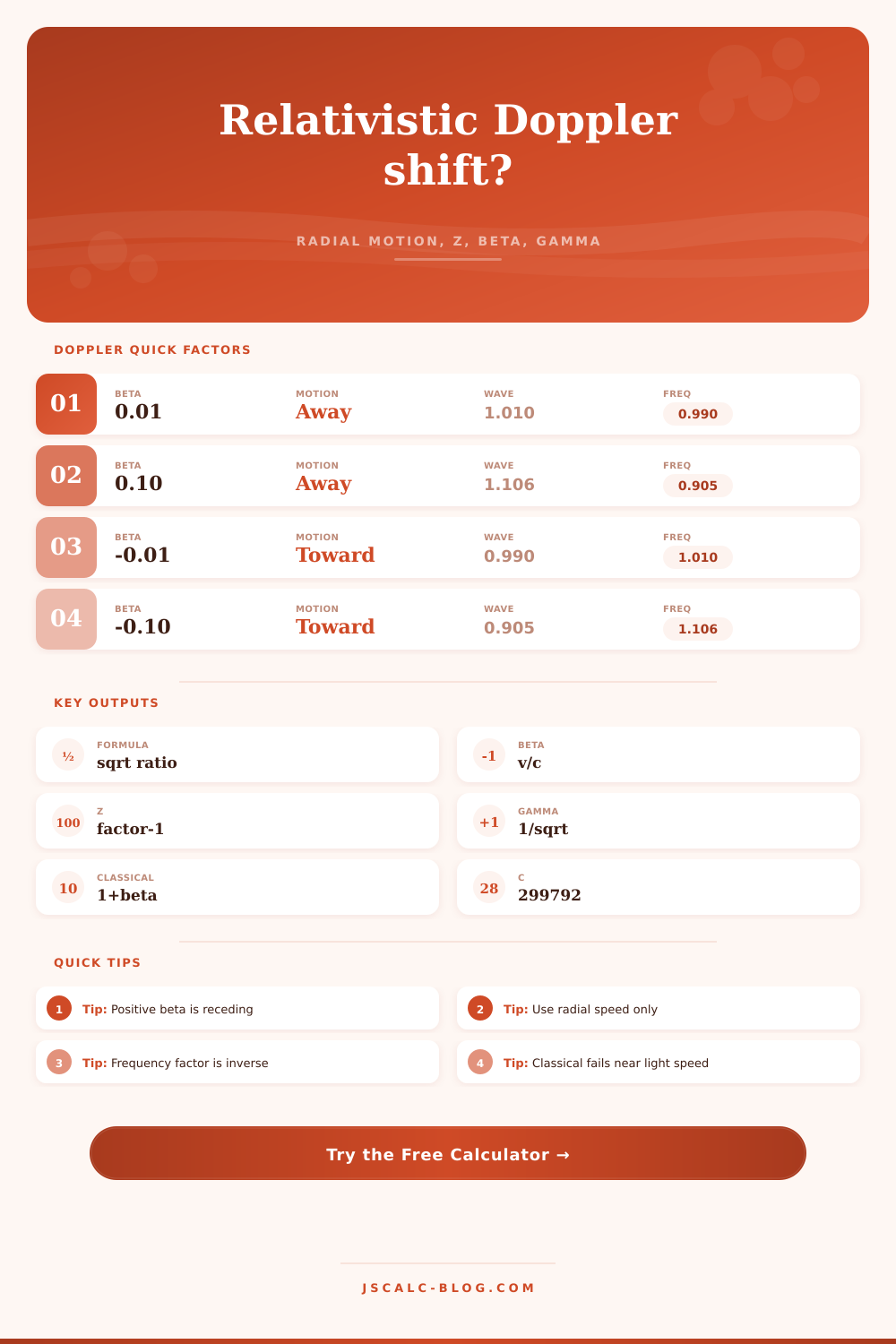
It all starts with beta, which is just velocity/speed of light. 1. The sign matters a lot. A +beta means you’re moving away from us, pushing that light to the red end of the spectrum. -beta means you’re coming at us, shifting the light to the blue side. That’s just how astronomers define the sign: because expansion dominates the universe, redshift is the primary shift we see, so it’s the default.
Many students assume a positive number means you’re coming at me. But the calculation reverses it for you automaticly, so don’t fret about the sign. It’ll get you right.
Wavelengths and frequencies are inverses. As one goes up, the other has to go down; they’re two halves of the same relativistic coin. The classical Doppler formula is simple enough; it’s intuitive, so most folks stop there. It’s perfect when you’re thinking about a siren or a police radar gun speeding past along the highway.
But light doesn’t move through any medium. For everyone who sees it, its speed are always the same. That means the frequency change must be proportional to the square root of the ratio of (1 + beta) to (1… Beta), which is exactly what special relativity says. The square root is a sign of relativity: it represents the fact that time dilates for moving observer.
For small velocities, this effect is extremely minor. Usually within a fraction of a percent, the classical formula agree with reality. As you approach the speed of light, however, the mistake goes nuts. The classical approximation errs noticeably at 30% of lightspeed, and by an enormous amount at 60%. To see precisely how such errors compound over time, look to the reference table on this page. It’s a serious lesson in the limits of human intuition as velocity approaches being a large part of c.
Suppose you’re observing two stars orbiting one another in a binary system, their components circling each other at thousands of kilometers per second. Or suppose you have a particle beam that accelerates ions to speeds approaching the speed of light (90% of c). Then it’s not just rounding that separates a relativistic calculation from a classical one; it’s the difference between detecting a certain element or determining it isn’t there.
We know what the rest wavelength of hydrogen alpha is. If you measure its wavelength shift, you can calculate back to get the velocity. But unless you apply the right equation, your measured value won’t be the actual velocity. Your result will be systematically biased based off higher speeds, the bias increases. You’ll perceive a galaxy as being either faster-moving or more slowly-moving then it truly is. And that affects cosmology: redshift measurements allow us to trace expansion of the universe. A small error in velocity becomes a big error in distance, and hence age.
The tool will spit out the Lorentz gamma factor for you as well, and that’s where you’ll find your answer about the amount of time dilation going on. There is no relativistic effect if gamma=1.0. As beta gets closer to 1.0, gamma goes to infinity…this is the price in energy paid by speed. You can pump infinite energy into a mass with acceleration, but you will never reach light speed. Accelerating something will only make it go faster, but nothing will ever reaches the speed of light.
So don’t be afraid to put in the math yourself…the calculator does it all for you. All you have to do is know what the math means. That high redshift isn’t simply changing colors. It’s directly measuring time distortions and kinetic energy. What you’re looking at when you get a number is the geometry of spacetime responding to motion.
But this radial calculator has its limits. The radial velocity we’re looking at here is based on motion directly toward or away from us. But actual galaxies and stars have proper motion; they have a transverse component (a sideways motion) as well that causes them to move across the sky. That causes an entirely different kind of shift due to time dilation, with no wave compression involved at all. This tool doesn’t account for that. No, it’s meant specifically for the radial component, that’s the dominant signal from far away. So even if you’re just curious how the physics works, or want to analyze a spectrum yourself, knowing the direction helps get halfway there.
If the galaxy or star is moving toward you, you’ll see its light blueshifted. It is redshifted if it’s moving away. Math takes it from there. Remember: Light doesn’t care about your speedometer. It cares about the shape of space. Get your head around that and then suddenly the numbers begin to make sense. And the stretching of the light becomes a map of the trip.