Doppler Wavelength Shift Calculator
Compute redshift or blueshift from radial velocity, rest wavelength, observed wavelength, and frequency, then compare the nonrelativistic result with the relativistic Doppler formula.
Doppler Shift Results
| Line | Rest wavelength | Rest frequency | Common use |
|---|---|---|---|
| Hydrogen H-alpha | 656.281 nm | 456.8 THz | Nebulae, stellar spectra |
| Hydrogen H-beta | 486.133 nm | 616.7 THz | Balmer line velocity checks |
| O III | 500.684 nm | 598.8 THz | Planetary nebulae, galaxies |
| Lyman alpha | 121.567 nm | 2466 THz | Ultraviolet and high-redshift work |
| Sodium D2 | 588.995 nm | 508.99 THz | Laboratory and stellar absorption |
| Calcium K | 393.366 nm | 762.12 THz | Solar and stellar chromospheres |
| Neutral hydrogen | 21.106 cm | 1420.406 MHz | Radio astronomy gas motion |
| CO J=1-0 | 2.6008 mm | 115.271 GHz | Molecular cloud velocity |
| Radial speed | Beta | Nonrel z | Relativistic z | Use note |
|---|---|---|---|---|
| 30 m/s | 1.001e-7 | 1.001e-7 | 1.001e-7 | Exoplanet precision scale |
| 30 km/s | 1.001e-4 | 0.0001001 | 0.0001001 | Stellar radial velocity |
| 300 km/s | 0.001001 | 0.001001 | 0.001002 | Galaxy internal motion |
| 3000 km/s | 0.01001 | 0.01001 | 0.01006 | Relativistic error visible |
| 30000 km/s | 0.1001 | 0.1001 | 0.1057 | Use relativistic result |
| 150000 km/s | 0.5003 | 0.5003 | 0.7330 | Nonrel result is poor |
| Quantity | Nonrelativistic formula | Relativistic comparison | Sign convention |
|---|---|---|---|
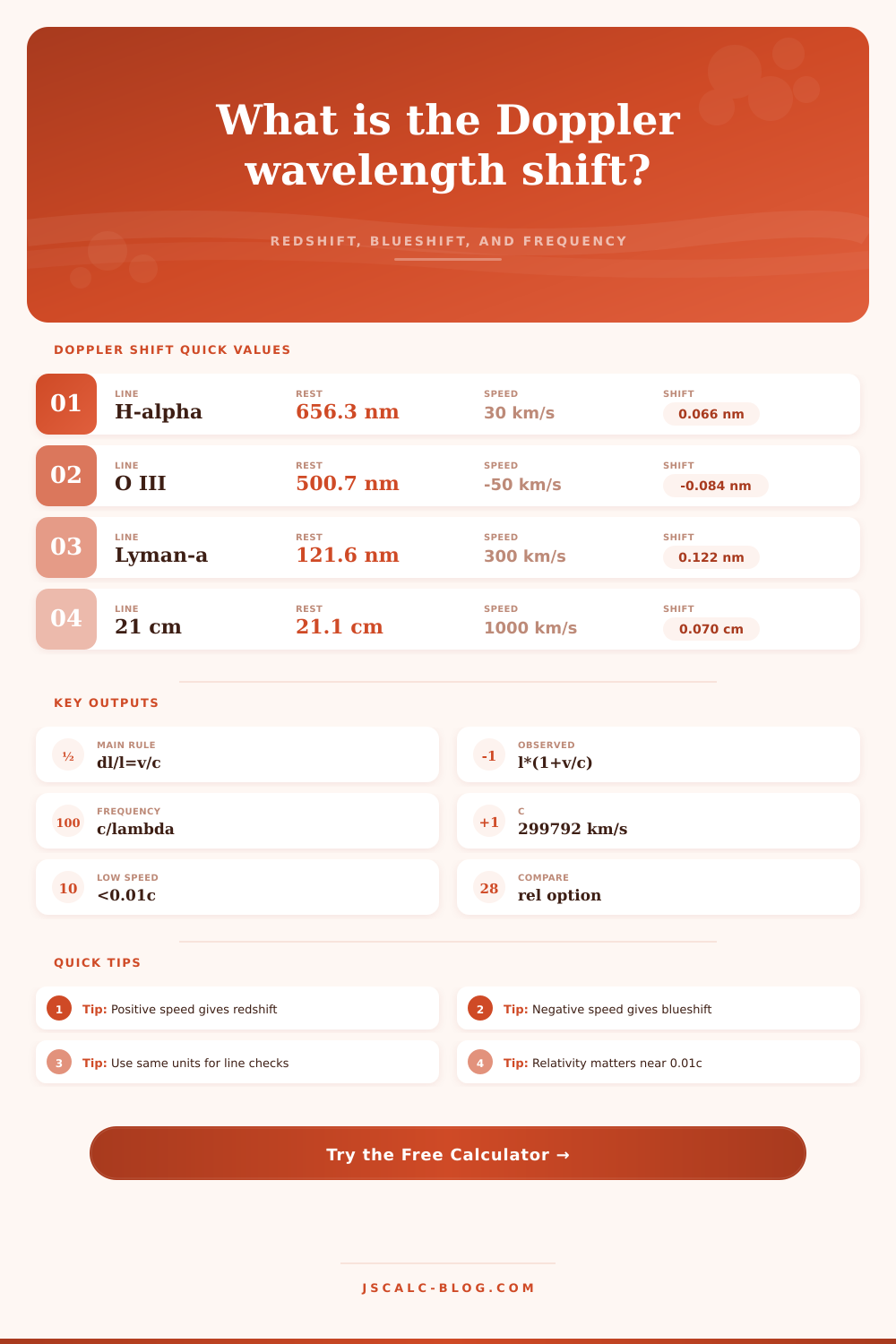
| Fractional wavelength shift | Δλ / λ = v / c | sqrt((1 + β) / (1 - β)) - 1 | Positive is redshift |
| Observed wavelength | λobs = λrest * (1 + v/c) | λrest * sqrt((1 + β) / (1 - β)) | Longer means receding |
| Observed frequency | fobs = c / λobs | frest * sqrt((1 - β) / (1 + β)) | Lower means receding |
| Velocity from lines | v = c * (λobs / λrest - 1) | β = (k^2 - 1) / (k^2 + 1) | k = λobs / λrest |
As light traverses space, it stretches and compresses in response to that journey. And that tells us what happened along the way. Called the Doppler effect, it show up in measurements of the color of light.
This shows us the expansion of the universe, helps us locate planet, and tells us how fast galaxies is moving away from us, all without needing a massive telescope. All that is needed is the ability to measure its wavelength and then calculate it based off the speed of light.
How Light Tells Us About the Universe
It’s pretty easy to grasp the concept here. As the light source approach or recedes from you, the waves bunch up or stretch out. If they bunch up, the light shifts toward blue. If they stretch out, the light shifts more red. Remember, this isn’t actualy a change in the light itself; it’s a change in perspective caused by motion.
Enter the observed shift and the reference line into a calculator, and it will do all the math for you. You won’t have to deal with the tedium of dividing by hand anymore. But you can’t really understand what the numbers mean without going beyond the button-pushing.
“The starting point is a spectral line which is a known quantity. It’s like a fingerprint. At a certain wavelength (in this case 656.3 nanometers), hydrogen will always leave the same mark. So if I’m looking for hydrogen and I see that mark at 656.3 nanometers then its source is still relative to me. But if I see it at 657.0 nanometers, something has moved.
And the shift is tiny. That’s the trick. We’re talking about things we’re trying to measure that are smaller than the size of one atom. One way to help you know whether or not your tool can see that difference is by checking how well it resolves. How sharp is the instrument? If you have poor resolution, you blur the line. Your instrument could be telling you there is a shift when you are actualy just seeing noise. It’s a small thing. But it matters.”
The other primary input is velocity. Is it coming or going? Coming is negative; going is positive. This movement gets changed by the calculator to a fractional shift.
In cases where the velocity is low (e.g., a star in the galactic neighborhood), we can use the non-relativistic equation without much trouble. It is easy and linear. But life isn’t always slow in the universe. Objects that travel at a large fraction of lightspeed doesn’t obey simple geometry anymore. Time distorts space. The relativistic equation take this into account.
The reference table on the page makes this clear. At 30 kilometers per second, there’s no practical difference between using the relativistic and the non-relativistic equations. At 30,000 kilometers per second, there’s a massive diffrence. Go fast enough, and neglecting relativity means you’ll underestimate how fast an object is moving. You’ll believe the galaxy is creeping along when in fact it’s screaming through the void.
That’s what folks is failing to grasp. They’re treating velocities as big as the speed of light as though they were governed by the same laws of everyday physics.
Why should you care? Why does this matter? Perhaps you’re an amateur astronomer who wants to look through your telescope at a nebula. Perhaps you’re a student, and want to check your homework. Perhaps you’re simply curious about why people think the universe is 13.8 billion years old. It’s because of these shifts.
Each redshifted galaxy is a clock. The farther away it is, the more quickly it must be moving. The Hubble constant is nothing but the slope on a plot of distance against velocity. Velocity. You create that plot one wavelength shift at a time.
The decimals aren’t important. The arrows are what matter. Blue, Red, right, left? Do these changes mean anything? Can they be measured? Does this change need relativity? Those are the questions that make data useful. Numbers come from the tool. Context comes from you.
We came from stars. And it sounds like bullshit. But it isn’t.
We know there’s a way to measure the light coming out of faraway galaxies. This light left them billions of years ago. It has been stretching ever since. It is redshifting across the unfolding cloth of space. Caught today, thinned and taut, we plot its path.
The physics that says your car is speeding down the highway also say the universe is getting older. All motion is written in light.