Age of the Universe Calculator
Compute the current cosmic age, the age at redshift, and lookback time from the flat Lambda-CDM integral using H0, ΩM, ΩLambda, numerical cutoff, and an analytic flat approximation.
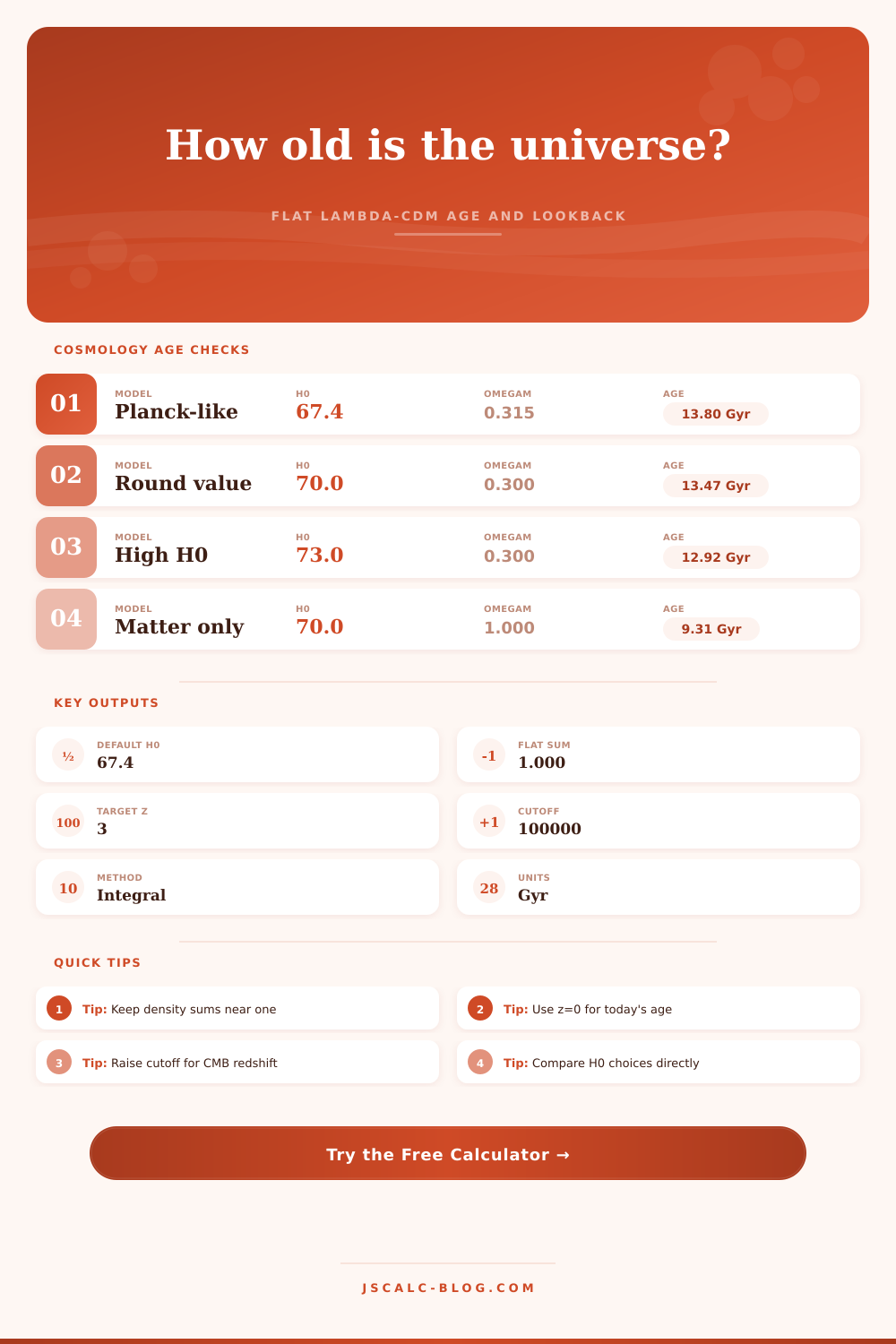
| Model label | H0 | ΩM | ΩLambda | Approx t0 |
|---|---|---|---|---|
| Planck-like flat model | 67.4 | 0.315 | 0.685 | About 13.80 Gyr |
| Round classroom model | 70.0 | 0.300 | 0.700 | About 13.47 Gyr |
| Local high-H0 comparison | 73.0 | 0.300 | 0.700 | About 12.92 Gyr |
| WMAP-like comparison | 69.3 | 0.286 | 0.714 | About 13.77 Gyr |
| Einstein-de Sitter | 70.0 | 1.000 | 0.000 | About 9.31 Gyr |
| Matter-heavy test | 70.0 | 0.450 | 0.550 | About 11.90 Gyr |
| Redshift z | Scale factor a | Typical age | Typical lookback | Use case |
|---|---|---|---|---|
| 0 | 1.000 | 13.8 Gyr | 0 Gyr | Today |
| 0.5 | 0.667 | 8.6 Gyr | 5.2 Gyr | Intermediate surveys |
| 1 | 0.500 | 5.9 Gyr | 7.9 Gyr | Galaxy evolution |
| 3 | 0.250 | 2.1 Gyr | 11.7 Gyr | Young galaxies |
| 6 | 0.143 | 0.9 Gyr | 12.9 Gyr | Early quasars |
| 10 | 0.091 | 0.5 Gyr | 13.3 Gyr | First galaxies |
| 1089 | 0.000918 | 0.00038 Gyr | 13.8 Gyr | CMB surface |
| Change | Direct effect | Age direction | Watch closely |
|---|---|---|---|
| Raise H0 | Shorter Hubble time | Age decreases | Every output in Gyr scales strongly |
| Lower H0 | Longer Hubble time | Age increases | Good for Hubble tension comparisons |
| Raise ΩM | Faster early expansion | Age decreases | High redshift ages shift noticeably |
| Raise ΩLambda | More late acceleration | Age often increases | Flatness must remain near one |
| Add radiation | Faster earliest expansion | Very-high-z ages decrease | CMB-era outputs |
| Lower cutoff | Less numerical range | Tail matters more | Use zmax far above comparison z |
Light will show you things (but so too will the dark). You can learn much about the universe from the night sky. Each galaxy and each star in that sky are a page in the book of life. That book isn’t printed on stone tablets; it’s inked across the fabric of time and space.
And while you might think there’s one fixed answer to how old the Universe is (and maybe even some plaque on a wall telling you its age), that number are only an educated guess. We don’t have a stopwatch; we have cosmology. Lambda-CDM refers to the standard model. This means that the universe is made up of just three things, dark energy, dark matter and flat space.
How Scientists Guess the Age of the Universe
The code calculate the complex integrals for you, but knowing what goes in can help you feel confident about the answer. What powers this equation? The Hubble constant. This number represent how fast the universe is currently expanding. The bigger this number, the more rapidly the universe is expanding, which means it had less time to grow to where it is today. The difference between 67 and 73 km/s/Mpc are almost a billion years.
The other parameter that figures into it is density parameters. One is called omega M for matter, both visible (ordinary) and invisible (dark) matter. The second is dark energy, which is expanding the universe by pushing space itself apart. These has to sum to one if the universe is flat. Increasing matter means gravity have more to pull on, slowing down the rate of expansion. That makes the universe younger. Increase dark energy and it take longer to kick in and accelerate. This stretches time, and the universe become older. The mix between them make the universe thirteen billion years old…or something else.
And depending on which model you select, the answer varies, though most people assumes that the age is fixed. As the table of references makes clear, the age comes out around 13.8 billion years for a Planck-style model based off early-universe satellite data. For a local-model based on supernova measurements, though, one can get a higher Hubble constant, meaning a younger universe. That’s what we call the Hubble tension, and physicists are attempting to see whether there may be some new physics hiding in the difference.
Redshift’s other feature let you dig into the past, too. Because the expansion of space stretches out the light coming from more distant galaxies, redshift behaves like a kind of time machine. One tells us the universe was half as big again. Six takes you all the way back to when the universe was only a tenth of its current size. Calculating what’s called lookback time… The gap between now and then, in terms of the age of the universe… Enables astrophysicists to work out when first stars lit up.
The models can be run as a check of some practicals. One is to sum their density parameters so that they adds up approximately to one for a flat universe. Otherwise, you are introducing curvature and altering its geometry. You should also watch out for integration limits. The mathematics require an integral over redshift running from today back to the Big Bang. In order to prevent numerical tools from getting into an infinite loop, there has to be a cutoff somewhere in high redshift. To make sure calculations aren’t computationally overloaded but also precise, calculator appends a mathematical tail onto the numerics.
Calculating the age of the universe is a humbling exercise. From the movement of faraway galaxies to the barely detectable afterglow of the Big Bang, you’re inferring the date of creation from tiny scraps. The numbers are precise to three decimal places, yet the image keeps changing. Each successive measurement of the Hubble constant tweaks our understanding; each new telescope add detail. We know that the universe is ancient, that it expands, and that it continues to surprise us.