Cosmological Lookback Time Calculator
Integrate a flat Lambda-CDM expansion history from redshift to today, compare the low-z approximation, and see age-at-emission, Hubble time, and distance-scale context.
| Preset | Redshift z | Typical use | What the result means |
|---|---|---|---|
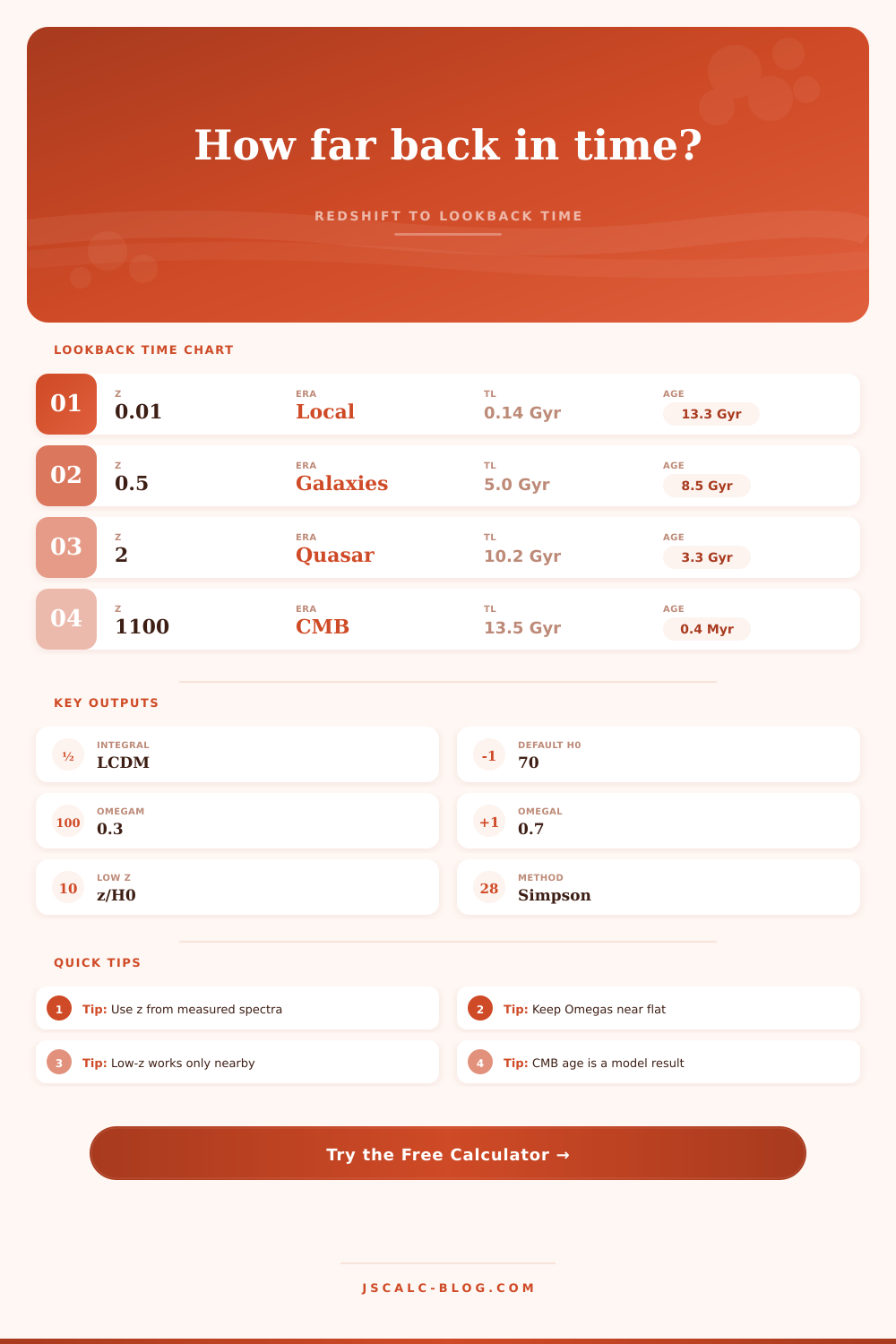
| Local Galaxy | 0.01 | nearby redshift check | low-z approximation is usually excellent |
| Virgo Cluster | 0.0036 | local universe scale | peculiar motion may matter more than cosmology |
| z 0.5 Galaxy | 0.5 | survey galaxy | the universe was already substantially younger |
| z 1 Survey | 1 | deep galaxy sample | light left when the scale factor was one half |
| Cosmic Noon | 2 | peak star-formation era | age at emission is only a few billion years |
| Quasar z7 | 7 | early quasar example | lookback time nearly reaches the universe age |
| Reionization | 10 | early-galaxy context | small changes in model age become noticeable |
| CMB Surface | 1100 | last scattering | age then should be read in Myr, not Gyr |
| Model label | H0 | OmegaM | OmegaLambda | Use case |
|---|---|---|---|---|
| Round classroom | 70 | 0.300 | 0.700 | fast astronomy examples |
| Planck-like | 67.4 | 0.315 | 0.685 | CMB-fit comparison |
| Local ladder-like | 73.0 | 0.300 | 0.700 | higher-H0 sensitivity check |
| Matter-heavy flat | 70 | 0.400 | 0.600 | tests stronger deceleration |
| Dark-energy-heavy flat | 70 | 0.250 | 0.750 | tests later acceleration |
| Einstein-de Sitter | 70 | 1.000 | 0.000 | matter-only benchmark |
When you point your telescope to some distant galaxy, what you see isn’t what it is; it’s what it was. And that difference, between when its light left the star and hit your telescope (are called lookback time). This is the great trick in astronomy.
The universe keeps getting bigger and stretching out the wavelength of the light until it delays how long it takes them to reach us. The calculator above do all the math for you. Plug in one number (the redshift) and it gives you a real number: how much time has elapsed. It accounts for the whole history of how the universe has expanded, without you having to fight through differential equations yourself.
How to Calculate Lookback Time
All you have to do is know what these inputs actualy mean. It’s all based off the Lambda-CDM model, a.k.a. It is the current standard framework for the cosmos. According to it, the universe consist of flat space, packed with stuff: matter, radiation and dark energy. You can adjust how much of each there is by using the Lambda-CDM model.
Matter tends to pull things back; it slows down expansion. Dark energy, by contrast, tends to push things apart; it speeds up expansion. Changing the ratio of Omega Matter and Omega Lambda change how fast the universe has been expanding over time (billions of years). And that changes the answer. For instance, a universe with more dark energy expand faster relatively recently, squeezing the timeline for nearby objects while stretching it out differently for distant ones.
The key anchor observable is redshift. That tells us how many times the universe expanded between the time the light was sent and when we see it now. Zero here and now. One means the light left at a time when the universe was half as big than it is now. From then on, the calculator add up the expansion rate. To do this, it solves a numerical integration called Simpson’s rule. There isn’t some simple algebraic trick to solve this generically. In fact, when you combine a period of dark energy dominance with a period of matter dominance, math becomes gnarly.
The tool smooths all that out; it provides lookback time expressed in gigayears. For closeby things, there’s an easier way to approximate this. For low redshifts (i.e., for galaxies in our local neighborhood), you can simply take the redshift divided by Hubble constant. That’s a nice linear approximation. As you get farther out it breaks down. You can see the error explicitly on the calculator. It displays both the exact integral and the low-z estimate. This serves as a good sanity check. If you’re dealing with a high-redshift object like a quasar, that simple division will spit out a number that’s wildly incorrect. What we have here is the curvature of expansion history.
Another thing they show you is the age of the universe when this radiation was emitted. How far back in time did this photon originate? In the case of the cosmic microwave background, it was just a few hundred thousand years into the history of the cosmos. For a redshift-seven quasar, it was less than a billion years after the Big Bang. So these values give context to the epoch. Are we looking into the infant universe, or are we looking out on the mature universe?
You can also see scale factor. This is just equal to one plus the redshift. This is a direct measurement of how much the universe has grown. So, you can load preset values and observe the effects of various cosmological models. There’s a table of reference values on the page that explains what all these mean for typical scenarios. For example, it demonstrates the sensitivity of the lookback time to variations in the Hubble constant. A difference of just a few kilometers per second per megaparsec can change the result by hundreds of millions of years. That’s why you’ll hear cosmologists debate exactly what H0 should of be. Because it matters. Not merely because we want to get it right; but because it tells us something fundamental about nature of reality itself.
You can use it to compare redshifts with each other (useful if you’re doing a survey). You enter a set of redshift values. The tool create a comparison grid that updates automatically as you change those values. What does this give you? It gives you a feeling of the time span that your data covers. It makes abstract numbers come alive in a timeline.
Some caution when using the calculator: make sure the sum of the density parameters equals one in a flat universe. Otherwise it will change the geometry and then that formula above won’t apply directly. Options on the tool take this into account but you’ll want to be aware of what option you’re under. For most applications (hobbyist or classroom), the default works fine.
But lookback time is also a bridge. It is a bridge between the history of the universe and the sky we see today. It is a way to put things in place, not just in space but in time. Measurements come from the calculator. What you bring to it is the meaning. Every time you enter a redshift, you send a probe back through time. And what comes out isn’t just a number. It’s a stamp on cosmic history. Page after page, light year after light year, you’re reading the cosmos’ diary.