Hubble Distance Calculator
Estimate cosmological distance from recession velocity or low-redshift z using D = v / H0 and the low-z approximation D = c z / H0, with selectable H0 references, Mpc/Gpc/light-year output, and uncertainty propagation.
| H0 option | Value | Typical use | Distance effect |
|---|---|---|---|
| Planck CMB | 67.4 km/s/Mpc | Early-universe reference comparisons | Longer distances for same velocity |
| Common classroom | 70.0 km/s/Mpc | Quick Hubble-law examples | Middle reference point |
| WMAP-like | 69.3 km/s/Mpc | Legacy cosmology exercises | Slightly longer than H0 = 70 |
| SH0ES ladder | 73.0 km/s/Mpc | Local distance-ladder comparison | Shorter distances for same velocity |
| Custom H0 | User entered | Coursework, paper values, sensitivity tests | Distance scales as 1 / H0 |
| Example | Input | D at H0 = 70 | D at H0 = 67.4 | D at H0 = 73 |
|---|---|---|---|---|
| Nearby flow | 600 km/s | 8.57 Mpc | 8.90 Mpc | 8.22 Mpc |
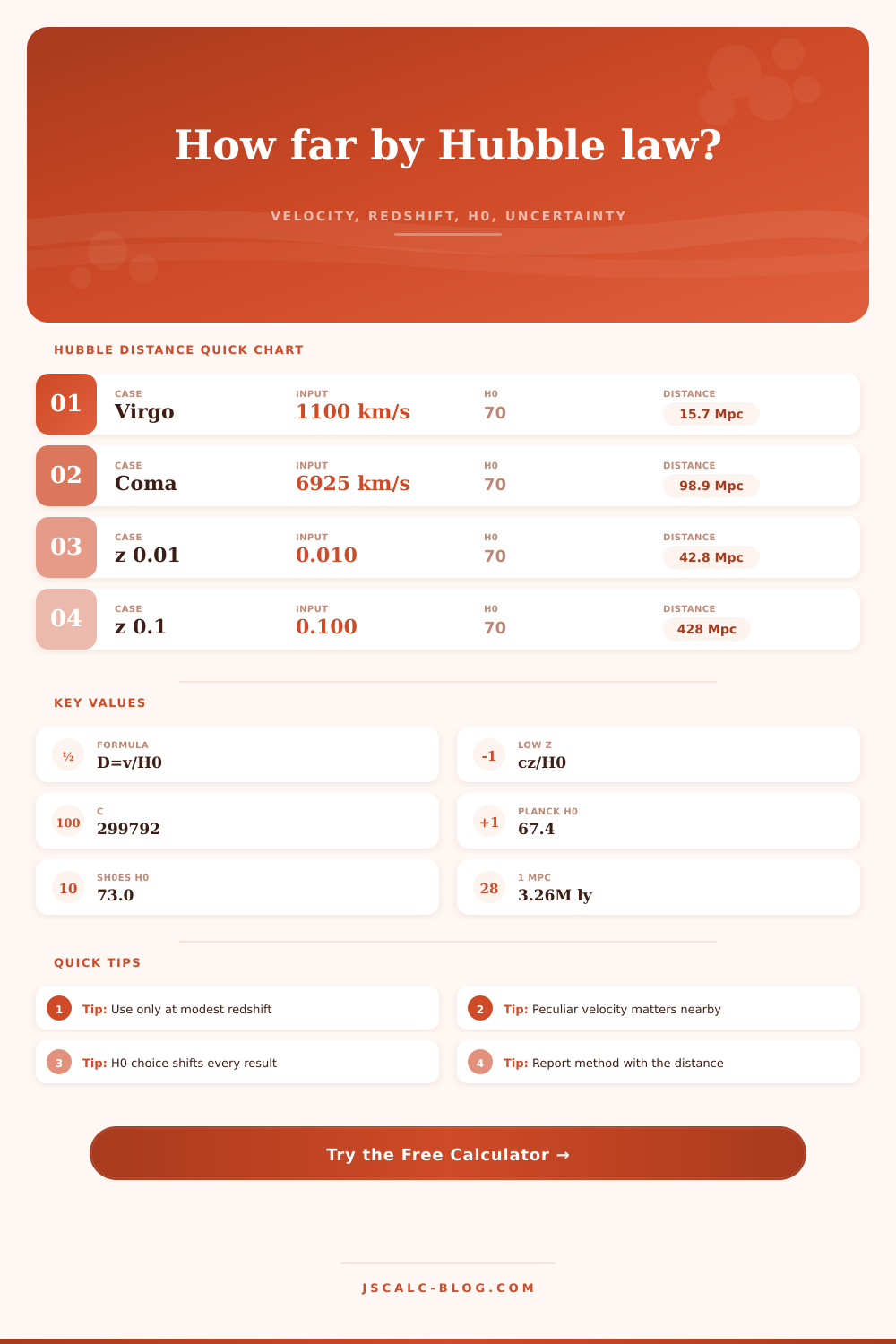
| Virgo-like | 1100 km/s | 15.71 Mpc | 16.32 Mpc | 15.07 Mpc |
| Fornax-like | 1379 km/s | 19.70 Mpc | 20.46 Mpc | 18.89 Mpc |
| Coma-like | 6925 km/s | 98.93 Mpc | 102.74 Mpc | 94.86 Mpc |
| z = 0.01 | 2998 km/s | 42.83 Mpc | 44.48 Mpc | 41.07 Mpc |
| z = 0.03 | 8994 km/s | 128.48 Mpc | 133.44 Mpc | 123.20 Mpc |
| z = 0.10 | 29979 km/s | 428.27 Mpc | 444.80 Mpc | 410.67 Mpc |
| Distance unit | Equivalent | Best for | Calculator label |
|---|---|---|---|
| 1 Mpc | 3.26156 million ly | Galaxies and clusters | Mpc |
| 100 Mpc | 326.156 million ly | Large local surveys | Mly |
| 1000 Mpc | 1 Gpc | Cosmology-scale summaries | Gpc |
| 1 Gpc | 3.26156 billion ly | Very large distances | Gly |
| 1 light-year | 0.306601 parsec | Plain-language output | ly |
| 1 parsec | 3.26156 light-years | Astronomy conversions | pc |
| Regime | Redshift | What dominates | Use this calculator for |
|---|---|---|---|
| Very nearby | z below 0.003 | Peculiar velocity | Rough flow-distance checks only |
| Nearby Hubble flow | 0.003 to 0.03 | H0 and local motion | Simple galaxy distance estimates |
| Low-redshift survey | 0.03 to 0.10 | H0 plus approximation limits | Fast classroom or planning estimates |
| Moderate redshift | 0.10 to 0.30 | Cosmology model terms | Only a first-order comparison |
| High redshift | above 0.30 | Matter, dark energy, curvature assumptions | Use a full cosmology calculator instead |
Maybe you picture the universe like a stage with stars and planets sitting still while you travel about among them. Instead, idea of expansion revealed by Edwin Hubble was that space itself were expanding. Galaxies aren’t just moving away; they’re all moving away from us, and more distant ones seems to be racing away faster then closer ones. It’s easy enough to express this relation on a napkin: D equals v over H0, but there’s some caution required in using this for actual observations.
You don’t need to try to remember any coefficient or conversion factor: simply input your redshift or velocity into the calculator and it’ll do the rest. H0, or the Hubble constant, is the problem. It’s expansion rate of universe at present. And it seems simple enough: we should of be able to measure one value. But that’s not true. Astronomers don’t even agree on what the right value is.
Why Measuring Distances in Space Is Hard
Do you want a value based off Planck, from the early universe? That satellite say the universe expanded more slowly, about sixty-seven point four kilometers per second per megaparsec. Or do you want a value from the local distance ladder, from the SH0ES project? They says the universe is expanding more quickly, something like seventy-three. That difference, that tension, is called the Hubble tension.
And why does it matter? Because the constant go into the denominator of your distance equation. Higher H0 means that the denominator is smaller; the distance to any object must be shorter if the Hubble constant are higher. On the page, they have a very clear reference table where you see same galaxy moving back and forth across the map of space, depending on what expansion rate you’re willing to accept.
There’s peculiar velocity, too: Peculiar Velocity The galaxies aren’t simply carried along with the expansion of space. Gravity pulls them around. Massive structures and nearby cluster pull on one another and on their galaxies. This local motion is a tiny blip for a distant galaxy. But if you’re studying something up close, that local motion dominates. A nearby galaxy may have its own gravitational wobble moving at three hundred kilometers per second. It could easily be half as big than what you see as its recession speed. Mess that up and you get huge errors in distances. The tool lets you account for an uncertainty allowance for that local motion. It also accounts for the noise it introduces into your results when you look at nearby things.
There’s another way to get to the same place, and it’s called Redshift. If the redshift value isn’t very large, meaning if we’re talking about modest distance, then you can use the speed of light times the redshift as a guess for velocity. It’ll work reasonably accuratley for objects within a hundred megaparsec. Beyond that, you run into general relativity. Space is stretching the wavelength of the light itself, so the crude linear formula doesn’t hold anymore. Instead, you has to use the full cosmological integrals which incorporate the density of matter and even dark energy. The calculator will warn you when you venture into those areas where the approximation don’t apply.
That’s a useful note: Hubble’s law holds locally but not universally. Amateurs also tend to ignore uncertainty propagation. All measurements have error bars, such as those for the Hubble constant, redshifts, and velocities. Combine them and they add up. The calculator does that: it computes the total fractional uncertainty by combining all the individual ones. The result is a one-sigma range, a band that shows you the probable span of actual distance. That turns one crisp number into an honest estimate. Accuracy trumps precision.
The point is, once you understand those inputs, you look at the outputs differently. A distance isn’t something that’s written in stone; it becomes an estimate based on a certain model. You realize that H0 is a statement about cosmic history, and there is indeed a debate about that. You know that nearby galaxies aren’t just sitting still on top of the cosmic web; they have minds of their own, and move around. And yes: the universe does expand, and yes: our estimates of that expansion are still evolving. That’s where the real story is: the tug-of-war between the straightforward equation and the messy real world.