Hubble Law Recession Velocity Calculator
Estimate a galaxy's recession velocity from distance and Hubble constant, convert common astronomy distance units, and flag when low-redshift interpretation becomes too simple.
✦ Descriptive Presets
⚙ Calculator Inputs
Hubble Law Result
🧮 Formula Breakdown
Core Hubble law: recession velocity v = H0 × distance.
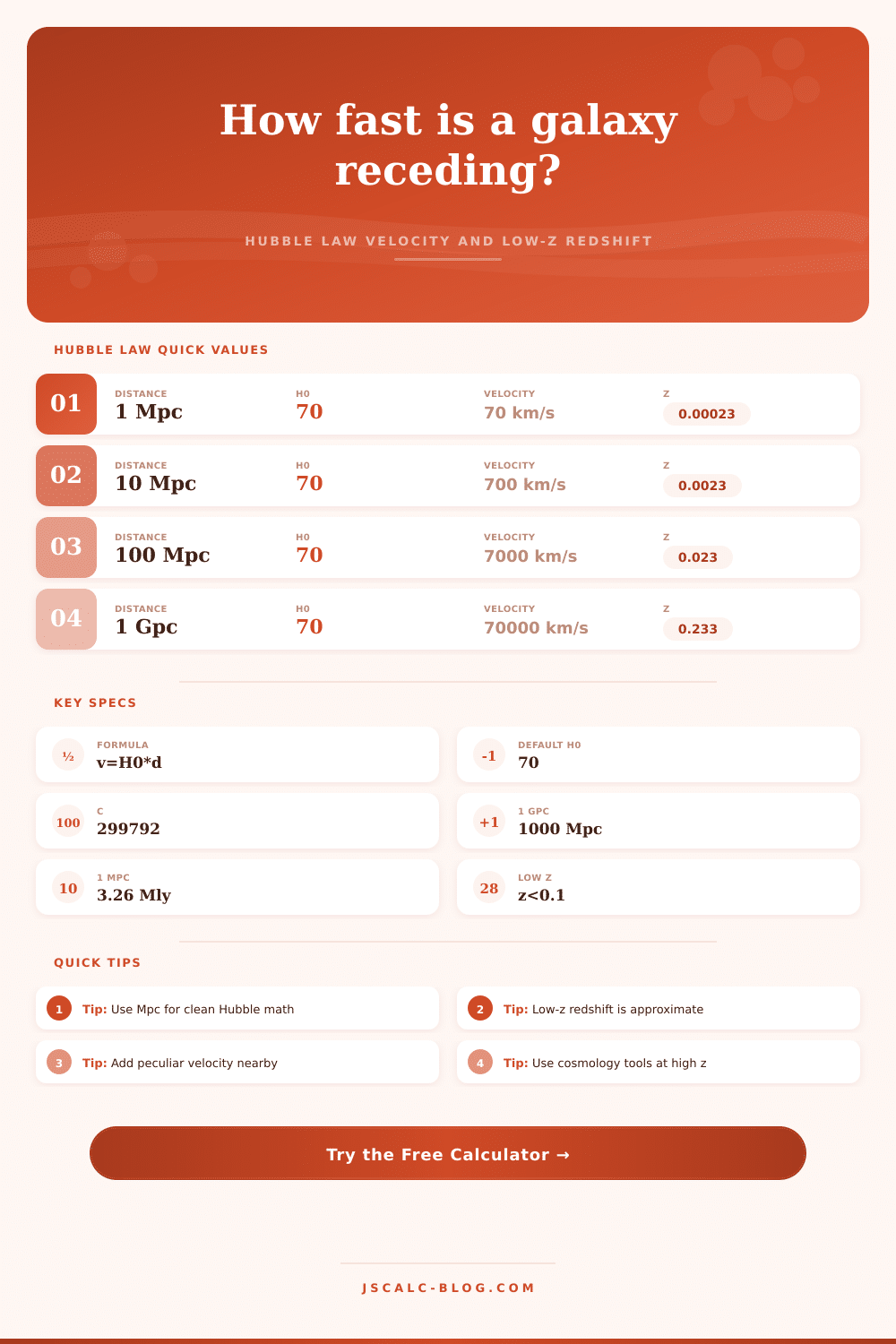
Unit normalization: distances are converted to Mpc before multiplication; 1 Gpc = 1000 Mpc and 1 Mpc = 3.26156 million light-years.
Low-redshift approximation: z ≈ v / c, where c = 299,792.458 km/s. This is a linear shortcut, not a full relativistic cosmology model.
Optional local motion: if selected, a peculiar velocity offset is added after the Hubble-flow velocity is calculated.
📊 Quick Reference Cards
🔭 H0 Reference Table
| H0 label | Value | Best use | Effect on velocity |
|---|---|---|---|
| Round classroom value | 70 km/s/Mpc | Fast estimates and examples | Baseline in this calculator |
| Planck-like CMB value | 67.4 km/s/Mpc | Early-universe comparison | About 3.7% lower than 70 |
| Local distance ladder | 73.0 km/s/Mpc | Nearby calibrated distance ladder examples | About 4.3% higher than 70 |
| HST Key Project style | 72 km/s/Mpc | Legacy astronomy exercises | About 2.9% higher than 70 |
| Low comparison value | 65 km/s/Mpc | Sensitivity testing | About 7.1% lower than 70 |
| High comparison value | 75 km/s/Mpc | Sensitivity testing | About 7.1% higher than 70 |
🌌 Distance Conversion Table
| Distance input | Mpc equivalent | Light-year equivalent | At H0 = 70 |
|---|---|---|---|
| 1 Mpc | 1 Mpc | 3.26 million ly | 70 km/s |
| 10 Mpc | 10 Mpc | 32.6 million ly | 700 km/s |
| 100 Mpc | 100 Mpc | 326 million ly | 7,000 km/s |
| 1 Gpc | 1,000 Mpc | 3.26 billion ly | 70,000 km/s |
| 5 Gpc | 5,000 Mpc | 16.3 billion ly | 350,000 km/s |
| 1 billion ly | 306.6 Mpc | 1.0 billion ly | 21,462 km/s |
⚠ Redshift Interpretation Table
| Approx z | v/c | Linear use | Context |
|---|---|---|---|
| 0.001 | 0.1% | Usually fine | Nearby galaxies; peculiar motion can dominate |
| 0.01 | 1% | Good approximation | Local-volume recession estimates |
| 0.05 | 5% | Useful shortcut | Survey planning and classroom examples |
| 0.10 | 10% | Borderline | Cosmology assumptions start to matter |
| 0.25 | 25% | Use caution | Distance definition and expansion history matter |
| 1.00+ | 100%+ | Not valid | Use a full cosmology calculator instead |
🗂 Comparison Grid
| Scenario | Distance | H0 | Velocity | z approx | Interpretation |
|---|---|---|---|---|---|
| Local Group edge | 1 Mpc | 70 | 70 km/s | 0.00023 | Peculiar motion often larger |
| Virgo Cluster core | 16.5 Mpc | 70 | 1,155 km/s | 0.00385 | Good nearby estimate |
| Fornax-like cluster | 20 Mpc | 70 | 1,400 km/s | 0.00467 | Low-z shortcut is strong |
| Coma Cluster scale | 100 Mpc | 70 | 7,000 km/s | 0.02335 | Linear estimate remains useful |
| SN host sample | 250 Mpc | 73 | 18,250 km/s | 0.06088 | H0 choice is noticeable |
| Deep survey slice | 500 Mpc | 70 | 35,000 km/s | 0.11675 | Start adding cosmology context |
| One Gpc benchmark | 1 Gpc | 70 | 70,000 km/s | 0.23349 | Linear redshift is rough |
| High-z caution case | 4 Gpc | 70 | 280,000 km/s | 0.93398 | Use relativistic cosmology tools |
✅ Actionable Notes
The beauty of Hubble’s idea, which was surprisingly elegant, was this: The more distant a galaxy is, the further away it moves; and all those distant galaxies are moving away from us. You could write that down in a classroom as simple linear relationship. This can be written as $v = H_0 d$, where velocity is equal to the Hubble constant (a number) times distance.
But the universe doesn’t play nice with clean equations. That simple multiplication isn’t the end; it’s just the beginning. And so the actual job starts when you learn that.
Why Hubble’s Law Is Not That Simple
The calculator above does all the math for you: it crunches basic algebra, figures out units, and lets you interpret what happens. You put in a distance. Choose a Hubble constant (a value). And you’ll see a recession velocity. Want to know roughly how much light’s been stretched? How much is the redshift? The thing’ll also provide an estimate of the redshift.
This is useful when looking at nearby galaxies because space itself is expanding, making it the dominant force over other motions at about ten megaparsecs away. At that point the flow is significant and local motion are secondary. It is a clean number, though you should of had knowledge to understand there is a limit to how much you can trust it.
The Hubble constant itself are quietly controversial. Astronomers have long rounded the number at 70 kilometers per second per megaparsec, to make it easy to use. That’s convenient and works well enough if you’re doing back-of-the-napkin math. But moddern cosmology has shattered that consensus. Estimates from measurements of early universe say it should be more like 67; estimates based off distance-ladder techniques here on Earth put it somewhere around 73.
Sounds like a difference of only a few percent, but that turns into big differences in what we think dark energy does and how old the universe is. You can toggle the calculator between these models, which show just how sensitive your results are to the underlying assumptions. This tiny feature shows one of the biggest tensions in modern physics.
And then there’s the issue of peculiar velocity: Not only does space expand, but galaxies also moves relative to one another. Some galaxy orbit; others collide or fall into the gravitational grasp of a large cluster. Within our own local group, for example, the Milky Way and its larger cousin Andromeda is actually moving closer together.
Even at distances of a few tens of millions of light-years away, these sorts of local motions can swamp out the Hubble flow. A galaxy could be seemingly moving slower then expected because it’s locally drifting towards us. To account for this, you can add an offset value into the tool. This reminds you that clean linear model is just an approximation. Gravity still plays a part, even as universe itself is shouting louder.
Redshift adds further complication. There is an approximate proportionality between redshift and velocity at lower speeds; if the object move away from us at some speed v, divide that by c (the speed of light) and you’re close enough. Perfectly OK for local stuff.
But things get complicated once you go farther out. The farther away something is, the more its redshift will be affected by the expansion of space. When it gets too far away, i.e., at high redshifts, even this relation no longer hold. Non-linearity in the history of cosmic expansion means that dividing by c just won’t cut it. To do this, you need a complete picture of cosmology, including general relativity, to convert redshift into distance.
The calculator warns you when you’ve crossed this threshold and are starting to diverge significant from the linear approximation. This is a needed guardrail against over-simplifying.
And that’s why calculation is less important than context. It’s one thing to get the number right; another thing entirely to know what the number means. Is it a faraway quasar where cosmology holds sway, or is it a nearer object where odd motion are dominant? Is this an object being pulled by its massive neighbor… Or is the whole universe simply expanding and the galaxy receding with it?
The astrophysics gives us the meaning; the tools give us the arithmetic. Out into the dark we gaze, stretching the light, trying to read the history of all things. The math will tell you how fast; it’s up to our understanding of the cosmos to tell us where we’re bound.