Orbital Eccentricity Calculator
Calculate orbital eccentricity from apoapsis and periapsis, from ellipse axes, or from a known e value. The tool also classifies circular, elliptic, parabolic, and hyperbolic trajectories.
Quick Presets
Orbit Inputs
Display Rules
Eccentricity Result
Step-by-Step Breakdown
Derived Geometry
| Quantity | Value | Rule | Meaning |
|---|---|---|---|
| Waiting | - | - | Run the calculator. |
Classification Comparisons
Formulas Used
Input Rules
The shape of an orbit conveys much information. The easiest case is that of a perfect circle, but as we all know, nature doesn’t deal in perfection very often. Because of momentum and gravity, most orbits aren’t circles; they’re squashed versions. They’re stretched to make ellipses. That’s where oddness comes in. A single number: how much is it stretched? Does it follow a wild trajectory or stay in a neat little loop? That’s why it matters: it determines communication windows and fuel budgets.
You enter in the distances, and the calculator above do all the math for you. Typicaly, you enter in the periapsis (closest point to the central body) and the apoapsis (farthest away). Those numbers should of be center-to-center distances, i.e., they’re not altitudes over the surface. Many newbies make that mistake; they forget to include radius of their planet or star. Your eccentricity number will be incorrect if you measure from the ground different than the core. It is a small detail, but it matters.
How to Use the Orbit Calculator
The tool assumes you’ll stick with one unit of measure (miles, kilometers, astronomical units, etc.) throughout. If you’re more inclined toward geometry, you’ll get eccentricity straight out of an ellipse’s semi-major and semi-minor axes, too. The semi-major is its long half-width; the semi-minor is its short half-width. Together they shows how flat your object’s orbit is. If the axes are equal (as on a sphere), then we have zero eccentricity. The longer the major compared to the minor, the flatter your shape becomes. And the formula ties the two length together directly with the eccentricity number itself. That’s handy for working with data gathered by astronomy surveys that measure the axes instead of radial distances.
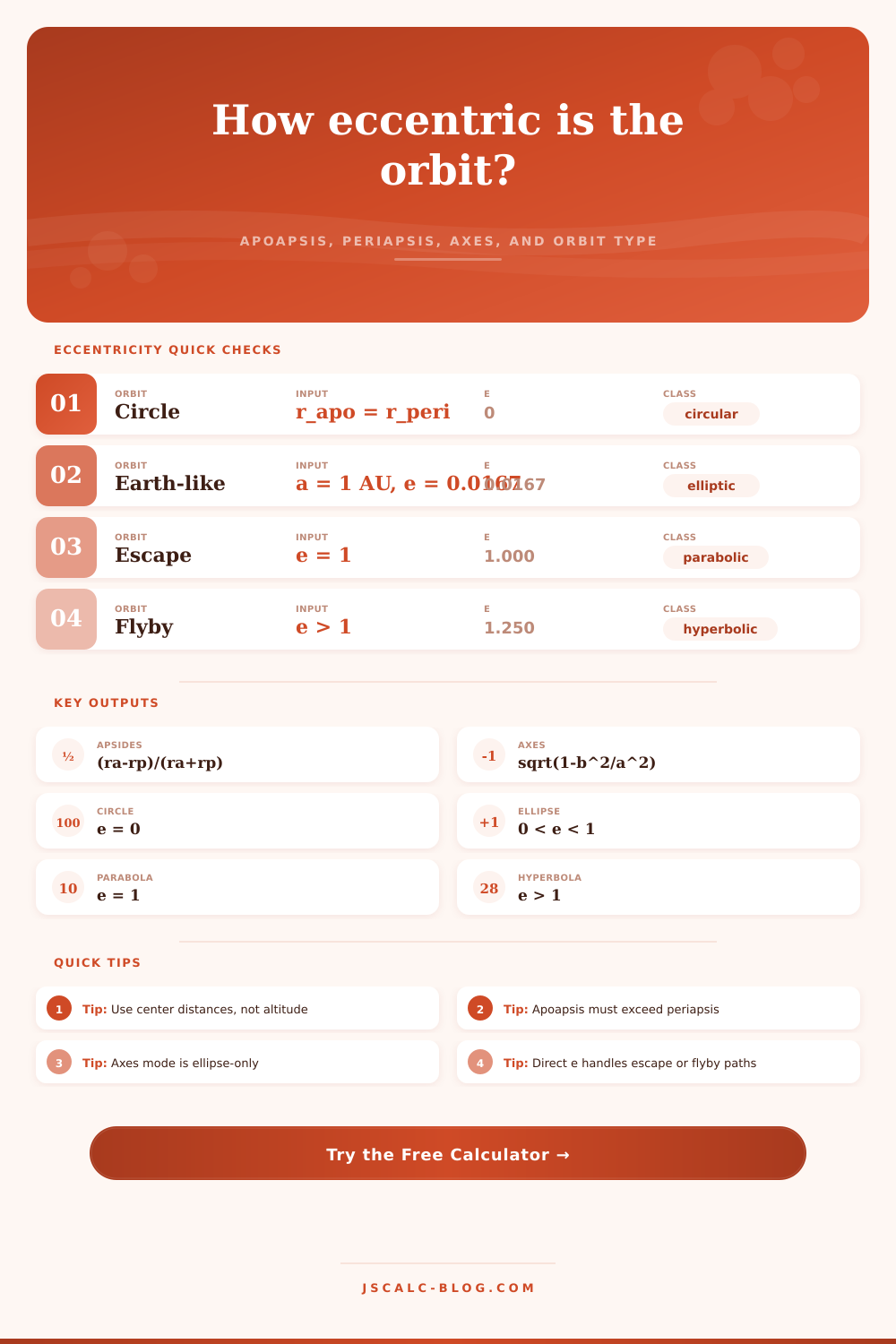
The eccentricity of most bound orbits ranges from zero (a circle) to one (a parabola). Earth’s orbit happens to be nearly circular with an eccentricity of roughly 0.0167. Mars’ orbit is more eccentric then Earth’s, which is part of the reason it gets such pronounced seasonal changes. Planets don’t typically has highly eccentric orbits. Artificial satellites do, as well as comets. Some satellites in Molniya orbits have super-high eccentricities that cause them to hang around a particular area for long time.
The calculator will tag those too and tell you what kind it thinks it is based off standard definitions. When eccentricity hits precisely one we enter into the world of the parabolic orbit. That’s the escape trajectory. It is the exact point of energy equilibrium that allows something to depart from gravitational control but not with additional velocity. It is the line between bound and unbound trajectories. A bit beyond that and we hit the hyperbolic region. These are the flyby trajectories. They intersect the system only once and never return. These are the pathways spacecraft take to pick up velocity as they move past planets. The tools allow for checking of these non-looping scenarios (which is why there is a direct input mode for this).
The equations for distance assumes a closed trajectory. You need some context to understand these numbers. Eccentricity refers to how stable the path is: the lower the number, the more stable (and so less change in speed/less change in distance). If eccentricity is higher, there are very large changes in speed/distance. Which makes designing missions harder. Apside ratio relates the farthest distance to the closest distance: the larger the number, the greater the difference between two points on either end of the trajectory. It provides an easy-to-understand indicator about this variability in the orbit, which then enables engineers to determine whether instruments aboard the spacecraft can handle the radiation and thermal conditions.
There’s an art to orbital mechanics. An art of being exact and approximate at once. Gravitational disturbance, atmospheric drag, they’re all real world variables that will change things slow over time. Eccentricity can change and the numbers are the framework for the story. Orbital mechanics’ initial state is the story that unfolds. Half the Battle is knowing how to read that initial state. How to see the path before setting out on the journey. Whether you’re curious about the harsh seasons on Mars or planning to plot a satellite launch, this is for you. The shape of the orbit tells the tale and waits for those who care enough to look close to crack its code.