Apoapsis and Periapsis Calculator
Convert between semi-major axis, eccentricity, apoapsis, periapsis, altitude, period, and apsis speed with JSCalc-Blog.com.
🛰Real Orbit Presets
⚙Apsis Solver Deck
Orbit Apsis Results
📌Selected Body Constants
🔢Formula Breakdown
| Need | Use this relation | Inputs | Meaning |
|---|---|---|---|
| Apoapsis distance | ra = a(1 + e) | a, e | Farthest center distance |
| Periapsis distance | rp = a(1 - e) | a, e | Nearest center distance |
| Semi-major axis | a = (ra + rp) / 2 | ra, rp | Average of apsis radii |
| Eccentricity | e = (ra - rp) / (ra + rp) | ra, rp | How stretched the ellipse is |
| Altitude | h = r - R | r, body radius | Height above surface |
| Speed context | v = sqrt(mu(2/r - 1/a)) | mu, r, a | Vis-viva speed at each apsis |
🌍Central Body Reference
| Body | Mean radius | Mu | Typical orbit use |
|---|---|---|---|
| Earth | 6,378.137 km | 398,600.4418 km³/s² | LEO, MEO, GEO, lunar transfer |
| Moon | 1,737.4 km | 4,902.800 km³/s² | Lunar mapping and landing orbits |
| Mars | 3,389.5 km | 42,828.3 km³/s² | Mars relay and science orbiters |
| Sun | 695,700 km | 132,712,440,018 km³/s² | Planet, comet, and transfer orbits |
| Jupiter | 69,911 km | 126,686,534 km³/s² | High-energy moon tour orbits |
| Saturn | 58,232 km | 37,931,207.8 km³/s² | Ring-plane and moon tour orbits |
| Venus | 6,051.8 km | 324,858.592 km³/s² | Radar mapping and aerobrake orbits |
| Mercury | 2,439.7 km | 22,032.09 km³/s² | Polar science mapping orbits |
🛸Real Orbit Preset Data
| Preset | Central body | Input route | Reference apsides |
|---|---|---|---|
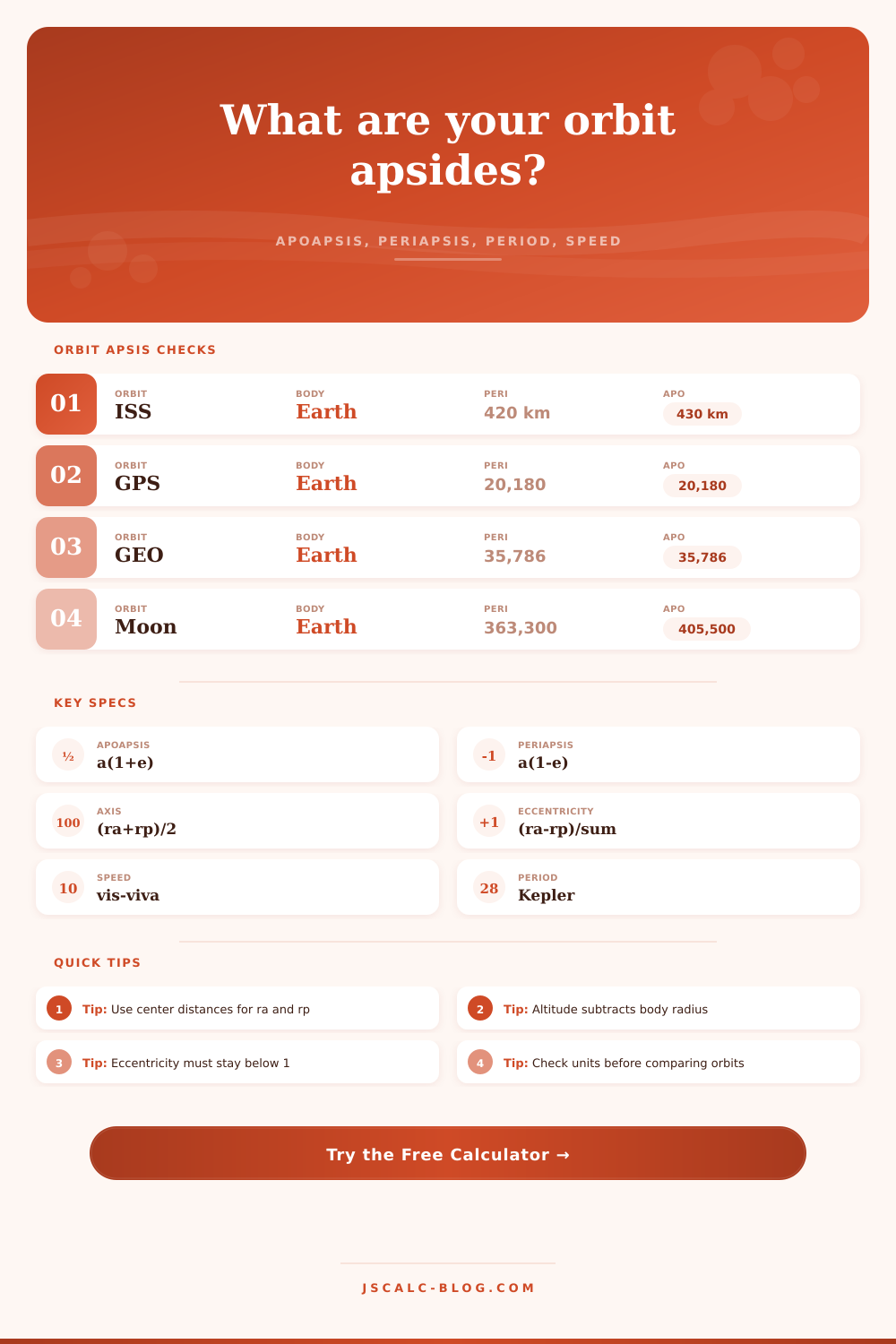
| ISS low Earth | Earth | Altitude pair | About 400 km x 420 km |
| Starlink shell | Earth | Semi-major axis and e | About 550 km circular altitude |
| GPS navigation | Earth | Altitude pair | About 20,180 km x 20,180 km |
| Geostationary | Earth | Altitude pair | 35,786 km circular altitude |
| Molniya ellipse | Earth | Altitude pair | About 600 km x 39,700 km |
| Moon around Earth | Earth | Center distances | 363,300 km x 405,500 km |
| Mars TGO science | Mars | Altitude pair | About 400 km x 400 km |
| Mercury around Sun | Sun | Center distances | 46.0 million km x 69.8 million km |
| Halley heliocentric | Sun | Center distances | 0.586 AU x 35.1 AU from Sun center |
📊Orbit Class Comparison
| Class | Typical periapsis | Typical apoapsis | Eccentricity cue | Period cue |
|---|---|---|---|---|
| Low circular Earth | 400 km alt | 400 km alt | Near 0 | About 92 minutes |
| Sun-sync LEO | 600 km alt | 900 km alt | Small | About 96 to 103 minutes |
| GPS-style MEO | 20,180 km alt | 20,180 km alt | Near 0 | About 12 hours |
| Geostationary | 35,786 km alt | 35,786 km alt | Near 0 | 23 h 56 min |
| Molniya | 600 km alt | 39,700 km alt | High | About 12 hours |
| Comet-like solar | Below 1 AU | Tens of AU | Very high | Years to decades |
🧭Eccentricity Quick Lookup
| Eccentricity | Orbit shape | Apsis behavior | Calculator check |
|---|---|---|---|
| 0 | Circle | ra equals rp | Apoapsis and periapsis altitudes match |
| 0.001 to 0.02 | Very mild ellipse | Small altitude swing | Common for maintained satellites |
| 0.02 to 0.2 | Moderate ellipse | Visible apsis spread | Check both speeds separately |
| 0.2 to 0.75 | Stretched ellipse | Long dwell near apoapsis | Period depends on a, not e alone |
| 0.75 to 0.999 | Extreme ellipse | Very fast periapsis passage | Confirm periapsis clears the body |
✅Apsis Tips
It is a little geometry and a little energy. Two numbers, the farthest point (apoapsis) and the closest point (periapsis) (form the shape of an ellipse). They determines everything, from fuel budgets to communication windows. And they tell the story of every orbit in two numbers. What is the relationship between these points? This turns the complex ideas of orbital mechanics into a practical engineering problem. The calculator on this page will solve it for you by doing all of the heavy lifting. It turn the values you know into a full orbital picture without you having to remember Kepler’s laws.
Altitude is what most mission parameters specify, and that’s where most people begin. They say they’re launching something to four hundred kilometers, for example, not sixty seven hundred and eighty kilometers from Earth’s center. That makes all the difference in the world, since center-to-center distance is what gravity equation takes as an input. Plugging the surface altitude directly into a formula designed to take radius as input will give you wildly incorrect values.
How Orbit Calculations Work
To avoid this problem, the tool simply converts it to radius automaticaly when you choose the central body. It extracts the appropriate radius from its own database of information. It then keeps track of that value and uses it throughout the rest of the calculation. This prevents the common mistake of forgetting to add or subtract the planet’s radius which can result in a crash instead of a stable orbit.
And then there’s the hidden variable: eccentricity. That’s just a number between zero and one that explains how stretched out the orbit is. Zero mean a perfect circle where the closest and farthest points are the same. Increasing values toward one stretch out the orbit, producing a big contrast between far point and close point. And that shape determines how fast things go. At periapsis, they’re zipping along; at apoapsis, they’re crawling. They do this because angular momentum is conserved. For an orbit highly stretched out, the object may stay for much of its time out at the far end, ideal for communicating with high-latitude areas. The calculator depicts this tradeoff showing how modestley changing the eccentricity can cause a huge shift in velocities at both apsides and hence the period.
It’s also key to select an appropriate reference body. Mu (a.k.a. The gravitational parameter differs greatly throughout the solar system. At any given radius, Mars will pull far less than Jupiter. Because of this it takes much longer to complete an orbit around Jupiter. To visualize how different they are, take a look at the pre-set buttons on the page. They range from the small, close-in loop of the International Space Station to the wide-open and elongated ellipse of a comet such as Halley. Seeing them all together helps put your numbers into context. Perhaps you’ll discover that your proposed lunar transfer orbit needs to have a much larger apoapsis then anticipated, or that you could still maintain a fairly circular science orbit around Mars even though it’s smaller.
Speed calculations shows how much energy is needed to maintain such a shape. The vis-viva equation demonstrates how velocity depends on position and the semi-major axis. It also shows that you pay a premium for high orbits. If you want to raise your apoapsis, you need an exact burn at periapsis. The Oberth effect applies here making fuel more efficient. Aerobraking by lowering your periapsis involves careful timing, too late and you’ll burn up. These is not abstract concepts but constraints that determine spacecraft design and mission length.
With this tool, you can check whether your proposed maneuvers are physically possible based off your available delta-v. You can also get those speeds instently.
Orbital mechanics can be boiled down to constraint management. There’s no setting everything as you please. If you set one thing, something else is locked in. Set the semi-major axis; you’ve pinned down your average distance. Set the period; set the periapsis; and let geometry dictate the apoapsis. Is it restrictive? Sure. But it clears things up. No more guesswork; now there’s design.
You get that concrete feeling that all those unseen forces line up when you see the numbers fall into place. Whether you’re thinking about a hypothetical mission or simply wondering how satellites remain in orbit, it’s about understanding the math behind them. And although it’s cruel, it’s beautiful. When you realize that the periapsis and apoapsis constrains the orbit, suddenly the madness of spaceflight starts to resemble a solved problem.