Orbital Energy Calculator
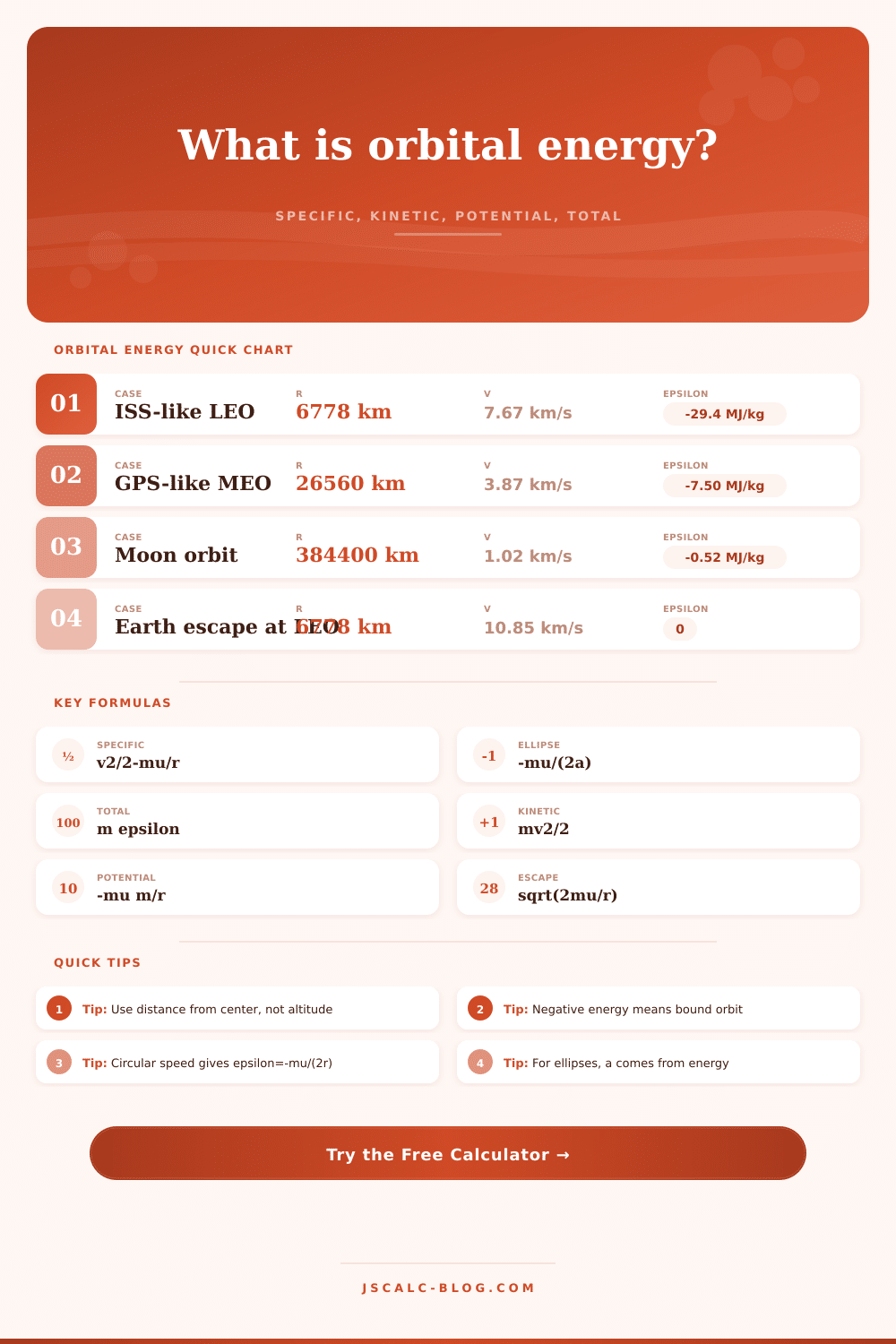
Calculate specific orbital energy ε = v2/2 - μ/r, total mechanical energy E = mε, kinetic energy, gravitational potential energy, ellipse semi-major axis, circular speed, and escape margin.
| Speed case | Speed | Specific energy | Total energy | Orbit meaning |
|---|
To get something into low Earth orbit, you drop some serious money in fuel (millions of dollars per satellite). Then you send it high up into space at a certain altitude. So now that you’re there, you think you’re done, right? Wrong.
That’s where the energy balance comes in. In space, everything has an orbital energy based off its distance away from the planet AND its rate of motion around it. There’s a trade-off here: the further out you go, the slower your object will travel… or vice versa. Understanding this help explain why things fall down or stay up.
How Orbital Energy Works
Using our calculator (which does all the work), you’ll be able to play with how tweaking the radius or velocity affects overall orbital energy. We’ve simplified one helluva physics problem so you don’t need a degree in astrophysics to understand what’s going on.
To understand that, you need to think about specific orbital energy, which is total mechanical energy per unit of mass. What that takes away is all of the weight of the spacecraft. At the same height and the same speed as each other, a feather and a massive satellite would have precisely equal specific energy. Why does that matter? Because the physics of the orbit. What’s happening there doesn’t depend on what you’re carrying; it depends solely on where you are and how fast you’re going.
The equation is straightforward in concept: take your speed and calculate kinetic energy, then take your distance from the center of the body and work out gravitational potential energy. Subtract the latter from the former, and you know the nature of your orbit. If the value turns out to be negative, you’ll stay bound to the planet in an elliptical orbit. Zero, and you have exactly the right amount of speed to get free entirely. Positive, and you’re gone for good. That’s the whole basis of how missions are planned.
The input needs is also confusing to most. They think that it’s asking for altitude (above the surface). Nope. It asks for distance from the center of the earth. That doesn’t seem like much of a distinction, and yet. In fact, I wrote some code to check. Sure enough, using altitude instead of radius makes the equation go horribly wrong.
And so, the calculator does let you put in altitude, and it lets you put in radius, because they aren’t the same thing. Gravity doesn’t care about altitude; it cares how far away from center of mass something is.
Once you know what the variable is, you can see that when it says the specific energy gets worse with higher orbits, it isn’t actualy true. Specifically, it means the satellite has increased its energy! But then the potential energy term overwhelms the kinetic part, so the specific energy value becomes less negative. This is counter-intuitiv. The higher you go, the harder it is to get there, despite the apparent lower specific energy number.
As you go along, those two parts change. In order to overcome high gravity, you have to go very fast near the surface. Then as you rise up, the gravity lessen and your orbital velocity decreases. Although they are far above the earth, the GPS satellites that you depend upon daily travel at much lower speeds then the International Space Station.
The calculator nicely shows the tradeoff. You can vary the speed and observe what happens to the semi-major axis. That’s the axis of the orbit. The bigger it gets, the larger the orbit. Given amount of energy, you know how large it will be. Not yet the shape (eccentricity) nor yet the inclination of the orbit. But just knowing the energy gives you a quick check on whether an orbit is possible without diving into the vector math.
And that’s a good thing because one of the things about energy is that it doesn’t care which way it goes. It’s a scalar quantity. That limits it, but it also provides a rapid sanity check: Is there enough?
The calculator also emphasizes escape velocity, which isn’t some magical moment when it’s time to shoot yourself out of there. It’s just where your potential energy matches your kinetic energy. Once you’ve hit that speed at whatever radius, your own specific energy will be zero. You’re free. The tool shows the margin you have against the escape velocity limit. That can help calculate fuel reserves or plan maneuvers. When you’re designing a mission, you’ll want to know how close you are to falling back down or drifting away from orbit.
The energy comparison section puts those numbers into context with things like known geostationary or lunar orbits. The two body model isn’t quite right. There is more going on in real life. There’s the shape of the Earth, which is an oblate spheroid. There is also drag from the atmosphere and friction with air molecules. These changes make its actual path messier.
The calculator ignores real-world perturbations like drag and atmospheric density. That would be confusing. Instead, this is just best case scenario. Think of the output as the target. It is not the ultimate reality. Engineers then apply margins for those disturbances when they’re planning missions.
But, the basic principle holds: in the vacuum, we have conservation of energy. And that energy is the currency of spaceflight. Understanding that gives you insight into why your high orbit seems so slow and how a small velocity adjustment can increase your orbit. It’s not a question of brute force. It’s about balance.
The next time you see a photo of a satellite orbiting earth, consider that it’s actually falling down but moving sideways at a speed fast enough to avoid hitting the ground. The balance of energy is what keeps it up there.
You should of seen how hard this was to write.