Semester GPA Calculator
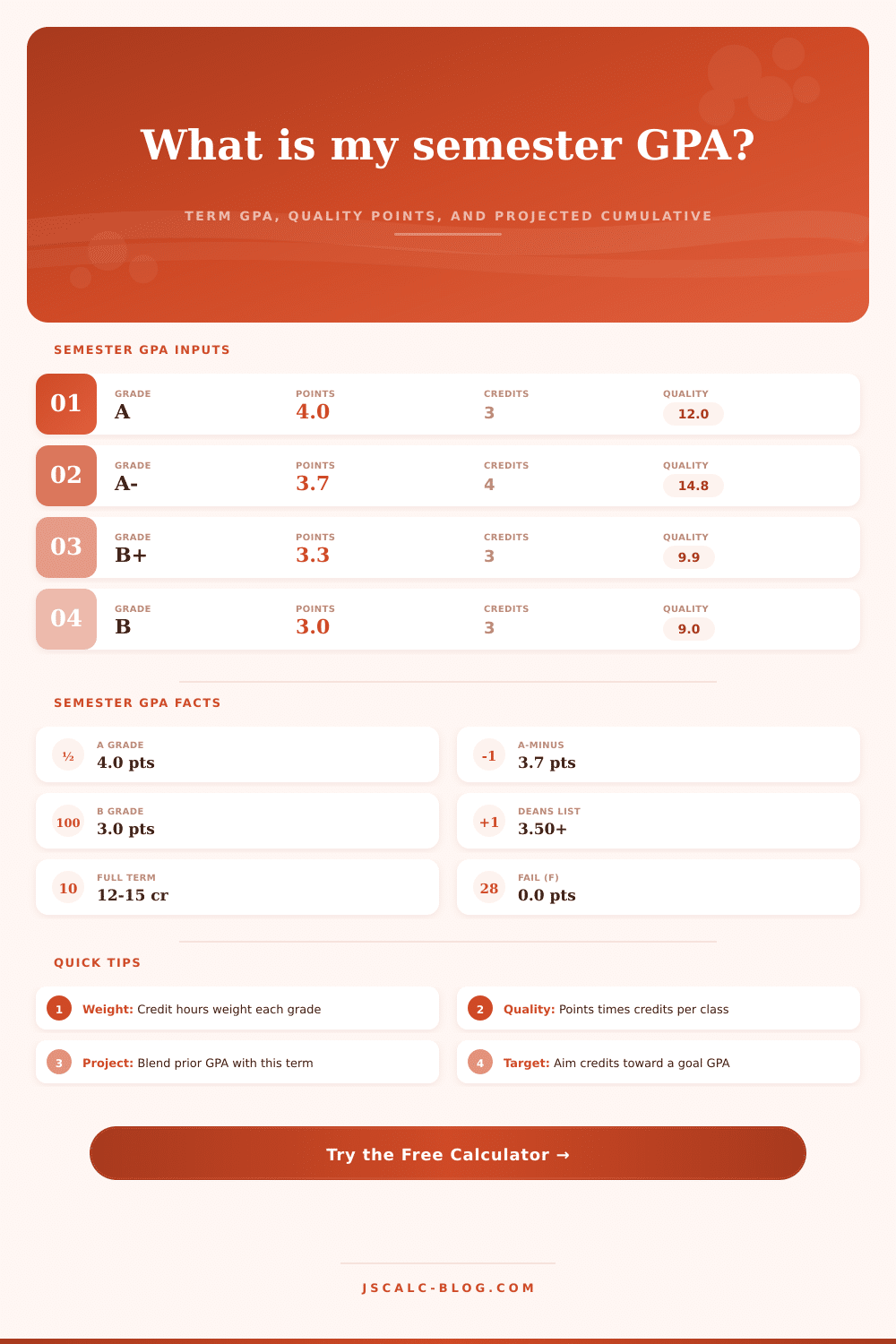
Add every class from one term, pick each letter grade on the plus/minus scale, and see your semester GPA, quality points, projected cumulative GPA, and Dean's List standing in real time.
🎓Real Semester Presets
📚This Semester's Courses
📝Projection & Goal Options
Your GPA before this term. Set to 0 if this is your first semester.
Credits already counted toward your cumulative GPA.
We estimate the 4.0 credits needed next term to reach this.
Choose term-only to see the semester GPA in isolation.
🔢Formula Snapshot
📊Letter Grade to Points (Plus/Minus)
| Letter | Grade Points | Percent Range | Meaning |
|---|---|---|---|
| A | 4.0 | 93-100% | Excellent, mastery of material |
| A- | 3.7 | 90-92% | Strong work, minor gaps |
| B+ | 3.3 | 87-89% | Above average grasp |
| B | 3.0 | 83-86% | Good, solid understanding |
| B- | 2.7 | 80-82% | Satisfactory with weak spots |
| C+ | 2.3 | 77-79% | Fair, meets basic standard |
| C | 2.0 | 73-76% | Average, credit earned |
| C- | 1.7 | 70-72% | Passing but below par |
| D+ | 1.3 | 67-69% | Weak, often non-major only |
| D | 1.0 | 63-66% | Minimum passing grade |
| D- | 0.7 | 60-62% | Lowest passing point |
| F | 0.0 | Below 60% | Fail, no credit, counts as 0 |
🏆Semester GPA Classification & Honors
| GPA Band | Standing | Typical Recognition | Academic Status |
|---|---|---|---|
| 3.90 - 4.00 | Highest honors | President's List, summa cum laude track | Top of the class |
| 3.70 - 3.89 | High honors | Dean's List, magna cum laude track | Excellent standing |
| 3.50 - 3.69 | Honors | Dean's List, cum laude track | Very good standing |
| 3.00 - 3.49 | Good standing | Solid, competitive for transfers | Above minimum |
| 2.00 - 2.99 | Satisfactory | Meets graduation minimum | Good standing |
| 1.00 - 1.99 | Academic warning | Advising and support recommended | Probation risk |
| 0.00 - 0.99 | Academic probation | Formal probation, plan required | At risk |
📅Credit-Load Reference
| Term Load | Credits | Enrollment Status | Typical Study Hours/Week |
|---|---|---|---|
| Overload | 18+ | Full-time (approval needed) | 36-54 |
| Heavy full-time | 15-17 | Full-time, on-track to graduate | 30-51 |
| Standard full-time | 12-14 | Full-time minimum | 24-42 |
| Three-quarter time | 9-11 | Part-time (aid may adjust) | 18-33 |
| Half-time | 6-8 | Part-time, half aid eligible | 12-24 |
| Less than half-time | 1-5 | Part-time, limited aid | 2-15 |
⚙Full Formula Breakdown
🗂Dean's List Threshold Comparison
| Scenario | Credits | Quality Pts | Term GPA | Dean's List | Standing |
|---|---|---|---|---|---|
| All-A full load | 15 | 60.0 | 4.00 | Yes | Highest honors |
| Mostly A/A- | 15 | 56.4 | 3.76 | Yes | High honors |
| Solid B+ term | 15 | 52.8 | 3.52 | Yes | Honors |
| Even B term | 15 | 45.0 | 3.00 | No | Good standing |
| Mixed B/C | 15 | 39.0 | 2.60 | No | Satisfactory |
| Part-time 3.5 | 9 | 31.5 | 3.50 | Load short | Honors GPA |
| One F drags term | 15 | 36.0 | 2.40 | No | Satisfactory |
| Retake recovery | 12 | 44.4 | 3.70 | Yes | High honors |
💡Semester GPA Tips
Anxiety grips you when you see your syllabus and wonder what kind of shape you’re going to be in academicaly. Worry becomes fact when you plug your grades into semester GPA calculator. It spits out your term GPA, quality points, and estimated cumulative score. However, knowing your numbers is one thing; understanding them is another.
Want to know which grade matter most and if having one bad grade will tank your term? You may also want to know how credit hours affects your transcript. Your GPA isn’t simply a mean score based off letter grades, at least most students believe that’s true. If I get an A in both calculus and art history, my GPA will be affected different than yours. Why? Because a four-credit calculus class weigh heavier than a one-credit art elective, regardless of performance. The system takes care of that for us. To determine quality points, it multiplies your credit hours by grade points.
How to Use Your GPA Calculator
Why does that matter? Because it tells you where to allocate your efforts. Sometimes protecting a higher-credit course pays greater reward then pushing for perfection in a lower-level course. The table referenced on the page show the impact of various load combinations on end result. The strategy lies in difference between cumulative and term GPA.
Cumulative represents the long game: it includes your existing point total from earlier credits plus whatever you add on this term. History matter. If you’ve already got forty-five credits with an average GPA of 3.20, then one fantastic semester won’t budge that much higher. That’s how momentum works mathematically.
Term shows you what’s happening right now. Is this the semester you’ll be on Dean’s List? Most schools sets their cutoff at 3.50 or thereabouts, which means most of your grades should be A’s and B+’s over a full workload. If your term score fall in the neighborhood of 3.7, you’re golden.
The projection feature addresses this. By entering your cumulative credits (and previous GPA) thus far, it combines that data with what you input into current semester. Then it produces a realistic projection of what your standing will be once grades is posted. There is no guessing or wondering if an A- will pull your grade up enough. Instead, you see the arithmetic. What it realy takes to hit your mark.
If you have big plans to switch majors or go to grad school, you want to know exactly how many additional credits, averaged out to a 4.0, it is going to require. The calculator does this math for you, estimating number of credits required in your upcoming term. Suddenly, it’s not a vague hope anymore; there is now a concrete goal.
Retaking classes is even more complicated. Depending on your school, they might replace the prior grade with your new one (yay!) or leave it on there and average the two together (boo!). If the latter, they may also still use old grade in their total calculation. However, there is an option here to filter out the terms and just show you what your GPA was during this term, separate from all your other semesters’ baggage. Whether you’re trying to recover from academic probation or you’d like some good news to tell yourself, it lets you know exactly whether you are improving, even if your cumulative math takes awhile to make up ground.
You should of known that earlier. That shifts how we think about registrations. Maybe you learn that it’s safer to take fewer credits but ones where you can get better grades, rather than maxing out and potentially pulling down some C’s from really hard courses. Maybe you learn that you’re on such a good path that it’s okay to overload and increase your cumulative average more quickly by earning those quality points.
I don’t know what the answer is for you. That depends on what your past academic record is like, and what kind of plans you have for the future. But the tool help you see clearly so that you can make that decision.
But ultimately, your grades are merely data points. It’s up to you what you’ll do with them next semester. When you realize that your past success anchors your future potential and your current GPA weighs in favor of your academic performance, it shift from panic to planning. Your grades don’t mean you’re any less or more worthy; they’re just a reflection of what happened, not who you are. They tell a story, one made of numbers, but you get to write the next chapter, credit hour by credit hour.