Last 60 Credit Hours GPA Calculator
Grad, law, medical, and nursing programs often weigh your most recent 60 credit hours. List courses newest first, and this tool accumulates from the top to 60 credits and reports your last-60 GPA, quality points, and overall GPA for comparison.
🎓Real Application Presets
⚙Scale & Window Settings
Whole-letter mode maps A-/A+ to A, B+/B- to B, and so on.
Most programs use 60; some AMCAS-style reviews use the last 90.
Registrars usually count whole courses; prorate is an estimate only.
📝Add Courses (Most Recent First)
Order matters: the calculator counts from the top of this list downward until it fills the credit window. Newest term first.
📈What The Numbers Mean
🔢Counted Course Breakdown
| # | Course | Grade | Points | Credits | Quality Pts | Running Credits |
|---|---|---|---|---|---|---|
| Add courses and calculate to see each counted course and the running credit total. | ||||||
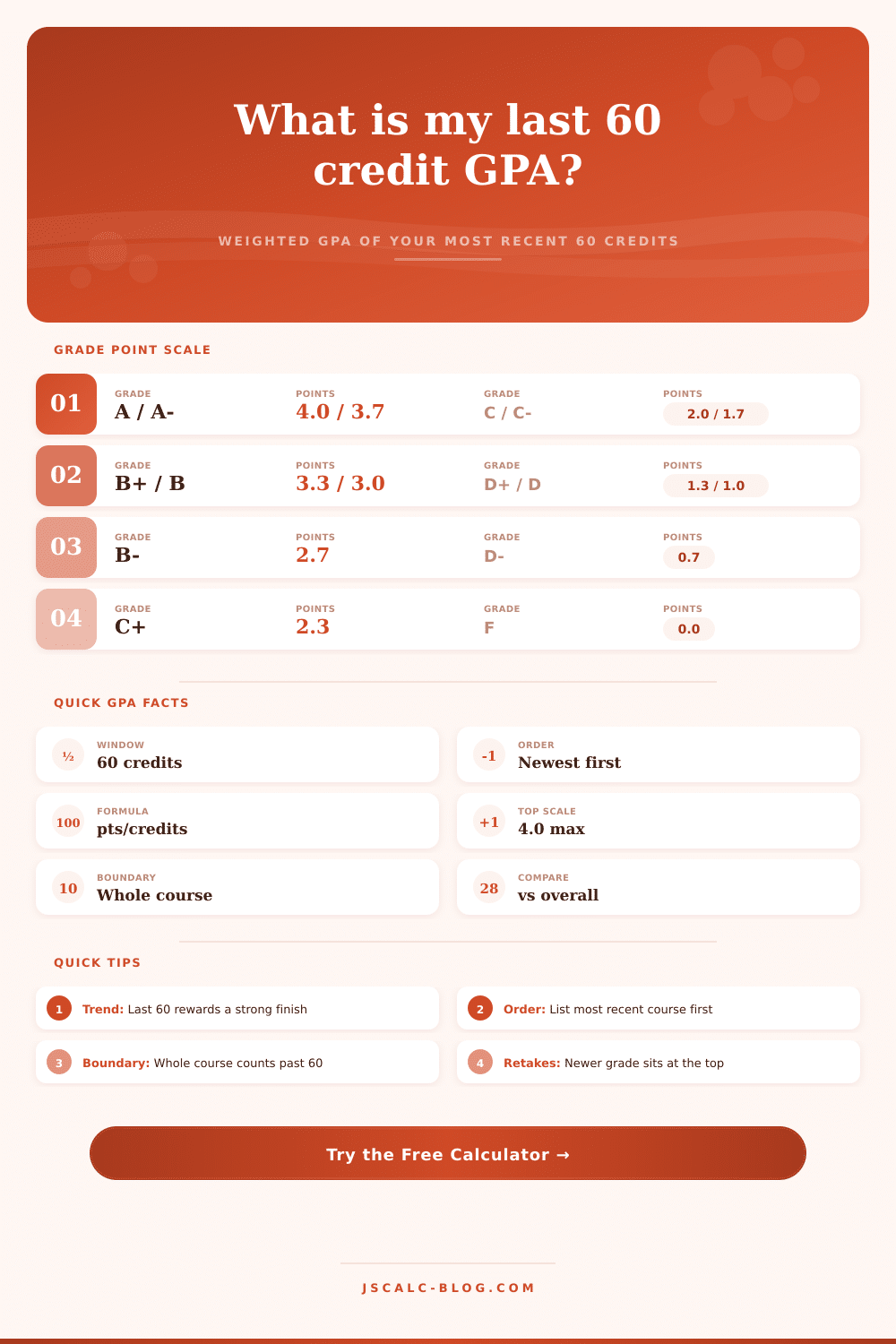
📋Grade Point Scale (4.0)
| Grade | Grade Points | Whole-Letter Mode | Typical Percent |
|---|---|---|---|
| A | 4.0 | 4.0 | 93–100 |
| A- | 3.7 | 4.0 | 90–92 |
| B+ | 3.3 | 3.0 | 87–89 |
| B | 3.0 | 3.0 | 83–86 |
| B- | 2.7 | 3.0 | 80–82 |
| C+ | 2.3 | 2.0 | 77–79 |
| C | 2.0 | 2.0 | 73–76 |
| C- | 1.7 | 2.0 | 70–72 |
| D+ | 1.3 | 1.0 | 67–69 |
| D | 1.0 | 1.0 | 63–66 |
| D- | 0.7 | 1.0 | 60–62 |
| F | 0.0 | 0.0 | Below 60 |
🎖GPA Classification Guide
| Last-60 GPA | Standing | How Admissions Reads It | Common Fit |
|---|---|---|---|
| 3.90–4.00 | Highest honors | Very competitive recent record | Top programs |
| 3.70–3.89 | High honors | Strong late-career performance | Selective programs |
| 3.50–3.69 | Honors range | Solid upward trend signal | Most grad programs |
| 3.00–3.49 | Good standing | Meets many stated minimums | Broad range |
| 2.70–2.99 | Fair | May need a strong narrative | Access, provisional |
| Below 2.70 | At risk | Usually below stated floors | Post-bacc first |
📊Semester vs Cumulative Last-60 Example
| Semester (Recent First) | Credits | Grades Mix | Semester GPA | Running Credits | Cumulative Last-60 |
|---|---|---|---|---|---|
| Spring (newest) | 12 | A, A, A-, B+ | 3.75 | 12 | 3.75 |
| Fall | 12 | A, A-, B+, B | 3.50 | 24 | 3.63 |
| Summer | 6 | A, A- | 3.85 | 30 | 3.67 |
| Prior Spring | 15 | A-, B+, B, B | 3.20 | 45 | 3.51 |
| Prior Fall | 15 | B+, B, B, A- | 3.25 | 60 | 3.44 |
| Older Summer | 6 | C, C+ | 2.15 | 66 | Outside window |
⚙How The Last-60 GPA Is Computed
📚Why The Last 60 Credits Matter
| Program Type | Common Focus | Why Recent Credits | Note |
|---|---|---|---|
| Nursing (BSN/ABSN) | Last 60 prereq GPA | Shows current science readiness | Prereqs weighted |
| Law (JD) | Trend after cumulative | Upward trend can offset early years | LSAT still key |
| Grad (MS/MA) | Last 60 as a floor | Recent major coursework matters | Varies by school |
| Med post-bacc | Recent science GPA | Proves rebound from early grades | Retakes visible |
💡Last-60 GPA Tips
Plug your classes into the calculator above, and it will do the work for you by handling all the conversions and coefficients. Admissions committees is aware that if you struggle at first, it doesn’t necessarily mean you’ll continue to struggle. If you went through a rough patch in college when you had an abysmal GPA, you may recall feeling as though it’s set in stone. It isn’t.
Your final sixty credits show whether you are ready for academics now, different than being based off your past performance. Most grad programs prefer to evaluate based on what you’re doing NOW. That’s why they take the last sixty credit: it’s still a significant number that provides meaning, but it’s not so broad as to represent anything other than your current effort level. So if you’ve been busting ass lately? This stat will tell a more positive story about you than cumulative average will. It is a simple idea that shows your current mental maturity.
Why Your Last 60 Credits Matter Most
Always put your classes in chronological order, beginning with your most recent semester. It will then add up your credits from the top down, stopping when it hits sixty. If new classes takes up spots previously held by old general education classes, those old classes might be removed from your list entirely. So think about this as a rolling timeline: You’re presenting your best stuff first and crafting the story of who you are at school.
This is the grading system at your school, it’s worth checking out. Most have a standard four-point scale, but some also incorporate plus or minus distinctions. For example, an A- may only count as 3.7 rather than 4. These tiny decimal differences accumulate over dozens of credit hour. To ensure accuracy, you’ll want to switch between scales in the calculator to match. They are not looking for perfection, just consistency to prevent skewed results.
One other thing: If you’re just barely over the sixty-credit line with one class, these boundary cases get trickier. Depending on your advisor, they may pro-rate it, or they may count the entire course. Different professors and departments interprets the rules differently, so how they view those boundaries matter if you’re hovering right on the edge of a cutoff. Registrars interpret the rules different, and the tool will give you options for this.
That’s the window. This is the moment of proof that you’re resilient. There are plenty of applicants with impeccable transcripts; there are also plenty of applicants who started strong and faded into complacency. That final 60 credits is the difference. If you’ve developed the ability to prioritize education and handle your workload, then this shows it. And it will show admissions officers that one bad grade doesn’t define you, as these recent grades prove that early mistakes were isolated incidents rather than character flaws. Think of it as an opportunity to showcase your growth, not a backdoor into a school.
Having good grades in your last 60 credits is a solid argument for admission even when your cumulative GPA is weak. Depending on which school you’re applying to, that might be right at the threshold of real consideration (see table below). That way you know what to aim for and whether you need to retake classes or add supplements. You get to dictate the pace of your story in your transcript. The final 60 credits represent the climax of that story. It reflects who you are as a scholar at this moment in time, and it moves the discussion away from your origins to your destination. That’s how you nail down the interview with a strong finish.