Fan Horsepower Calculator
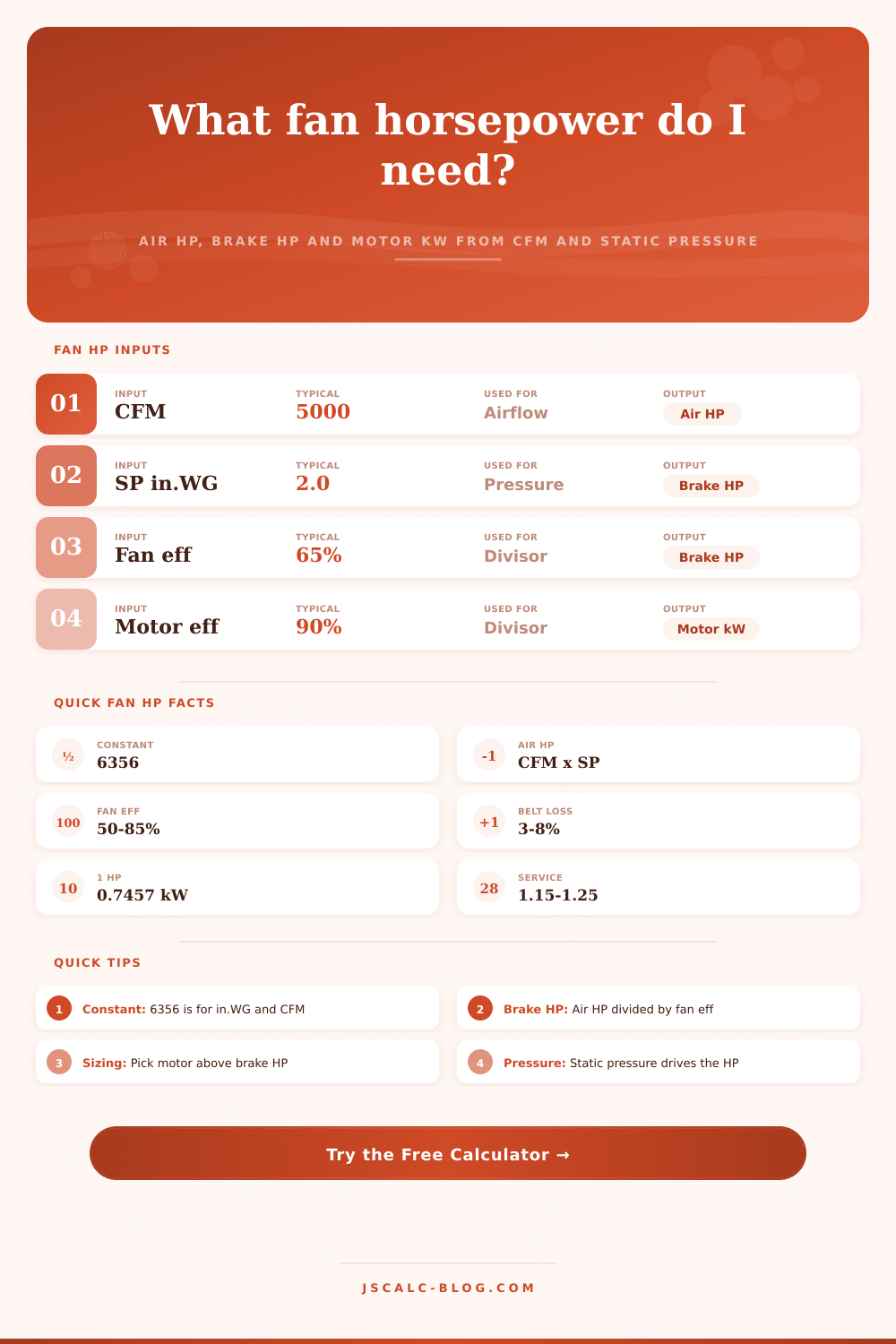
Estimate air horsepower, brake horsepower, required motor horsepower, and kilowatts for an HVAC fan or blower from airflow in CFM, static pressure in inches of water gauge, and real fan and drive efficiency.
🌬Real Fan & Blower Presets
📝Fan Inputs
Volume flow in cubic feet per minute.
Total static pressure in inches of water gauge.
Static efficiency of the fan wheel.
Belt drives add a small transmission loss.
Auto-set by drive type; edit to override.
Used for input kW at the wall.
1.00 at sea level. Below 1 for altitude or hot air.
Multiplier applied to brake HP for the suggested motor.
🔢Formula Snapshot
⚙Air HP & Brake HP Formula
📈Typical Fan Static Efficiency
| Fan Type | Static Efficiency | Typical Use | Notes |
|---|---|---|---|
| Forward curved (squirrel cage) | 45% to 60% | Furnaces, small AHUs | Quiet, low pressure |
| Backward inclined | 65% to 78% | AHUs, rooftop units | Non-overloading |
| Airfoil centrifugal | 75% to 85% | Large AHUs, plants | Highest efficiency |
| Radial (paddle) | 50% to 65% | Dust, material handling | Rugged, high pressure |
| Axial / tube axial | 55% to 70% | Exhaust, ventilation | High flow, low SP |
| Propeller | 40% to 55% | Wall exhaust fans | Very low pressure |
📋CFM & Static Pressure by Application
| Application | Airflow (CFM) | Static (in. WG) | Typical Fan |
|---|---|---|---|
| Bathroom exhaust fan | 50 to 150 | 0.10 to 0.40 | Axial / propeller |
| Residential furnace / air handler | 800 to 1600 | 0.5 to 1.0 | Forward curved |
| Kitchen hood exhaust | 1500 to 4000 | 0.75 to 1.5 | Backward / radial |
| Commercial rooftop unit | 4000 to 8000 | 1.5 to 3.0 | Backward inclined |
| Large air handling unit | 8000 to 20000 | 2.0 to 4.5 | Airfoil centrifugal |
| Dust collector / paint booth | 3000 to 6000 | 3.0 to 8.0 | Radial paddle |
| Data center CRAC / CRAH | 5000 to 12000 | 1.0 to 2.5 | Backward / EC plug |
🗂Brake HP Comparison Grid (65% fan eff)
| CFM | Static (in. WG) | Air HP | Brake HP | Motor HP (90%) | Brake kW |
|---|---|---|---|---|---|
| Values populate after calculation using your fan and motor efficiency. | |||||
🔌Standard NEMA Motor Sizing
| If Brake HP Is | Standard Motor | Full-Load kW (approx) | Common Frame |
|---|---|---|---|
| Up to 0.33 | 1/3 HP | 0.25 kW | 48 / 56 |
| 0.34 to 0.50 | 1/2 HP | 0.37 kW | 48 / 56 |
| 0.51 to 0.75 | 3/4 HP | 0.56 kW | 56 |
| 0.76 to 1.00 | 1 HP | 0.75 kW | 56 / 143T |
| 1.01 to 1.50 | 1.5 HP | 1.12 kW | 145T |
| 1.51 to 2.00 | 2 HP | 1.49 kW | 145T |
| 2.01 to 3.00 | 3 HP | 2.24 kW | 182T |
| 3.01 to 5.00 | 5 HP | 3.73 kW | 184T |
| 5.01 to 7.50 | 7.5 HP | 5.59 kW | 213T |
| 7.51 to 10.0 | 10 HP | 7.46 kW | 215T |
💡Practical Fan Sizing Tips
A big box of metal sits before you. It’s a commercial air handling unit. What does it sound like? Is that noise too much or just right? Typically the volume comes down to one thing: horsepower. But it is not in the sense that auto buffs mean when they talk about an engine’s power. Here in the world of HVAC, horsepower represent the expense of pushing air against resistance, not brute force. That’s what tells us if our system move air efficienty for comfort, or squanders energy by spinning wheels as it barely pushes some around.
If you have pressure and airflow numbers, there are calculators that will spit out the answer you’re after. But to understand how those figures make a difference, lets look at the physics behind them. Theoretical air horsepower is the minimum amount of energy required to push a given volume of air through a system at a certain static pressure. That’s a theoretical number in the ideal world.
What is Air Horsepower?
In the real world there are fans with some inefficiency converting power input to rotational power; there is friction and leaking duct; it isn’t a perfect world. And it isn’t. Engineering happens when we compare theoretical air horsepower to what our electricity bill says. Consider several factors. The mechanical efficiency of the fan wheel is how much of its shaft rotation convert into moving air. If there are belts, then there is drive losses to add into the equation. Each link in the chain decrease available energy by just a little.
The problem with static pressure in all this is that it’s invisible; until there’s an issue. The tendency here is for folks to get caught up in the cubic feet per minute (CFM) thing; “more = better,” right? Nope. It takes a LOT more torque to push 5000 CFM through long runs of small ducts & tight filters than it does to move the same air around freely. That pressure builds up like a dam holding back water, which makes your motor has to work even harder just to keep it flowing. In many cases, static pressure pushes required horsepower way higher then the volume of airflow itself.
This process includes conversion of all those units with the calculator doing it for you. It uses common efficiency factors and constants; no need to remember fluid dynamics formulas. Then it spits out Brake Horsepower (BHP), the true power that motor puts on the fan shaft, from the raw inputs you enter. From that BHP number, it recommend a motor size to match normal industry standards.
The difference between rated motor and brake horsepower is key. Running a motor 100% continually will cause overheating and premature failure. The calculator add a service factor to allow for changes in conditions. These include hot summer days where air is slightly less dense or dusty filter.
The sizing math is only half of the equation; you also need to choose the proper fan type. In residential furnace a forward curved fan looks quiet and cheap, but when the system resistance change, this type of fan becomes unstable at high pressures. For a complicated commercial setup, backward inclined fans are the safer bet because their higher static pressure won’t overload the motor. Paddle or radial fans is designed to take abuse, suitable for dirty environments where dust is constantly clogging up the works. However, they sacrifice efficiency for durability.
While the calculator doesn’t reveal what fan to purchase, it reveals how much electricity that fan will pull from your electrical panel. The common mistakes many installers do are upsizing motors because they’re afraid not to. They’ll grab a three-horsepower motor when all you need is half a horsepower. It’s a waste up front and it’s going to run poorly because the oversized fan runs in an inefficient part of its curve. And there are those who try to save some bucks by undersizing the system and end up with weak airflow and disgruntled people complaining it was too stuffy.
You want the load matched closely to capacity so there is just enough extra room to handle normal wear and tear, but nothing more than necessary so you don’t waste power. The bottom line: A fan’s size depends on balancing how comfortable it feels with how much it costs to run. You need sufficient pressure to counteract resistance of ducts, but no more than is needed to push air that doesn’t require movement. Kilowatt by kilowatt, it all adds up.
The formula includes those physical properties of air at standard conditions. These are constants that ensure your calculation begins at a baseline reality instead of being left to guess. Get the horsepower correct, and the system stop fighting itself and begins working with the space it serves. Bills stabilize, noise drops, and air finally becomes fresh.