Business Days Calculator
Count working days between two dates. This tool tallies weekdays, weekend days, whole work weeks, and total calendar days, then subtracts holidays that land on weekdays inside your range.
📌Quick Date Ranges
📝Date Range Inputs
Inclusive counts both start and end. Exclusive drops the final day.
Enter how many holidays fall on a Mon–Fri inside the range.
🔢How The Count Works
⚙Counting Logic Breakdown
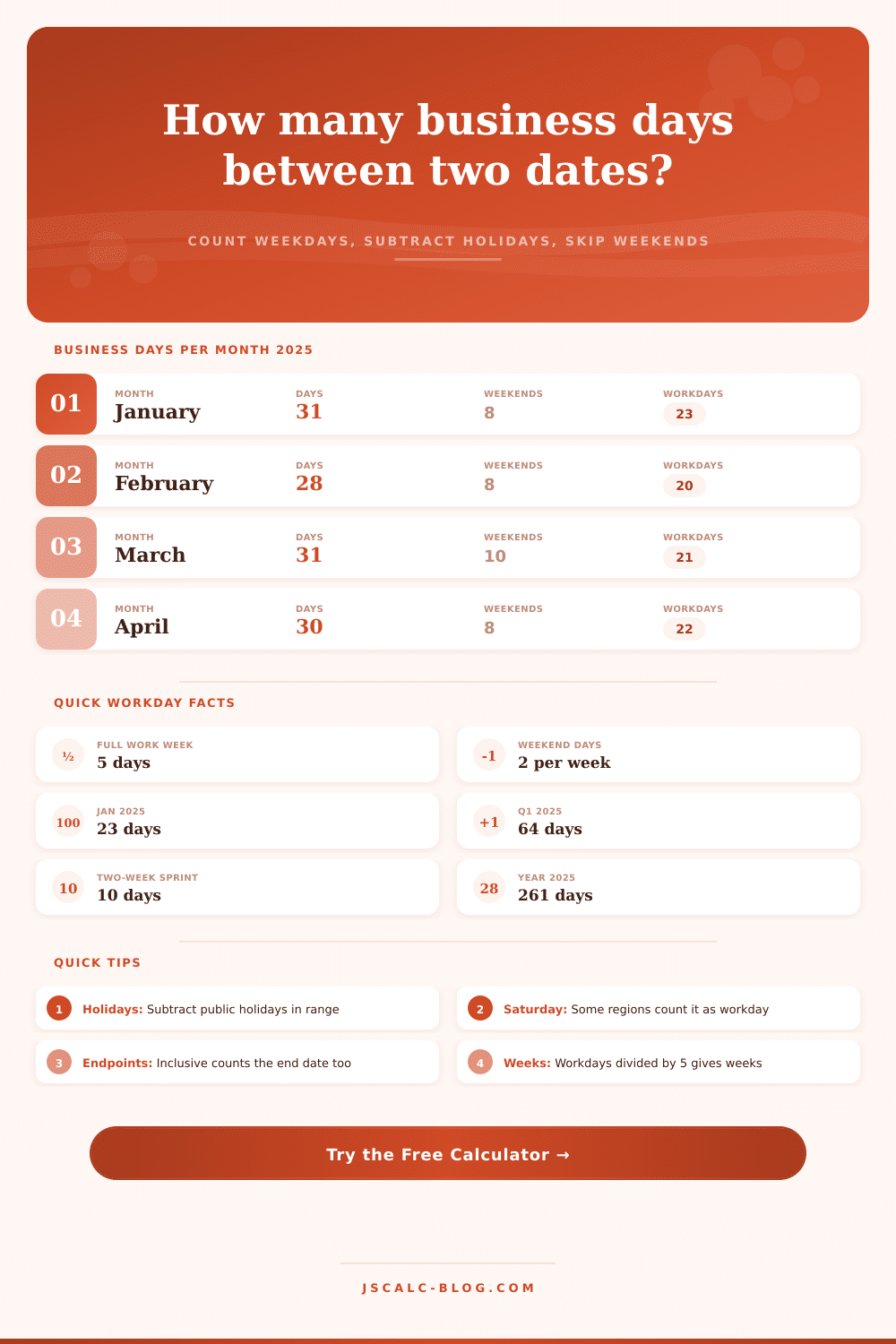
📆Business Days Per Month, 2025
| Month | Total Days | Weekend Days | Holidays (US) | Business Days |
|---|---|---|---|---|
| January | 31 | 8 | 2 | 21 |
| February | 28 | 8 | 1 | 19 |
| March | 31 | 10 | 0 | 21 |
| April | 30 | 8 | 0 | 22 |
| May | 31 | 9 | 1 | 21 |
| June | 30 | 9 | 1 | 20 |
| July | 31 | 8 | 1 | 22 |
| August | 31 | 10 | 0 | 21 |
| September | 30 | 8 | 1 | 21 |
| October | 31 | 8 | 0 | 23 |
| November | 30 | 10 | 2 | 18 |
| December | 31 | 8 | 1 | 22 |
Weekday totals ignore holidays. The business-days column here already subtracts the listed US federal holidays that fall on weekdays.
🗂Weekdays In Common Ranges
| Range | Example Dates 2025 | Total Days | Weekend Days | Weekdays | Work Weeks |
|---|---|---|---|---|---|
| One work week | Jan 6 – Jan 10 | 5 | 0 | 5 | 1.0 |
| Two week sprint | Jan 6 – Jan 17 | 12 | 4 | 10 | 2.0 |
| Calendar month | Jan 1 – Jan 31 | 31 | 8 | 23 | 4.6 |
| 30 day range | Jan 1 – Jan 30 | 30 | 8 | 22 | 4.4 |
| Quarter (Q1) | Jan 1 – Mar 31 | 90 | 26 | 64 | 12.8 |
| 90 day period | Jan 1 – Mar 31 | 90 | 26 | 64 | 12.8 |
| Half year | Jan 1 – Jun 30 | 181 | 52 | 129 | 25.8 |
| Full year | Jan 1 – Dec 31 | 365 | 104 | 261 | 52.2 |
All rows use inclusive endpoints, a 5-day work week, and no holiday subtraction.
🌴Holiday Impact On A 22-Weekday Month
| Holidays In Range | Raw Weekdays | Business Days | Work Weeks | Days Lost |
|---|---|---|---|---|
| 0 holidays | 22 | 22 | 4.4 | 0 |
| 1 holiday | 22 | 21 | 4.2 | 1 |
| 2 holidays | 22 | 20 | 4.0 | 2 |
| 3 holidays | 22 | 19 | 3.8 | 3 |
| 4 holidays | 22 | 18 | 3.6 | 4 |
| 5 holidays | 22 | 17 | 3.4 | 5 |
Only holidays that fall on a working day reduce the count. A holiday on a weekend changes nothing.
🌍Working-Day Conventions
| Convention | Working Days | Weekend Days | Days Per Week | Where Common |
|---|---|---|---|---|
| Standard (Mon–Fri) | Mon, Tue, Wed, Thu, Fri | Sat, Sun | 5 | US, UK, EU |
| Six-day week | Mon–Sat | Sun | 6 | Retail, trades |
| Sun–Thu week | Sun, Mon, Tue, Wed, Thu | Fri, Sat | 5 | Middle East |
| Fri–Sat weekend | Sun–Thu | Fri, Sat | 5 | Israel, Gulf |
| Continuous | All seven days | None | 7 | 24/7 operations |
| Four-day week | Mon–Thu | Fri, Sat, Sun | 4 | Compressed shifts |
Toggle Saturdays and Sundays above to match the convention that fits your region or schedule.
💡Business Day Counting Tips
On paper, counting business days sounds easy, right up until someone has their career riding on a tight timeframe. Can a given deliverable land on Friday, or will it get bumped to Monday? That’s something you realy want to know, but here’s what doesn’t care about deadlines: the calendar. When it rolls forward, it doesn’t cares about holidays or weekends.
The thing is, while we think this is easy, it’s not just about counting weekdays. You also has to account for the fact that some days are workdays and others aren’t. A lot of folks assume five days a week at work, but then they’re working for a company with different hours (think global team) or managing contractor who work Saturdays. If your contractor works on Saturdays, and you ignore Saturday, you’ve thrown off the entire schedule. One Saturday can push back a deadline by roughly a fifth of all available time in a brief sprint. Thankfullly, you can configure these settings with the tool.
Why Counting Business Days Is Important
Most planing mistakes are caused by holidays. Until you close the office, a federal holiday on a Tuesday appear just like any other workday. You’ll need to manually subtract those days from your weekday count. Unless you do so, you’re planning for a time that doesn’t actualy exist. The table on the page illustrate this point nicely. It explains how certain holiday dates can result in as few as twenty or twenty-one working hours in a thirty-one-day month.
Why is that detail important? Remember to consider inclusivity when entering your start and end dates. Adding the last day provides another slot of work. Maybe you’ll reach a milestone sooner then expected. Perhaps you won’t have to ask for an extension. Leaving it out maintains a clean boundary, lawyers like this approach in legal contracts where the last day isn’t included in the service period.
Real life exists, however, so there’s a difference between calendar days (total) and business days (labor capacity). Total days takes into consideration traffic, vacation time, sleep, email, meetings, etc. Business days exclude all those variables. On paper, maybe you’ve got ninety total days in Q1 2025. Take away weekends plus holidays and now you’re down to sixty-four or so working day. A loss of twenty-six days, that’s almost a third of the time required for producing work in typical office jobs. Without accounting for this deficit, you’ll give delivery estimates that demand late nights. The resulting burnout will happen more quickley than gradual progress would.
Another good way to normalize is based off weeks. They account for the unevenness of months. How many complete cycles is there? There are five days in a week, which means we can divide business days into weeks. Ten days in a sprint normally equals two weeks. That’s true regardless of whether the sprint falls across a month boundary or not. Keeping it consistent makes goal-setting more realistic and lets us track our speed better.
It is fifteen working days rather than twenty-one calendar days. That distinction removes the weekend illusion that make people think they have more time then they really do. That’s why the calculator will automatically split up the number of days for you. You don’t should of try and do any math on the fly as you look at a wall chart. It presents you with a clear view of how much you have to work with.
But at its core, time isn’t really about mathematics; it’s about managing expectations. Time is measured by clients who demand answers within days. It’s tracked by employees whose brains is wired for tasks and hours. Connecting the two means establishing a common baseline for the value of a business day. Knowing the precise number of working slots left until the end will let you say no to unreasonable requests backed up with data. No more flimsy explanation are required.
It becomes less stressful and more strategic. Instead of wondering whether or not you’ll make it, you now know when. And when you know, that knowledge will help you create a roadmap out of chaos. A plan where each counted day has a meaningful purpose.