Flesch Kincaid Reading Level Calculator
Paste any passage to measure Flesch Reading Ease and Flesch-Kincaid grade level. See sentence, word, and syllable counts, average length, and a plain-language readability band in one pass.
📚Real Text Samples
📝Your Text
Punctuation ends sentences at periods, question marks, and exclamation points. Blank input scores as zero.
Short passages give noisy scores; raise this to require more text.
🔢Live Text Statistics
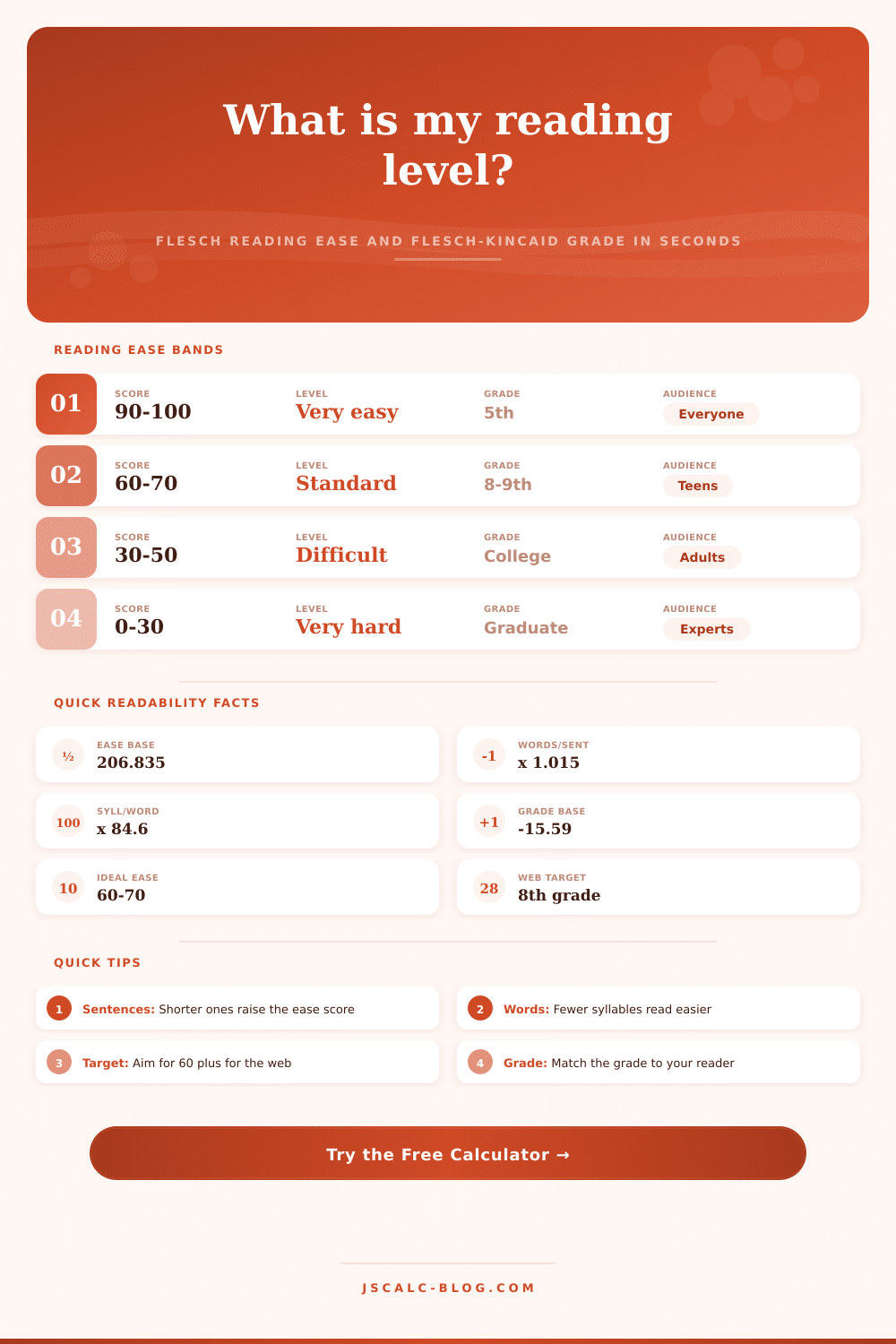
📊Flesch Reading Ease Bands
| Score | Difficulty | School Grade | Typical Audience |
|---|---|---|---|
| Enter text above to highlight the matching band. | |||
🎓Grade Level to Audience
| Grade Level | Stage | Reader Age | Content Fit |
|---|---|---|---|
| Enter text above to highlight the matching grade row. | |||
🧮Other Readability Formulas
| Formula | Output Type | Uses Words / Sent | Uses Syllables | Best For |
|---|---|---|---|---|
| Enter text above to fill the comparison grid. | ||||
⚙Formula Breakdown
📋Reference Values
| Metric | Easy Text | Standard Text | Hard Text |
|---|---|---|---|
| Reading Ease | 80 to 100 | 50 to 70 | 0 to 40 |
| Grade Level | Grade 3 to 6 | Grade 7 to 10 | Grade 13 and up |
| Avg sentence length | 8 to 12 words | 14 to 18 words | 22 words and up |
| Avg syllables/word | 1.2 to 1.4 | 1.5 to 1.6 | 1.8 and up |
| Common use | Kids, ads | Web, news | Legal, research |
💡Practical Readability Tips
Somewhere you’ve probably read or been told: Write at a sixth-grade reading level and you’ll reach more people. While this is something of a catchphrase, it’s also deceptive when taken out of context. Writing down to your audience just because they’re supposedly less intelligent isn’t what we’re after. What we’re after is making the material match the reader ability to absorb it.
For instance, if you were crafting an academic paper for fellow academics, then shooting for sixth grade simplicity would render you unprofessional instead of accessible. On the other hand, if you were composing a safety manual for use on factory floor, sixth grade might still prove too sophisticated as it hides vital directions underneath jargon.
How to Make Your Writing Clear and Easy to Read
What’s confusing about that? It turns out there are two separate scores. There is Reading Ease score (on a scale of 0-100) and Grade Level score (which shows the approximate US school year needed to understand the text). Although these two scores relate to each other, they has slightly different uses. If you want a quick idea of how easy something is to read, use the ease score; if you’re trying to match reading levels with education goals, try the grade level instead.
In general, most content found on the internet is in the eighth or ninth-grade range. This tends to be the appropriate reading level for scanners who skim through information on the internet instead of studiers.
One of the largest factors to pushing a sentence toward a more difficult level are its length. Commas and conjunctions chaining multiple ideas together add to amount of information the reader has to keep in their working memory. Long sentences increase the difficulty score in the formula because readers has to remember the beginning of a thought by the time they reach the end. Splitting a twenty-word sentence into two ten-word sentences will not alter the meaning, but it immediately improves your readability score. It provides reader an opportunity to rest before continuing onto the next thought.
And this brings us to syllables, because how you say something also counts. Specifically, the formula take into account the average length (in syllables) of each word. So any words with more than one syllable increase total weight of sentence; words like infrastructure or utilization pile on a bit more syllable mass that tacks up grade level. By replacing them with simpler synonyms, systems or use, you bring down the bar while maintaining accuracy.
Letting the computer count out periods and vowel sounds for you allows you to concentrate on rewriting instead of computation. Then it shows you where you land: is your writing in the very-easy, standard, difficult, or graduate-level bands? And once you see that your draft has landed in the difficult band, then you know it’s probably too thick for common reading, even though you might think you’re speaking plain old English.
But how should we interpret these results? Here’s the context: If I’m reading a blog post on finance, I’d like it to be clear but I also expect it to reflect an interest in complicated matters. It’s patronizing to strip every bit of detail out of a piece of financial writing just to get a perfect ease score. Clarity is what you want; you don’t want simplicity for simplicity’s sake. Remove the friction, not the insight.
A reference table provides typical audiences and their scores to help you determine if your work connects with them. Diagnosis does not equal prescription. Readability tools can show you what’s tripping you up, but they can’t repair the foundation of your argument for you. So use their feedback to find stumbling blocks (words? Find the stumbling blocks, like odd words or sentences, and re-word them so the text flows. Compare the reading level against your intended audience. Tweak accordingly. Understand that making something slightly harder to read isn’t better then keeping it simple if the harder version fails to express your meaning. Run your draft through, let it land somewhere, and start editing downward until it all makes sense.