G Force Calculator
Convert acceleration into g-units from a linear rate, a 0-to-speed sprint time, a cornering radius using v²/r, or free-fall and braking. See the value in m/s², ft/s², the equivalent force on a mass, and where it lands on the human tolerance scale.
🎯Real G-Force Presets
📝G-Force Inputs
Enter in the acceleration unit selected below.
Usually 0 for a launch or standing start.
Speed at the apex; uses the unit toggle above.
Radius in meters (metric) or feet (imperial).
Free-fall sits at 1 g; height shows impact speed.
Crush or padding depth for the impact deceleration.
Used for the equivalent force F = m × a.
🔢Formula Snapshot
🦴Human G-Force Tolerance
| Event or Level | G-Force | Direction | What the Body Feels |
|---|---|---|---|
| Standing on Earth | 1 g | Vertical | Normal weight, baseline |
| Passenger jet takeoff | 1.3 g | Forward | Gently pushed back into seat |
| Hard car braking | 1.0–1.5 g | Forward | Body strains against belt |
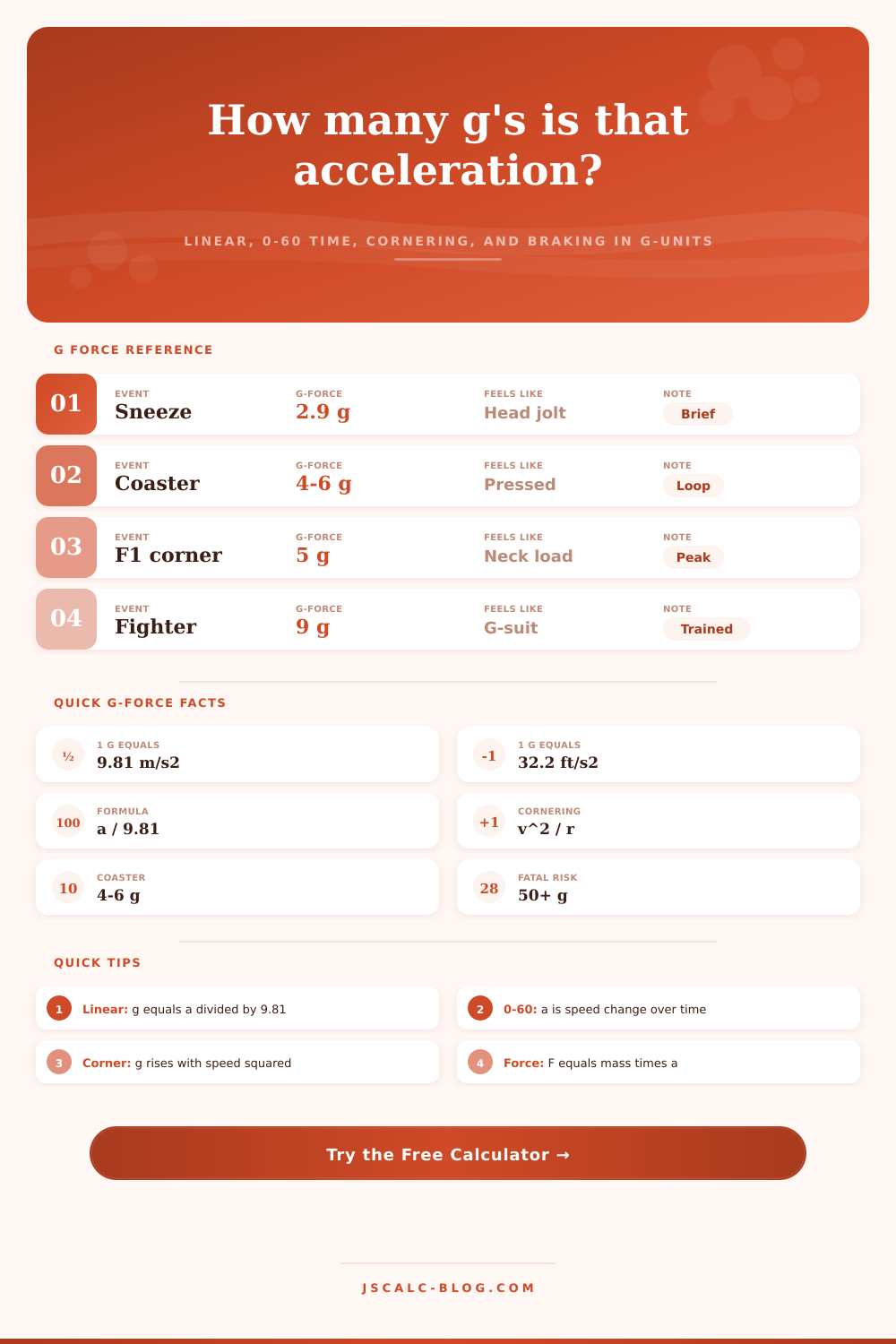
| Sneeze | ~2.9 g | Head | Brief sharp head jolt |
| Roller coaster peak | 4–6 g | Vertical | Heavy, hard to lift arms |
| Fighter pilot sustained | 9 g | Vertical | Needs G-suit and straining |
| Untrained blackout risk | 4–6 g | Head-to-foot | Vision greys, tunnel out |
| Brief survivable crash | ~45 g | Forward | Severe injury, restrained |
| Typically fatal impact | 50+ g | Any | Rarely survivable |
🏎0-60 mph Time to G-Force
| 0-60 mph Time | Acceleration | G-Force | Vehicle Class |
|---|---|---|---|
| 2.0 s | 13.41 m/s² | 1.37 g | Top EV / hypercar |
| 2.5 s | 10.73 m/s² | 1.09 g | Supercar |
| 3.0 s | 8.94 m/s² | 0.91 g | Sports car |
| 4.0 s | 6.71 m/s² | 0.68 g | Hot hatch / muscle |
| 5.0 s | 5.36 m/s² | 0.55 g | Warm sedan |
| 6.0 s | 4.47 m/s² | 0.46 g | Family sedan |
| 8.0 s | 3.35 m/s² | 0.34 g | Compact commuter |
| 10.0 s | 2.68 m/s² | 0.27 g | Economy car |
Average g over the run; peak launch g is higher. 60 mph equals 26.82 m/s.
🔄Cornering G by Speed and Radius
| Speed | Radius 25 m | Radius 50 m | Radius 100 m | Radius 200 m |
|---|---|---|---|---|
| 30 km/h | 0.28 g | 0.14 g | 0.07 g | 0.04 g |
| 50 km/h | 0.79 g | 0.39 g | 0.20 g | 0.10 g |
| 70 km/h | 1.54 g | 0.77 g | 0.39 g | 0.19 g |
| 90 km/h | 2.55 g | 1.27 g | 0.64 g | 0.32 g |
| 120 km/h | 4.53 g | 2.27 g | 1.13 g | 0.57 g |
| 160 km/h | 8.06 g | 4.03 g | 2.01 g | 1.01 g |
Uses a = v²/r with v in m/s. G-force rises with the square of speed, so doubling speed quadruples the load.
🌍Acceleration Comparison Grid
| Scenario | G-Force | m/s² | ft/s² | Source | Comparison |
|---|---|---|---|---|---|
| Free fall on Earth | 1.00 g | 9.81 | 32.2 | Gravity | Baseline weight |
| Gravity on the Moon | 0.17 g | 1.62 | 5.32 | Gravity | One sixth of Earth |
| 0-60 mph in 4 s | 0.68 g | 6.71 | 22.0 | Sprint | Fast street car |
| Hard braking | 1.20 g | 11.77 | 38.6 | Braking | Grippy tires |
| Roller coaster loop | 5.00 g | 49.03 | 160.9 | Cornering | Strong ride |
| Space Shuttle launch | 3.00 g | 29.42 | 96.5 | Thrust | Peak ascent |
| Fighter jet turn | 9.00 g | 88.26 | 289.6 | Cornering | G-suit limit |
| Formula 1 corner | 5.00 g | 49.03 | 160.9 | Cornering | Neck training |
| Rifle bullet in barrel | ~35000 g | 343000 | 1125000 | Thrust | Extreme, brief |
⚙Full Formula Breakdown
📋Reference Values
| Quantity | Value | Where It Is Used | Handy Fact |
|---|---|---|---|
| Standard g | 9.80665 m/s² | The divisor for every g result | Defined constant, not measured |
| g in ft/s² | 32.174 ft/s² | Imperial acceleration checks | Same 1 g, different units |
| mph to m/s | × 0.44704 | 0-60 and speed inputs | 60 mph = 26.82 m/s |
| km/h to m/s | ÷ 3.6 | Cornering speed inputs | 100 km/h = 27.78 m/s |
| Newton to lbf | ÷ 4.44822 | Equivalent force display | 1 lbf = 4.448 N |
💡Practical G-Force Tips
In fact you don’t notice the pull of gravity acting on you, but if a sneeze hits your face, you do. It happen quickly, and it hits you in the face. You feel it, because it’s a jolt, maybe a three g’s.
The thing about gravity is that it’s always there, and your body adapts to it so well that you hardly notice most of it at all. Acceleration is what this is, expressed as a multiple of Earth’s gravity. So when people talk about ‘pulling’ five g’s, they’re talking about feeling like weight has been multiplied by five.
What Are G-Forces?
Whether it’s from a fighter jet turn or launching a car, the calculator run through the maths for you, and show you exactly where those numbers fall on the human tolerance scale. If you had the raw data, understanding linear acceleration would be simple. It’s simply the change in speed divided by the time it took to get there. That’s how they measure that zero-to-sixty sprint all those car brochures brag about.
When you choose the sprint mode, the tool do the conversion for you automatically. It takes those miles per hour, and behind the scenes, converts them into meters per second. Then it divides that by standard gravity constant (nine point eight one meters per second squared). What it tells you is how hard engine is pushing relative to ground you’re sitting on. So a four-second run gets you around zero point seven g’s. That’s a firm shove in the back, but not enough to make your vision blurr.
Cornering isn’t quite as simple because direction is just as important than velocity. I think this confuses many as to why they feel something when a car corners; it’s not because it’s accelerating at full tilt down the road, it’s accelerating towards the middle of the turn, as it changes direction. That acceleration are called centripetal and it depends upon the square of speed over the radius of the turn.
Notice how the velocity appears squared? That’s the important part. Because it’s squared, tiny increments of speed result in huge jumps in g load. If your car go around a corner twenty percent quicker, it doesn’t put an extra twenty percent load on your neck: it puts almost exactly half again as much load on your neck. Change the velocity number (holding the radius constant) in the calculator and see how it jump.
A small note: the math here assumes the car is turning around its centerline, i.e., going around a corner. It depends, though, on how long the force lasts and in what direction it push you: Human beings are amazingly tolerant of the forces pulling you backward in your seat. When we stand up fast or run downhill, our cardiovascular system evolved so that we don’t pass out because all the blood leave our head. A one-point five g’s stop-and-go type of thing isn’t dangerous (it’s simply uncomfortable).
Vertical g forces, however, are another matter entirely. Any pushing down on your chest restrict your breathing and drives blood away from your brain. Four or five vertical g’s will knock out an untrained individual if held long enough. Fighter pilots tense their muscles perpetually and must wear specially designed suits just to remain conscious during nine-g maneuvers.
However, it’s the impact scenario where things get dicey because they decelerate in fractions of a second. When you’re falling freely, you’re doing 1 g. You’re accelerating at same rate as gravity, which is what free fall is. Where it gets dangerous is when you fall and then suddenly something prevents your fall. How fast do you stop? The amount of force depend on how quickly you stop. If you hit a concrete wall, it stops you instantly and produces thousands of g’s… and nobody walks away from that.
Cars have crumple zones designed just to increase the stopping distance by even a few feet. That extra few feet massively decreases the maximum acceleration. You can plug in an estimated crush depth and drop height into the calculator to estimate the impact load. It explain what a difference padding makes.
But we do g forces most days, and don’t even notice them. There is a spike of vertical load when riding up in an elevator. You also feel a split-second sense of lightness as you crest a hill in car. These are all just variations on the change in acceleration compared to gravity. And knowing that the g force isn’t something that you carry around with you. It’s a measure of what is trying to push on you this very instant.
Whether your design challenge is a race track or you’re wondering how scary a roller coaster loop will be, knowing the difference between brief spikes and sustained loads helps you avoid under or over-estimating the danger. Even that sneeze at the opening of the article was a high-g event unto itself. It was brief enough to overlook but strong enough to show that wherever there’s acceleration to try and shift your mass, it’ll leave a mark.
You should of seen how fast it happen.