Current Divider Calculator
Push a known total current into two, three, or four parallel resistors and this tool splits it for you. It finds the current in every branch with Ix = Itot times Rp divided by Rx, the shared node voltage, the equivalent parallel resistance Rp, and the power burned in each resistor, then checks that the branch currents add back up to your input.
⚡Real Current Divider Presets
🔌Divider Inputs
The full current entering the parallel network.
Applies to Itot and all branch current results.
Extra resistor fields appear as you add branches.
Applies to every branch resistance below.
Must be greater than zero.
Must be greater than zero.
Used with 3 or 4 branches.
Used with 4 branches.
🔢Formula Snapshot
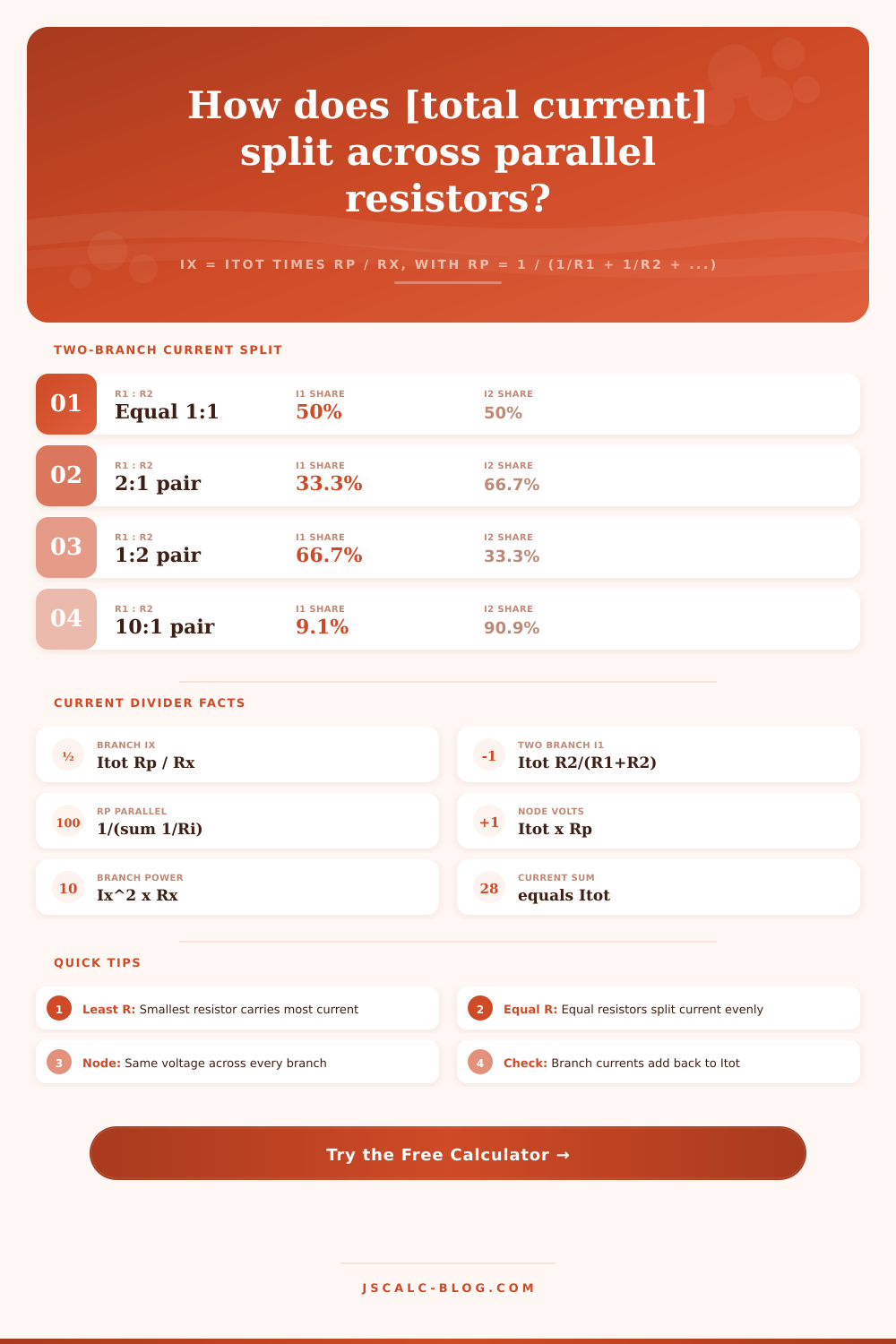
📊How Two Branches Share the Current
| R1 : R2 Ratio | I1 Share of Itot | I2 Share of Itot | Which Carries More |
|---|---|---|---|
| 1 : 1 equal | 50.0% | 50.0% | Even split |
| 2 : 1 | 33.3% | 66.7% | R2 (smaller) |
| 1 : 2 | 66.7% | 33.3% | R1 (smaller) |
| 3 : 1 | 25.0% | 75.0% | R2 (smaller) |
| 4 : 1 | 20.0% | 80.0% | R2 (smaller) |
| 5 : 1 | 16.7% | 83.3% | R2 (smaller) |
| 10 : 1 | 9.1% | 90.9% | R2 (smaller) |
| 1 : 10 | 90.9% | 9.1% | R1 (smaller) |
📏Equivalent Parallel Resistance Quick Table
| R1 | R2 | Rp = R1 R2 / (R1 + R2) | Note |
|---|---|---|---|
| 100 ohm | 100 ohm | 50 ohm | Equal pair halves Rp |
| 100 ohm | 200 ohm | 66.7 ohm | Below the smaller R |
| 220 ohm | 470 ohm | 149.9 ohm | Common resistor pair |
| 1 k ohm | 1 k ohm | 500 ohm | Two equal 1k |
| 1 k ohm | 10 k ohm | 909 ohm | Near the smaller R |
| 10 ohm | 90 ohm | 9 ohm | 10:1 keeps Rp low |
| 4.7 ohm | 47 ohm | 4.27 ohm | Shunt style pair |
| 50 ohm | 50 ohm | 25 ohm | Matched termination |
📑Three and Four Equal Branch Splits
| Branches | Each R | Rp Result | Share per Branch | Example at 1 A |
|---|---|---|---|---|
| 2 equal | R | R / 2 | 50.0% each | 0.500 A each |
| 3 equal | R | R / 3 | 33.3% each | 0.333 A each |
| 4 equal | R | R / 4 | 25.0% each | 0.250 A each |
| 3 equal | 100 ohm | 33.33 ohm | 33.3% each | 0.333 A each |
| 4 equal | 1 k ohm | 250 ohm | 25.0% each | 0.250 A each |
| 3 equal | 470 ohm | 156.7 ohm | 33.3% each | 0.333 A each |
| 4 equal | 220 ohm | 55.0 ohm | 25.0% each | 0.250 A each |
| 3 equal | 10 ohm | 3.333 ohm | 33.3% each | 0.333 A each |
🗃Two-Branch Current Split Comparison Grid
| R1 | R2 | Itot | I1 = Itot R2/(R1+R2) | I2 = Itot R1/(R1+R2) | Vnode = Itot Rp |
|---|---|---|---|---|---|
| 100 ohm | 100 ohm | 1 A | 0.500 A | 0.500 A | 50.0 V |
| 100 ohm | 200 ohm | 1 A | 0.667 A | 0.333 A | 66.7 V |
| 220 ohm | 470 ohm | 0.5 A | 0.341 A | 0.159 A | 74.9 V |
| 10 ohm | 90 ohm | 2 A | 1.800 A | 0.200 A | 18.0 V |
| 1 k ohm | 10 k ohm | 0.1 A | 0.0909 A | 0.00909 A | 90.9 V |
| 47 ohm | 68 ohm | 0.5 A | 0.296 A | 0.204 A | 13.9 V |
| 4.7 ohm | 47 ohm | 1 A | 0.909 A | 0.0909 A | 4.27 V |
| 50 ohm | 50 ohm | 0.3 A | 0.150 A | 0.150 A | 7.50 V |
| 330 ohm | 1 k ohm | 0.2 A | 0.150 A | 0.0496 A | 49.6 V |
| 2.2 k ohm | 3.3 k ohm | 0.05 A | 0.030 A | 0.020 A | 66.0 V |
⚙Formula Breakdown
💡Current Divider Design Tips
That is the idea behind our current divider, which is simple in theory, but how do you size it? Current goes where it wants: through the circuit with the lowest resistance. OK so far. But how much current flows down each path? If there are multiple paths in parallel at a junction, total current divides between them. And they don’t divide equally; only if all those resistors is the same value will this be true.
Plug in values for the resistors and source current and let calculator do the work. It’ll save you doing algebra. It will also show power used and voltage drop across the resistors. Knowing what happens can save you from component failure. And it can help you design good, stable circuits that reacts as expected when loaded.
How Current Divides in Parallel Circuits
This is based off Kirchhoff’s Current Law. What does this say? No charge can build up in a node. For every electron that enters the junction, one has to leave via one or more of branches. So the net current into each branch will be the same than the net current from the input. If you don’t get your sums right then something is wrong.
On real world design side, this law gives you a sanity check of your design. Simply ensure that values for the various branches add back up to what you had initialy. It is a small thing but it is useful when debugging complex boards.
Two resistor are easy. The branch current are inversely proportional to the other resistance value; i.e., higher resistance has lower current in that branch. It’s counter-intuitive, which catches people starting out. They think: I want more current from the bigger resistor. Wrong! You get more current with smaller one.
With 10 ohms and 100 ohms in parallel, you’d get about nine times as much current through the 10-ohm resistor and less on the big resistor. The calculator does math so you don’t have to memorize the algebra. Just remember that the lower the resistance, the higher the current flow.
With a third or fourth branch, things gets more complicated and move away from straightforward fractions into reciprocal sums. To find the equivalent parallel resistance, you need to sum the reciprocals of each separate resistor, then invert that result. It sounds cumbersome on paper but in software it happen instantly. From there, simply multiply that equivalent resistance times the total current going into the node. That gives you voltage at the node. Because all parallel branches are at equal voltage, you can then use Ohm’s Law to calculate the current through each one. It doesn’t have to be just two or three branch. The process works with as many as you want.
Where hardware meets theory is power dissipation. Current running through a branch may not be harmful. However, the resistance create power that could easily exceed the rated value for the component. Power equals current squared times resistance. Therefore a small current (even less than an Amp) running through a low value resistor creates a lot of power! For example, if you have a five ohm shunt and run almost an Amp through it, then that resistor will burn several Watts of power. A quarter-watt resistor here would of fail immediately.
The tool provides the current and the power figure. You can therefore choose the correct wattage ratings without ever soldering a joint. These dividers are frequently used by designers as LED balancing and sensor input points that need to distribute current accuratley. By using matched resistors, you can evenly divide up the load making it easier to manage heat over several devices. If your loads is mismatched then you’ll have to calculate carefully so that you don’t end up starving one part while another overheats.
The tool’s reference tables shows some common ratio examples and how even small imbalances can put most of the load on one side. Knowing this upfront helps save time in the lab.
The bottom line: The present day divider isn’t so much about fancy formulas as it is following the laws of parallel. It’s all about distributing energy over several channels with one common voltage potential. So whether you’re paralleling loads on a power rail or bypassing current past an ammeter, it’s all the same deal. It controls the flow without killing the devices through which it flows.
And yes, the calculator provides the numbers. But knowing why the lowest resistor carries the maximum current? That makes you a better engineer. Remember that inverse relationship and your circuits will run consistently and coolly.