Self-Employment Tax Calculator
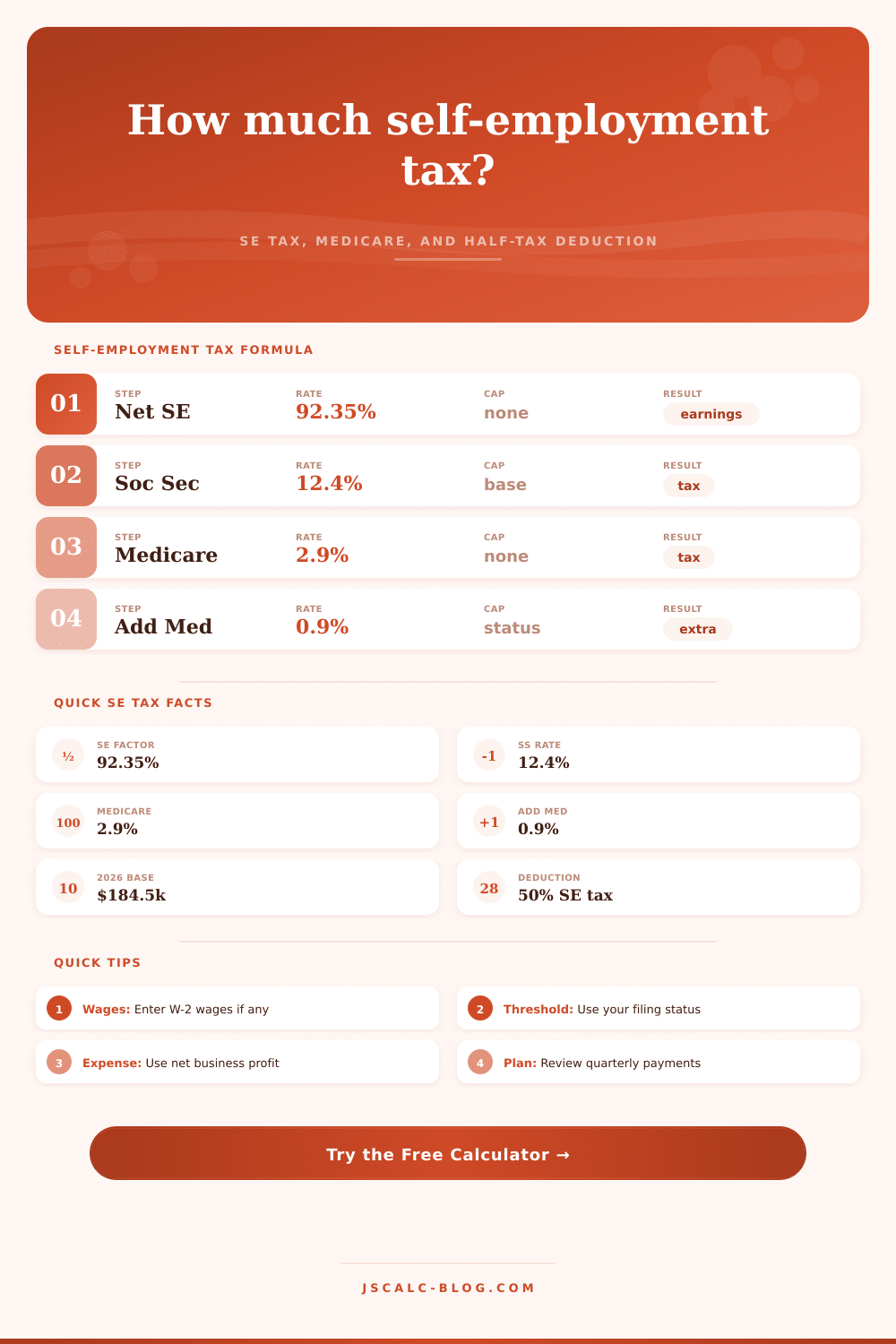
Estimate US self-employment tax from net business income, W-2 wages, filing status, Social Security wage base, Medicare tax, Additional Medicare tax, and the one-half SE tax deduction.
The selector controls the cap for the 12.4% Social Security part.
Used only when the year selector is set to custom.
Additional Medicare thresholds are $200k, $250k, or $125k by status.
Both methods feed the same Schedule SE-style net income line.
Enter Schedule C or K-1 net earnings before SE tax adjustment.
Used when gross-minus-expenses mode is selected.
Subtract deductible business expenses before applying the 92.35% factor.
Combine other Schedule C, partnership, or farm SE amounts here.
W-2 wages reduce the remaining wage base available to SE earnings.
Additional Medicare applies after combined wages and SE earnings exceed the filing threshold.
Used to show a remaining SE tax planning balance, not income tax.
Internal calculations keep cents before display rounding.
Year and wage base selector
| Tax year | Social Security wage base | Maximum SE Social Security part | Use in calculator |
|---|---|---|---|
| 2026 | $184,500 | $22,878.00 | Current-year planning option |
| 2025 | $176,100 | $21,836.40 | Prior-year or extension estimate |
| 2024 | $168,600 | $20,906.40 | Filed-year comparison |
| 2023 | $160,200 | $19,864.80 | Older return check |
| 2022 | $147,000 | $18,228.00 | Historic Schedule SE review |
| Custom | Manual input | Custom base x 12.4% | Use if a future wage base is known |
Additional Medicare filing thresholds
| Filing status | Threshold | Additional rate | How this calculator applies it |
|---|---|---|---|
| Single | $200,000 | 0.9% | Combined Medicare wages and SE earnings above threshold |
| Head of household | $200,000 | 0.9% | Same threshold as single |
| Qualifying surviving spouse | $200,000 | 0.9% | Same threshold as single |
| Married filing jointly | $250,000 | 0.9% | Higher combined household threshold |
| Married filing separately | $125,000 | 0.9% | Lower separate-return threshold |
Static formula walkthrough
| Line | Formula | Rate or factor | Planning meaning |
|---|---|---|---|
| 1 | Gross receipts - expenses | Business records | Starts from net self-employment income |
| 2 | Net SE income x 92.35% | 0.9235 | Reduces earnings before SE tax rate applies |
| 3 | SS subject earnings x 12.4% | 0.124 | Caps at the selected wage base after W-2 wages |
| 4 | SE earnings x 2.9% | 0.029 | Medicare has no wage base cap |
| 5 | Excess earnings x 0.9% | 0.009 | Applies above filing-status threshold |
| 6 | Total SE tax x 50% | 0.5 | Shows the one-half SE tax deduction |
Scenario comparison grid
| Scenario | Net SE income | SE earnings | SS tax | Medicare tax | Add Med | Total SE tax | Half deduction |
|---|---|---|---|---|---|---|---|
| Run the calculator to fill comparison scenarios. | |||||||
JSCalc-Blog.com: This self-employment tax calculator uses federal SE tax formulas for planning: 92.35% net earnings, 12.4% Social Security, 2.9% Medicare, 0.9% Additional Medicare, and the one-half SE tax deduction. It is an estimate, not tax filing advice.
The rates are twelve point four percent for Social Security, plus two point nine percent for Medicare. It’s just twelve point four percent for Social Security, plus two point nine percent for Medicare. It is fifteen point three percent. Simple math, right? WRONG!
Almost all new freelancers gets tripped up by this hidden structure of the self-employment tax. You don’t need to memorize the whole formula just to guess how much to set aside. The calculator takes care of how your business profit, your W-2 wages, and all these different cap works together.
Why You Need a Self-Employment Tax Calculator
First is the ninety-two point three-five percent factor. This is the statutory discount in the system designed to even things out between you (the employee) and your employees (the employer). As an employee, half of the FICA taxes on your paycheck come from your boss who then forwards them to the IRS. You pay half. Since you’re both the employee and the employer when you work for yourself, the government allows you to subtract half of what you earn before calculating tax rate. Think of it as a little bit of math wizardry that saves you a huge pile of money. Unless you account for it, you’ll end up overestimating how much you owe. The tool will do it for you automatically. It removes this deduction from your net income so you can see your true taxable base instead of just your gross profit.
Next is the Social Security wage base limit. Aka: “the amount of income on which social security taxes are charged.” For 2026, it’s $184,500. If you have a day job and receive a W-2 paycheck, then that eats into that cap before your freelance income even gets factored in. If you’ve reached the limit at your main job, then your freelance work may be subject to little or no Social Security tax. The calculator takes this overlap into account so that you don’t end up paying twice on income that’s already been taxed to the max. A lot of side-hustlers never make this distinction at all.
The Medicare tax, however, is uncapped. It lasts forever. You pay 2.9 percent on every dollar of net earnings, forever. You also pay an additional 0.9 percent if you earn enough to cross the “Additional Medicare Tax” threshold. This is determined by your filing status. If you file single, that’s $200,000. Married couples filing joint returns is subject to the 0.9-percent bite if their combined income tops $250,000. The tool provides a chart showing those exact cutoffs, so you can find the precise moment that another percentage point gnaws away at your margin.
Is it a regressive penalty against success? No, it’s a progressive one! You might wonder when we will ever learn that self-employment tax isn’t something to think about until April. Underpaying it results in penalties. The IRS wants you to pay it on a quarterly basis with estimated taxes. Enter how much you’ve paid so far using the tool and see what’s still outstanding. No more paying a huge lump sum at year-end, this will keep it manageable month by month instead of becoming a once-a-year panic.
Another perk: You can lower your taxable income. You do this by taking the one-half SE tax deduction, which lets you subtract half of the SE tax you pay. When you calculate your adjusted gross income, you can subtract out 50 percent of your self-employment tax payments. That means less income being taxed at your regular income tax rate. Double dip, baby! You’re rewarded with a second way to save by contributing your fair share of payroll taxes. You’ll see this line item in the calculator. You can use it in your larger financial plan.
Initially most freelancers guess at what percentage they should set aside. They go with 30%. That’s fine if you have W-2 income up to the Social Security cap. If you don’t have W-2 income up to the cap, that amount may be too much. If you do, it may not be enough if you earn enough to pay the Additional Medicare Tax. Accuracy is important. Enter your real numbers into the model. Turn data into the antidote to anxiety. Plan rather than guess.
Inputting some information (it only takes a couple of minutes) can make all the difference in whether or not you know what you’re doing or if you’re actualy doing it right. You supply the details on your filing status and earnings, while the tool does the work for you. Adjust your savings rate, get an accurate picture of how much tax you’re actually paying, and even use it to determine how much to pay each quarter.
It’s more than figuring out a number. It’s about taking back control of your money. Your plan doesn’t need to be rigid; the math is rigid. Put in the numbers first and the rest will fall into place.