Business Tax Estimate Calculator
Estimate taxable business income, selected income tax rates, self-employment or employer payroll tax, credits, prior payments, and quarterly planning amounts by entity type.
Presets load realistic structures and rates for planning. Replace the rates with your expected federal, state, and local assumptions.
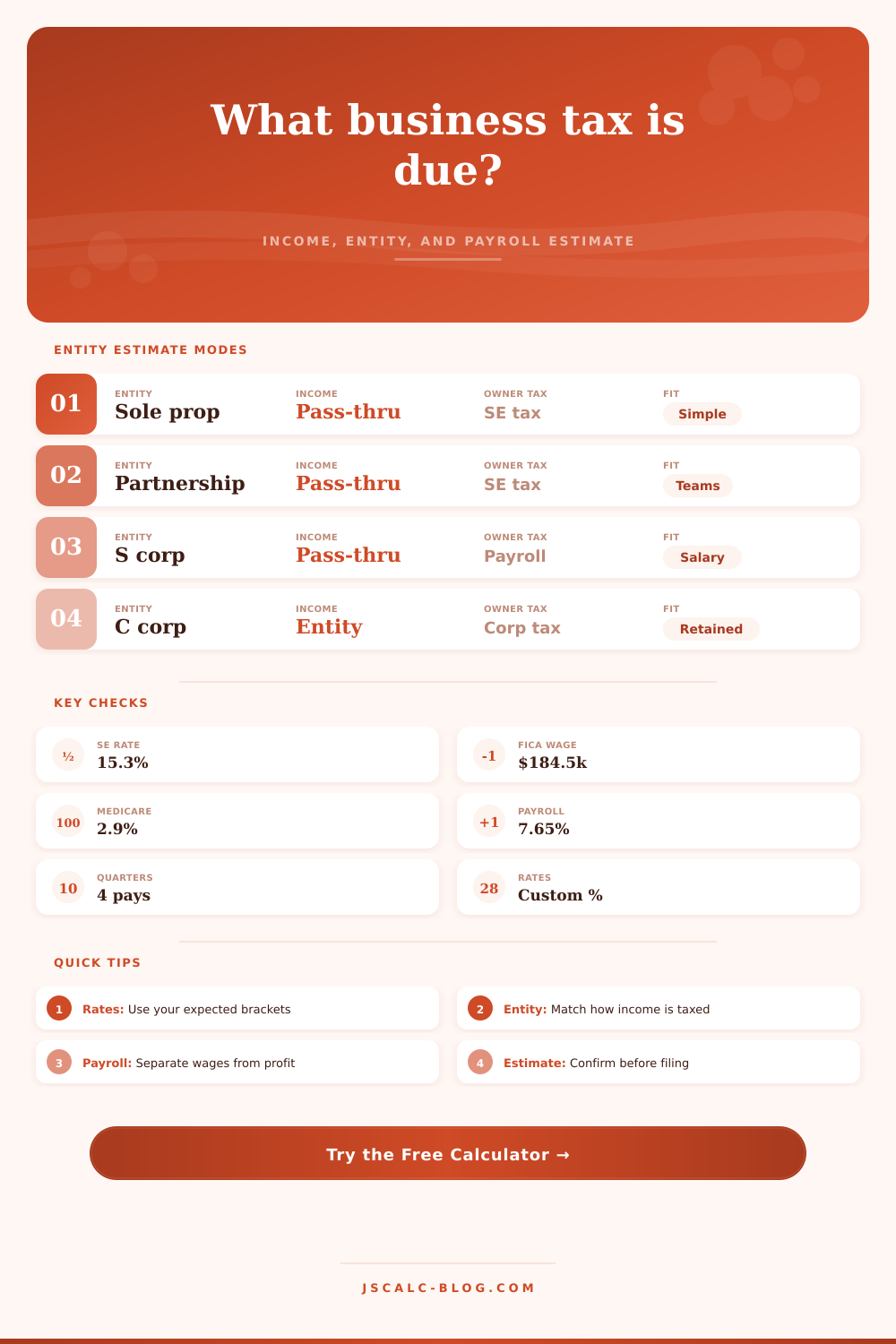
| Entity type | Income tax base | Employment tax default | Use in this calculator |
|---|---|---|---|
| Sole proprietor | Owner share of taxable business income | Self-employment tax | Simple owner-operated estimate |
| Single-member LLC | Owner share of taxable business income | Self-employment tax | Disregarded entity planning |
| Partnership | Partner share of taxable business income | Self-employment tax by default | Shared ownership estimate |
| Multi-member LLC | Member share of taxable business income | Self-employment tax by default | LLC taxed as partnership style |
| S corporation | Owner share after salary and deductions | Employer payroll tax on wages | Salary plus pass-through profit view |
| LLC taxed as S corporation | Owner share after salary and deductions | Employer payroll tax on wages | Election-style planning estimate |
| C corporation | Entity taxable income | Payroll tax if owner wages entered | Corporate-level tax estimate |
| Professional corporation | Entity taxable income | Payroll tax if owner wages entered | Corporate-style professional practice |
| Rate input | Default example | Applies to | Formula role |
|---|---|---|---|
| Federal income tax rate | 22.0% | Pass-through owner income | Taxable owner share x selected federal rate |
| State income tax rate | 5.5% | Owner or entity taxable income | Tax base x selected state rate |
| Local income tax rate | 1.0% | Owner or entity taxable income | Tax base x selected local rate |
| C corporation flat rate | 21.0% | C corporation style entities | Taxable entity income x selected corporation rate |
| Self-employment tax | 15.3% | SE earnings estimate | 12.4% Social Security plus 2.9% Medicare |
| Employer payroll tax | 7.65% | Owner W-2 wages | 6.2% Social Security plus 1.45% Medicare |
| Input | Subtracted from revenue? | Common planning use | Check before relying |
|---|---|---|---|
| Deductible expenses | Yes | Rent, supplies, software, contract labor, fees | Business purpose and documentation |
| Depreciation/amortization | Yes | Equipment, vehicles, intangibles, startup assets | Placed-in-service dates and method |
| Owner deductions | Yes | Owner retirement, health, QBI-style adjustment | Eligibility, limits, and entity treatment |
| Owner share percent | Applied after taxable income | Partner or member share of business income | Operating agreement and allocation rules |
| Credits and prepayments | After tax is calculated | Credits, extension payments, withholding, deposits | Carryforwards and payment records |
| Planning buffer | Payment schedule only | Reserve for rate, income, and deduction uncertainty | Cash flow and tax professional review |
| Scenario | Taxable income | Income tax | SE/payroll tax | Total tax | Payment each |
|---|---|---|---|---|---|
| Current inputs | $0 | $0 | $0 | $0 | $0 |
taxable business income = gross revenue - deductible expenses - depreciation/amortization - owner deductions
estimated tax = taxable income x selected federal/state/local rates + self-employment/payroll tax where selected - credits - prior payments
The employment tax portion is an estimate. Self-employment mode applies 12.4% Social Security up to the remaining wage base plus 2.9% Medicare on estimated SE earnings. Payroll mode applies the employer share of Social Security and Medicare to owner wages.
If most entrepreneurs thought about their taxes at all, its only in April; which is too late and potentially too dangerous. Business taxes aren’t a one-time deal; they’re a recurring set of quarterly payments that eat away at your cash flow unless planned ahead of time.
Before the invoices hit your inbox, use business tax estimate calculator to model your annual tax exposure. It will do the math for you. All you have to do is know what those inputs translate into on your bottom line. Your net income is what determines basis of all your taxes, not your gross revenue.
How to Estimate Your Business Taxes
Many entrepreneurs falls into this trap: They look at their gross sales and apply appropriate tax rate. BOOM! Now they owe the government more than they have in the bank. Before doing this, though, subtract out all deductible expenses. This includes things like supplies, contractor fees, software subscriptions and rent. Next, factor in depreciation on any vehicle or equipment.
Why does this matter? How you categorize these deductions matters. If you’re depreciating something, then you spread its cost across multiple years. If it’s an operating expense, then you pay it right now. Either way, it reduces your taxable base. However, you’ll want to keep the receipts organized (by category) just in case IRS wants to question your claims.
It all depends based off your legal structure. For federal income tax purposes, the IRS treats a single member LLC and a sole proprietorship nearly identical. Both are what we call “pass through” entities. The income flows directly through to you, the person. In other words: you’ll report the income on your personal return.
There’s a catch. Because it’s your own personal income, you’ll have to pay income tax on it. You’ll also owe self-employment tax, which includes Medicare and Social Security. The typical rate is 15.3 percent. It’s calculated against nearly all of your net earnings.
Here’s how an S corporation differs. You’re required to pays yourself a reasonable wage. One that’s subject to payroll taxes. Any excess profit distribution can be paid as dividends, which aren’t subject to self-employment tax. If your business earns enough to cover the administrative burden of running payroll, this difference could save you a lot of money.
You can switch back and forth from payroll tax mode to self-employment tax mode. Why? This lets you test different scenarios. Want to know if you should elect S corporation status? Model what percentage of profits vs. Salary you’d recieve. How much less (or more) will you pay in employment taxes relative to how much more (or less) you’ll have to pays yourself as a W-2 wage? It’s a simple math equation with complex consequences.
You need to balance the savings against the time and accounting fees associated with running payroll. There is one more layer of variation: state and local taxes. Certain states features flat income tax rates. Other states are progressive like the federal one. You can select an income tax rate in the calculator.
If you want a conservative estimate, enter in your marginal rate. If you’d prefer a blended view, enter in your effective rate. Local taxes may be minor, yet they accumulate over time. Don’t overlook them simply because the percentage appears small.
The trick is managing cash flow. No, you don’t pay your entire estimated tax bill in a single lump payment; you pay in four installments: once per quarter. Underpay by even a penny and you’ll owe interest payments. There’s a field on the calculator where you can enter amount of a planning buffer.
Tack a couple of percentage points onto your estimated payments. This establishes a bit of a safety net. Overpay a little and receive a tiny refund; underpay and you’ll be charged interest. That buffer is insurance against reduced income (or expenses) different than what you projected.
Check your findings. How much was your effective tax rate? Check what deductions were entered. Was it lower or higher then expected? Check the reference table on the page to see how various entities is handled.
Do not use this as an end-all, be all tool; always speak with a professional for a final decision. You want your business to remain compliant and in good health. Plan ahead. The numbers would of appreciated it down the road.