Amortization of Intangibles Calculator
Estimate straight-line amortization, period expense by reporting frequency, accumulated amortization, carrying value, impairment write-downs, and revised future expense.
📌Scenario presets
🧾Inputs
Category sets a useful-life reference, not a rule.
Use 0 for most finite-life intangibles.
For one quarter, choose quarterly frequency and enter 1.
Enter 0 to use original life less elapsed months.
📊Output snapshot
📋Projection schedule
| Period | Beginning carrying value | Amortization expense | Ending carrying value | Remaining amortizable amount |
|---|
🔍Scenario comparison grid
| Scenario | Annual amortization | Accumulated amortization | Carrying value | Signal |
|---|
🗂Useful-life category reference
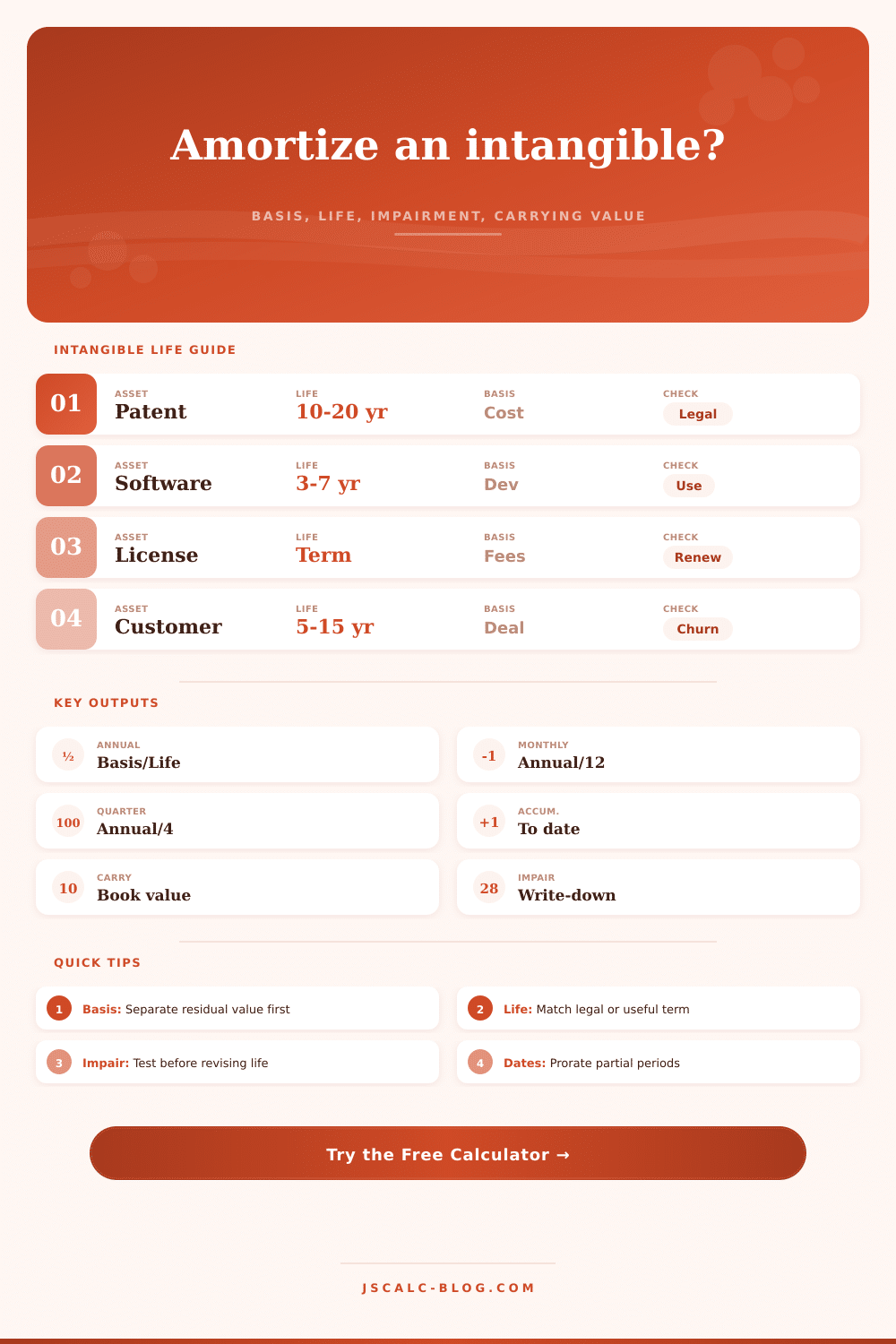
| Category | Common useful-life approach | Typical review trigger | Amortization note |
|---|---|---|---|
| Capitalized software | 3 to 7 years | Platform replacement | Use when ready for intended use |
| Patent or technology | Shorter of legal or useful life | Patent challenge or technical change | Residual value is usually zero |
| Customer relationship | 5 to 15 years | Churn, lost channel, contract attrition | Life should reflect expected benefit pattern |
| License or franchise | Contract term if finite | Nonrenewal or regulatory event | Renewal rights may change the life estimate |
| Contract backlog | Expected fulfillment term | Cancellations or margin deterioration | Often amortized over delivery period |
| Noncompete agreement | Agreement term | Counterparty exit or unenforceability | Usually a short straight-line schedule |
| Finite-life trade name | Expected branding period | Rebrand plan or weaker demand | Indefinite-life names are not amortized |
| Content rights | License window or revenue period | Rights expiry or reduced use | Match expense to expected consumption |
📐Frequency and formula reference
| Frequency | Periods per year | Period formula | Use case |
|---|---|---|---|
| Monthly | 12 | Annual amortization / 12 | Monthly close and SaaS reporting |
| Quarterly | 4 | Annual amortization / 4 | Quarter-end reporting packages |
| Semiannual | 2 | Annual amortization / 2 | Midyear review schedules |
| Annual | 1 | Annual amortization / 1 | Year-end-only models |
📝Statement and adjustment reference
| Item | Formula in this calculator | Where it lands | Review point |
|---|---|---|---|
| Amortizable basis | Gross value - residual value | Schedule driver | Exclude indefinite-life or residual amount |
| Annual amortization | Amortizable basis / useful life | Income statement expense | Use straight-line for this model |
| Accumulated amortization | Prior accumulated + elapsed expense | Contra-asset account | Cannot exceed amortizable basis |
| Impairment write-down | Entered adjustment reduces carrying value | Separate impairment expense | Apply before revised future amortization |
| Carrying value | Gross value - accumulated - impairment | Balance sheet net value | Do not reduce below zero |
| Future amortization | Remaining amortizable value / remaining life | Forward expense run-rate | Update life after triggering events |
💡Amortization tips
Intangibles are tricky things. You own them, but you have to mark down what they’re worth from year to year to match accounting rules.
The thing is: intangible assets don’t maintain their original value. They age. They get challenged. They fall out of favor when you still owns the rights to them. This is where amortization comes into play. It is a way to force you to acknowledge that something you purchased yesterday isn’t as valuable today as it was then. You do not necessarily have to give up your legal claim on it.
How to Calculate Amortization
Mathematically, the calculator does the heavy lifting for you. But you need to know what goes into the formula before plugging in numbers.
The number one mistake I see: People begin with the gross purchase price. That’s almost never right. First, deduct residual value, how much do you estimate the asset will be worth when its useful life ends? Most items with a set lifespan, from dissolving customer lists to expiring licenses, has a residual value of zero. Not factoring this out overstates your annual expenses and twists your profit margin. It’s not a big mistake, but it adds up each quarter.
How do we know what’s useful? That takes some judgment. There are some presets: franchise rights, internal software and so on. But those are just examples; they is meant to give you an idea, not a set of rules. “A patent may have 20 more years left on its legal term,” writes the tool, “but if the underlying technology is changing rapidy, perhaps the patent has only three years of useful life.” Look at your market situation, not just the law. The reference table links typical asset categories to typical life spans. Treat it as a sanity check, not a bible. Stretch the life out and you’re burying costs in the distant future. Squeeze it too tight, and you’re unfairly penalizing current revenues. The trick is knowing what you’re measuring.
But it’s also like an emergency brake on dramatic declines in value. Why? Say a competitor comes out with a superior product, or you lost a major contract. Then you can’t just keep spreading the cost based off your initial cost basis. No! Immediately take into account the impairment. Write it down. That lowers the carrying amount, which now serves as the new basis from which you’ll spread the cost going forward. If you don’t account for impairment, you’re doing shoddy financial reporting.
Enter a write-down amount, and the calc will automatically recalculate your remaining amortizable basis and future schedule of expenses. How often do you report expenses? Do you close at month end? Quarterly? Then the system will break out each of those periods so you can recognize the expense in that time frame. Your cash flow should be matched to when you’re recognizing revenue on your income statement. It’s just admin work, but it keeps everything accurate (and makes auditors happy).
When looking at the schedule of projected amortization, keep an eye on that carrying value column. It ought to be trending downward towards either residual value (if there is one) or zero. And if it’s ever less than zero, that means you made a mistake somewhere with your assumptions.
Amortization is an offset that diminishes the original cost on the balance sheet. Over time, it turns a big capital expenditure into a series of more manageable and predictable operating expenses. It helps spread the financial effects of purchasing growth. To spread out the cost of intangibles, you need to assess how long assets will last. This means recognizing that licenses, relationships and even intellectual property aren’t forever. They’re time-limited benefits that require payment over a period.
The arithmetic is done by the calculator; the realism comes from the inputs. Feed it accurate stuff and it will spit out something that shows your business health. When the numbers are accurate, balance sheet shows the truth.