Quarterly Estimated Tax Calculator
Estimate federal income tax, self-employment tax, deductions, credits, withholding, safe harbor, and the payment to spread across remaining installments.
| Target | Annual target | Offsets counted | Remaining amount | Per remaining installment |
|---|
| Installment | Due date | Status | Suggested safe-harbor payment |
|---|
| Filing status | Standard deduction | Prior AGI 110% trigger | Additional Medicare trigger |
|---|---|---|---|
| Single | $16,100 | Over $150,000 | Over $200,000 |
| Married filing jointly | $32,200 | Over $150,000 | Over $250,000 |
| Married filing separately | $16,100 | Over $75,000 | Over $125,000 |
| Head of household | $24,150 | Over $150,000 | Over $200,000 |
| Self-employment item | 2026 value | Formula in calculator | Use |
|---|---|---|---|
| Net earnings factor | 92.35% | SE profit x 0.9235 | Taxable SE earnings |
| Social Security base | $184,500 | Base less W-2 wages | Caps 12.4% SE portion |
| Medicare SE rate | 2.9% | SE earnings x 0.029 | No wage cap |
| SE tax deduction | 50% | Regular SE tax x 0.50 | Reduces expected AGI |
| 2026 taxable income bracket | Single / MFS | Married filing jointly | Head of household |
|---|---|---|---|
| 10% | $0 to $12,400 | $0 to $24,800 | $0 to $17,700 |
| 12% | $12,400 to $50,400 | $24,800 to $100,800 | $17,700 to $67,450 |
| 22% | $50,400 to $105,700 | $100,800 to $211,400 | $67,450 to $105,700 |
| 24% | $105,700 to $201,775 | $211,400 to $403,550 | $105,700 to $201,750 |
| 32% | $201,775 to $256,225 | $403,550 to $512,450 | $201,750 to $256,200 |
| 35% | Single to $640,600; MFS to $384,350 | $512,450 to $768,700 | $256,200 to $640,600 |
| 37% | Over the 35% ceiling | Over $768,700 | Over $640,600 |
When you’re a freelancer, side-hustler, there’s a certain fear you get when the U.S. Postal Service deliver a piece of mail: one from the government that isn’t a check. It’s what stays on your mind as you lie awake in bed at night.
The IRS doesn’t understand your seasonal business cycle. They don’t care if your cash flow suck right now. They want to get paid … before you do.
How to Calculate Your Estimated Tax Payments
The estimated tax payment process isn’t just a bureaucratic hoop to jump through. For every person who generate income beyond traditional W-2 paychecks, it’s a matter of survival.
Here’s the thing: this system was built for collecting taxes on an income as it’s earned. But most people don’t earn money at a steady rate. In fact, you may earns half of your yearly income in November and none in February. This is why the government doesn’t want you to pay in April the next year; they want you to pay all year long. If you don’t, penalties accumulate quicky.
That’s where the calculator above come in, it’ll tell you precisely how much to pay to avoid getting slammed with a balance due.
Income Tax, Yes, most people know they need to consider their income tax. But Self-Employment Tax? Nope. That’s where people mess up. If you’re self-employed, you’ll end up paying not just the taxes you’d normally pay as an employee (the employee portion), but also the taxes paid by your “employer” (the employer portion).
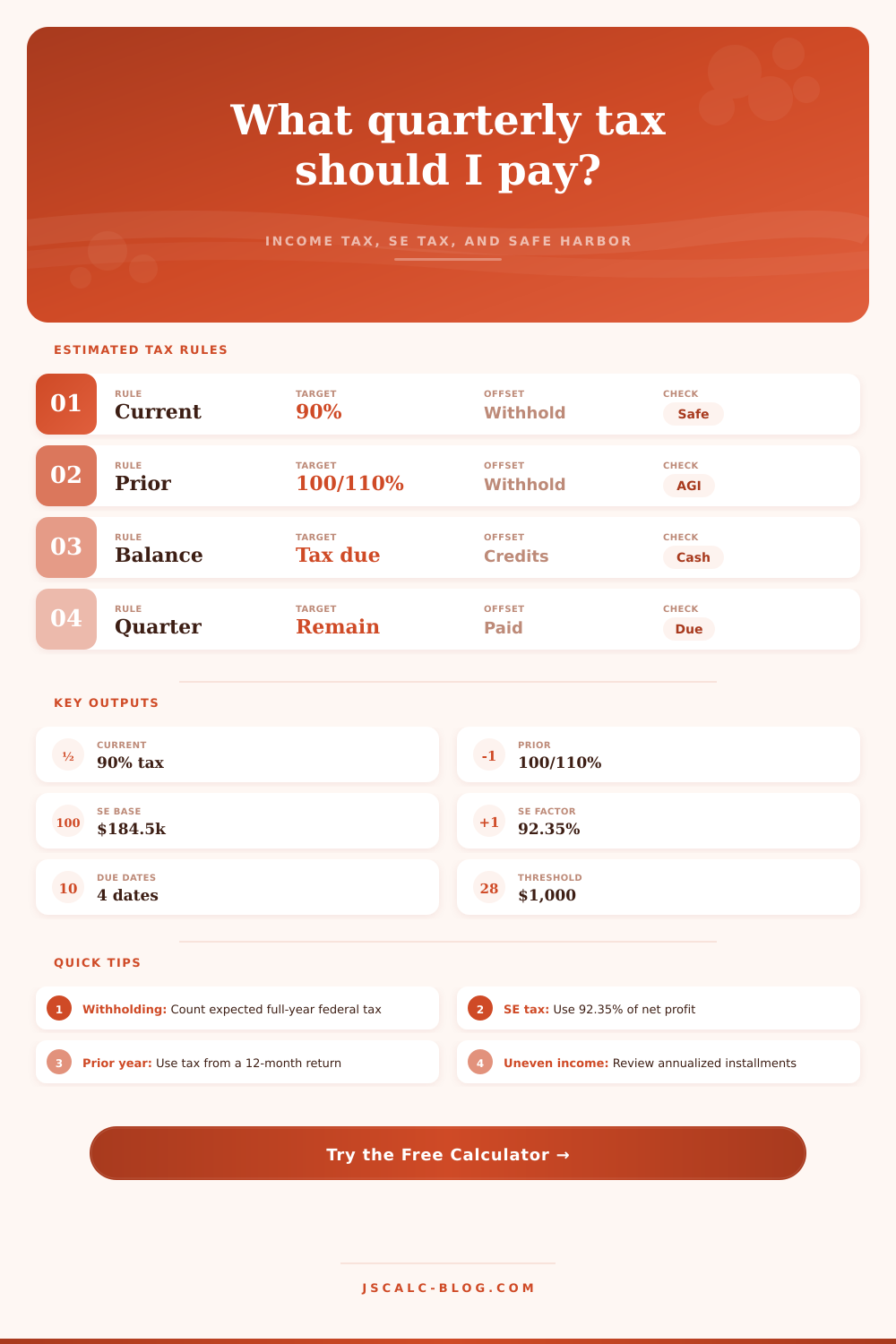
And here’s where things get complicated: You only pay self-employment tax on 92.35 percent of your net profit. This calculator accounts for that adjustment for you. It also calculates whether your wages exceeds the Social Security wage base. If you have a W-2 job in addition to your side gig, your self-employment tax may actualy be lower than anticipated. The calculator will automatically deducts your W-2 wages from the cap so it knows whether you still owe that 12.4 percent Social Security piece. It is a small detail, but it can save you some serious money.
And then, of course, there is the safe harbor rule. It is your penalty shield. If you owe taxes in the current year, you’ll be shielded from penalties if you pay 90 percent of your tax liability now. Or, alternatively, you could pay last year’s full tax bill. If you earns enough, that climbs to 110 percent. The table on the page makes that clear. The calculator runs both those targets and chooses between them. If you’re eligible to use last year’s shelter, it will choose the smaller target. This is typically safer bet. History becomes something known; the future an unknown.
But how about timing? Turns out that’s important, too. If you work a W-2 job, withholding treats that income like it was paid all year long. For estimated payments, there are certain dates for those estimates. If you earned the majority of your income during the second half of the year, you may be overpaying during the first quarter, which sucks up your cash flow.
Enter: this tool. Adjust for irregular income. See what you should pay today to keep your hands clean. Also see what happens if you don’t. Most times, there is a difference between the cost of paying too little and facing penalties versus the cost of paying too much, only to have that money sit in an interest-free IRS account. That difference can amount to hundreds of dollar each quarter.
Another wildcard is credits. Perhaps you’ll recieve an education credit, or child tax credits. Those lower your tax bill. Enter anticipated refundable and non-refundable credits on the calculator to see how that affect your real tax obligation.
Don’t overlook the other side of the equation: Deductions. The standard deduction vary each year. The calculator also includes one of the newest benefits: the Qualified Business Income deduction. This can significantly reduce your taxable income if you’re operating a pass-through entity.
Take a percent of each dollar that comes in and set it aside. Make sure you pay on time. Double-check yourself with the tool, you should of used it earlier. If you’re a little over, great! If you get a penalty notice, oh well. The bottom line is this: Pay what you owe, when you owe it. Go back to work.