Scientific Notation Calculator
Convert any number to and from scientific notation, run addition, subtraction, multiplication, and division on two E-notation values, choose significant figures, and read the full normalization steps and engineering form.
🔬Real Notation Presets
📝Notation Inputs
Accepts plain numbers such as 0.00042 or 93000000.
🔢Notation Snapshot
📏Metric Prefix Reference
| Prefix | Symbol | Power of 10 | Multiplier | Example |
|---|---|---|---|---|
| Giga | G | 10^9 | 1,000,000,000 | 2 GB = 2E9 B |
| Mega | M | 10^6 | 1,000,000 | 5 MW = 5E6 W |
| Kilo | k | 10^3 | 1,000 | 3 km = 3E3 m |
| Base | – | 10^0 | 1 | 1 m = 1E0 m |
| Milli | m | 10^-3 | 0.001 | 7 mm = 7E-3 m |
| Micro | µ | 10^-6 | 0.000001 | 4 µm = 4E-6 m |
| Nano | n | 10^-9 | 0.000000001 | 9 nm = 9E-9 m |
🌌Famous Constants in Scientific Notation
| Constant | Standard Value | Scientific | Units |
|---|---|---|---|
| Speed of light | 299,792,458 | 2.998 × 10^8 | m/s |
| Avogadro number | 602,214,076 e15 | 6.022 × 10^23 | 1/mol |
| Planck constant | 0.000...6626 | 6.626 × 10^-34 | J·s |
| Electron mass | 0.000...9.109 | 9.109 × 10^-31 | kg |
| Elementary charge | 0.000...1.602 | 1.602 × 10^-19 | C |
| Earth mass | 5,972,000... e18 | 5.972 × 10^24 | kg |
| Gravity G | 0.0000000000667 | 6.674 × 10^-11 | N·m²/kg² |
📊Powers of Ten and Decimal Places
| Power | Value | Zeros | Decimal Shift | Named Scale |
|---|---|---|---|---|
| 10^12 | 1,000,000,000,000 | 12 | 12 left | Trillion |
| 10^9 | 1,000,000,000 | 9 | 9 left | Billion |
| 10^6 | 1,000,000 | 6 | 6 left | Million |
| 10^3 | 1,000 | 3 | 3 left | Thousand |
| 10^0 | 1 | 0 | none | One |
| 10^-3 | 0.001 | 3 | 3 right | Thousandth |
| 10^-6 | 0.000001 | 6 | 6 right | Millionth |
| 10^-9 | 0.000000001 | 9 | 9 right | Billionth |
🗂Notation Comparison Grid
| Standard | Mantissa | Exponent | Scientific | E Notation | Engineering |
|---|---|---|---|---|---|
| 93,000,000 | 9.3 | 7 | 9.3 × 10^7 | 9.3E7 | 93 × 10^6 |
| 6,022 e20 | 6.022 | 23 | 6.022 × 10^23 | 6.022E23 | 602.2 × 10^21 |
| 1,500 | 1.5 | 3 | 1.5 × 10^3 | 1.5E3 | 1.5 × 10^3 |
| 0.0042 | 4.2 | -3 | 4.2 × 10^-3 | 4.2E-3 | 4.2 × 10^-3 |
| 0.00000016 | 1.6 | -7 | 1.6 × 10^-7 | 1.6E-7 | 160 × 10^-9 |
| 250,000 | 2.5 | 5 | 2.5 × 10^5 | 2.5E5 | 250 × 10^3 |
⚙Full Formula Breakdown
📋Decimal Place to Exponent Guide
| Move Decimal | Direction | Exponent Sign | Example In | Example Out |
|---|---|---|---|---|
| 5 places | Left (big number) | Positive +5 | 350,000 | 3.5E5 |
| 3 places | Left (big number) | Positive +3 | 4,200 | 4.2E3 |
| 0 places | Already 1 to 10 | Zero 0 | 7.5 | 7.5E0 |
| 2 places | Right (small number) | Negative -2 | 0.089 | 8.9E-2 |
| 4 places | Right (small number) | Negative -4 | 0.00061 | 6.1E-4 |
| 7 places | Right (small number) | Negative -7 | 0.00000023 | 2.3E-7 |
💡Practical Notation Tips
Sometimes you run across numbers where writing them out is awkwardly huge or tiny. How about speed of light which is approximately three hundred million meters per second? That’s a lot of zeros to type.
Enter scientific notation which breaks up numbers into easy size chunks. It divides a number into two parts: one containing the significant digits and another for keeping track of how big the number is in terms of powers of ten. This help keep calculations clean and also helps avoid accidentally losing a zero somewhere along the line.
What Is Scientific Notation?
This page include a tool to perform calculations in scientific notation as well as convert to and from standard decimal form.
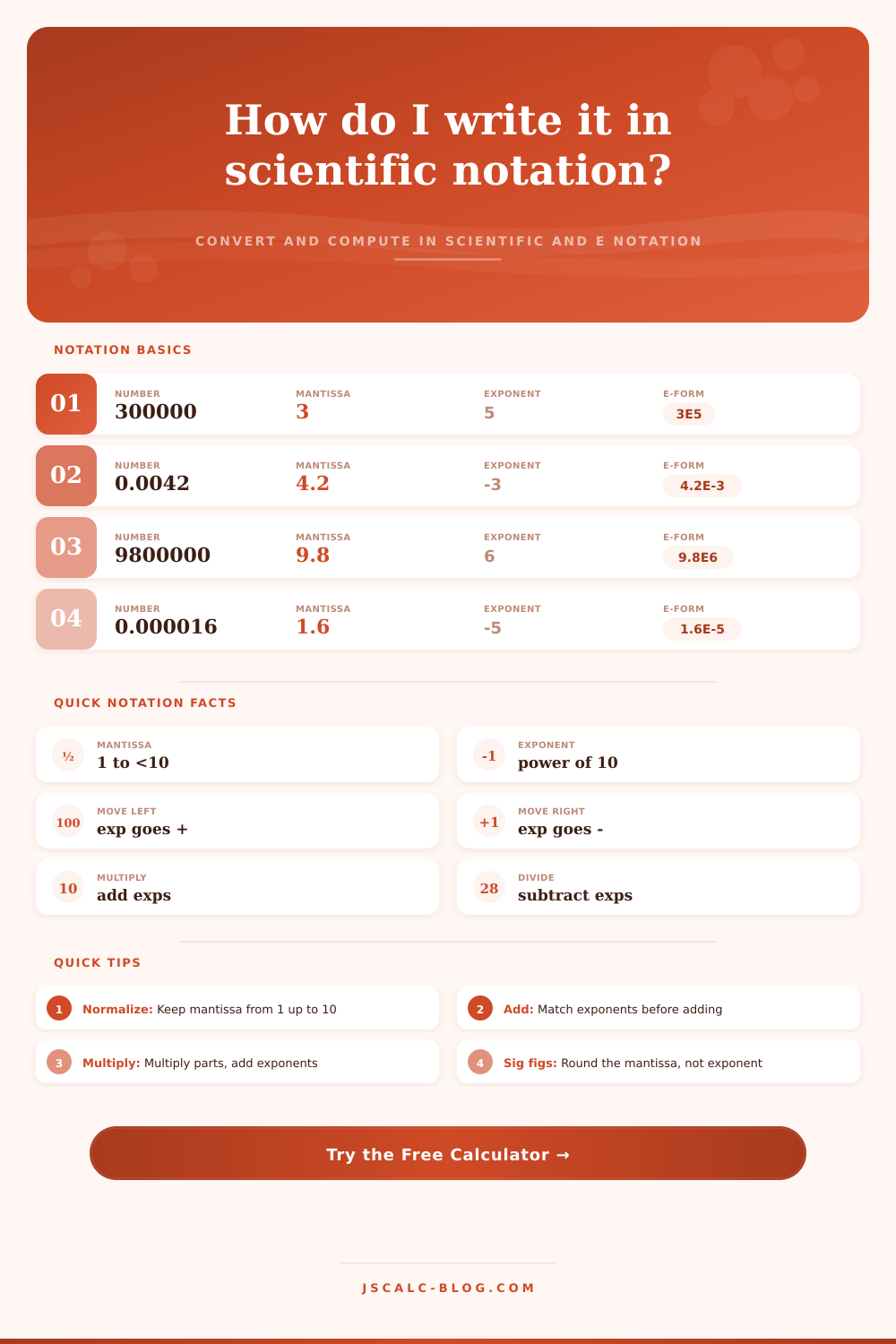
A couple things are important about way that scientists write numbers in scientific notation. First, they use what is called an exponent and what is called mantissa. The mantissa has to be between 1 and 10 so that it will always have just one number before the decimal place (i.e., not zero). That means we always know how to compare numbers because they’re all standardized.
If I wrote ‘5’ as ‘five times ten squared’, then ‘50’ would also became ‘fifty times ten’. Who knows if I mean ‘fifty times ten or five times ten squared’?
The other thing the exponent does is tell us how far to move the decimal point. For large numbers, the decimal moves to the right (a positive exponent); for small numbers like fractions, it moves to the left (a negative exponent). Get this balance and you’ll read science right.
Arithmetic is subject to different rules based off what operation you’re doing. For example, multiplication and division are simple: just handle the exponent and the mantissa separately, multiplying or dividing each as needed. Next, add or subtract the powers of ten, and multiply or divide main digits to match those operations.
Subtraction and addition need a little more consideration. When you have two numbers expressed in scientific notation, you don’t just add their exponents. You must line up the numbers so they are both expressed as multiples of the same power of ten then combine their decimal parts. That way you is actualy adding things of the same scale, not a mixture of scales. The calculator handles this lining up automatically, which help avoid a very common mistake of having mismatching powers.
How you show your results matters. And this is where big numbers come into it. How you present your result makes a big difference. Accuracy is important but so is precision. Too few decimal places might hide the fact that your calculations was inaccurate; too many might imply more certainty then you have.
You get to decide how many significant figures your final answer will contain. This is useful when trying to make sure your answers match your input data (or measurement tools). If you can only measure something to one millimetre, then reporting your answer to the nearest nanometre isn’t realistic. By selecting the appropriate number of sig figs you are respecting your original data while still producing a readable answer. It encourages you to consider nature of your measurements rather than simply crunching arbitrary numbers.
Many professionals use a variation available in engineering notation. Here they limits their exponent values to only multiples of three instead of any power of ten. They do this because engineering uses the metric prefix system (kilo, mega, giga), which aligns with these exponents. For people used to working with the specs of hardware products, seeing something written out in terms of thousands or millions is more intuitive. On a schematic, a two-thousand-ohm resistor looks nicer if we write it as two kilo-ohms.
By doing so, the program demonstrate how notation can be useful not just for math but also as a way to communicate across certain fields.
Forgetting to normalize after an operation or not paying attention when counting decimal places will lead you to make common mistakes. Your number may pass the one-to-ten rule test for the mantissa but still be incorrect when looking at the numerical value of the result. Make sure you look at the exponent and see if it correspond with the amount you would of needed to shift it back into standard form. Always make sure you have the right precision and scale in your final answer.
This is a little sanity check, but it helps catch mistakes before those mistakes are passed into bigger calculations. The reference tables also shows how powers of ten match everyday units. This can serve as a quick sanity check for your answers.
This is the science behind it. Respect the scale, this is the heart of mastering scientific notation. Whether we’re talking about galactic distances or mass of atoms, it’s no different. You take something complicated and condense it to a simple form that shows you the nitty gritty. The exponent provides the backdrop, the digits provide the details. These tools free you from having to count zeros and allow your mind to engage in understanding the relationship between numbers. This is why magnitude is overwhelming but becomes manageable data points. That’s where the notation becomes powerful.