Exponent Calculator
Evaluate any power b^n, work with negative and fractional exponents, take nth roots, solve for an unknown exponent with logarithms, read the result in scientific notation, and see every law of exponents applied with numbers and steps.
🎯Worked Exponent Presets
📝Power Inputs
Evaluate raises base to exponent. Solve finds n from base and target. Root finds the n-th root of the base.
The number being raised to a power. May be negative or a decimal.
Whole, negative, or decimal such as 0.5 for a square root.
Top of the fraction: the power part of b^(p/q).
Bottom of the fraction: the root part, so q of 3 is a cube root.
Used only in solve mode: find n so that base^n equals this.
Used only in root mode: 2 is a square root, 3 a cube root.
🔢Exponent Anatomy
📏Laws of Exponents Reference
| Law | Rule | Example | Result |
|---|---|---|---|
| Product rule | b^m * b^n = b^(m+n) | 2^3 * 2^4 = 2^7 | 128 |
| Quotient rule | b^m / b^n = b^(m-n) | 2^6 / 2^2 = 2^4 | 16 |
| Power of a power | (b^m)^n = b^(m*n) | (2^3)^2 = 2^6 | 64 |
| Zero exponent | b^0 = 1 (b not 0) | 7^0 | 1 |
| Negative exponent | b^-n = 1 / b^n | 2^-3 = 1 / 8 | 0.125 |
| Fractional exponent | b^(1/n) = nth root of b | 27^(1/3) | 3 |
| Power of a product | (a*b)^n = a^n * b^n | (2*3)^2 | 36 |
| Power of a quotient | (a/b)^n = a^n / b^n | (6/2)^3 | 27 |
📈Powers of 2 Table
| Exponent | Power | Value | Notes |
|---|---|---|---|
| 0 | 2^0 | 1 | Any base to zero |
| 1 | 2^1 | 2 | The base itself |
| 2 | 2^2 | 4 | Squared |
| 3 | 2^3 | 8 | Cubed |
| 4 | 2^4 | 16 | Nibble range |
| 5 | 2^5 | 32 | |
| 6 | 2^6 | 64 | |
| 7 | 2^7 | 128 | Signed byte range |
| 8 | 2^8 | 256 | One byte |
| 9 | 2^9 | 512 | |
| 10 | 2^10 | 1,024 | One kibi (Ki) |
| 12 | 2^12 | 4,096 | 4 KB page |
| 16 | 2^16 | 65,536 | Two bytes |
| 20 | 2^20 | 1,048,576 | One mebi (Mi) |
🗂Squares and Cubes (1 to 15)
| n | Square n^2 | Cube n^3 | Sqrt of n | Cube root of n |
|---|---|---|---|---|
| 1 | 1 | 1 | 1.0000 | 1.0000 |
| 2 | 4 | 8 | 1.4142 | 1.2599 |
| 3 | 9 | 27 | 1.7321 | 1.4422 |
| 4 | 16 | 64 | 2.0000 | 1.5874 |
| 5 | 25 | 125 | 2.2361 | 1.7100 |
| 6 | 36 | 216 | 2.4495 | 1.8171 |
| 7 | 49 | 343 | 2.6458 | 1.9129 |
| 8 | 64 | 512 | 2.8284 | 2.0000 |
| 9 | 81 | 729 | 3.0000 | 2.0801 |
| 10 | 100 | 1,000 | 3.1623 | 2.1544 |
| 11 | 121 | 1,331 | 3.3166 | 2.2240 |
| 12 | 144 | 1,728 | 3.4641 | 2.2894 |
| 13 | 169 | 2,197 | 3.6056 | 2.3513 |
| 14 | 196 | 2,744 | 3.7417 | 2.4101 |
| 15 | 225 | 3,375 | 3.8730 | 2.4662 |
🌐Powers of 10 and Metric Scale
| Power | Value | Name | Prefix | Symbol |
|---|---|---|---|---|
| 10^-3 | 0.001 | Thousandth | milli | m |
| 10^-2 | 0.01 | Hundredth | centi | c |
| 10^0 | 1 | One | – | – |
| 10^1 | 10 | Ten | deca | da |
| 10^2 | 100 | Hundred | hecto | h |
| 10^3 | 1,000 | Thousand | kilo | k |
| 10^6 | 1,000,000 | Million | mega | M |
| 10^9 | 1,000,000,000 | Billion | giga | G |
| 10^12 | 1,000,000,000,000 | Trillion | tera | T |
⚙Full Formula Breakdown
📋Common Powers Comparison Grid
| Base | ^2 | ^3 | ^4 | ^5 | ^10 |
|---|---|---|---|---|---|
| 2 | 4 | 8 | 16 | 32 | 1,024 |
| 3 | 9 | 27 | 81 | 243 | 59,049 |
| 4 | 16 | 64 | 256 | 1,024 | 1,048,576 |
| 5 | 25 | 125 | 625 | 3,125 | 9,765,625 |
| 6 | 36 | 216 | 1,296 | 7,776 | 60,466,176 |
| 7 | 49 | 343 | 2,401 | 16,807 | 282,475,249 |
| 8 | 64 | 512 | 4,096 | 32,768 | 1,073,741,824 |
| 9 | 81 | 729 | 6,561 | 59,049 | 3,486,784,401 |
| 10 | 100 | 1,000 | 10,000 | 100,000 | 10,000,000,000 |
💡Practical Exponent Tips
Multiplication is expressed quickly through shorthand called exponents. It begins with a base number raised to some power, where the power tells you to multiply the base by itself that many times. Basically, it’s easy enough. This is true except when things get big, small, or even worse, fractional or negative. Let the calculator do those math bits and let you work out what all this means instead of how it works.
To use this calculator, you need to know what both of its inputs mean: the base and exponent. The base is the number that’s getting multiplied; the exponent is how many times that happens. When you square a number, you multiply it by itself once; when you cube it, you perform three multiplications in total. Understanding what those inputs represent also allows you to check whether or not the answer makes sense.
Understanding Exponents and Their Uses
If you double something ten times, you won’t get twenty; you’ll end up with over a thousand. That’s exponential growth, which is why viral marketing works so well and compound interest grows fastly. As chart at top demonstrates, doubling a value ten times results in over a thousand. Twenty doublings gets you past a million. The slope of line gets steeper very fast.
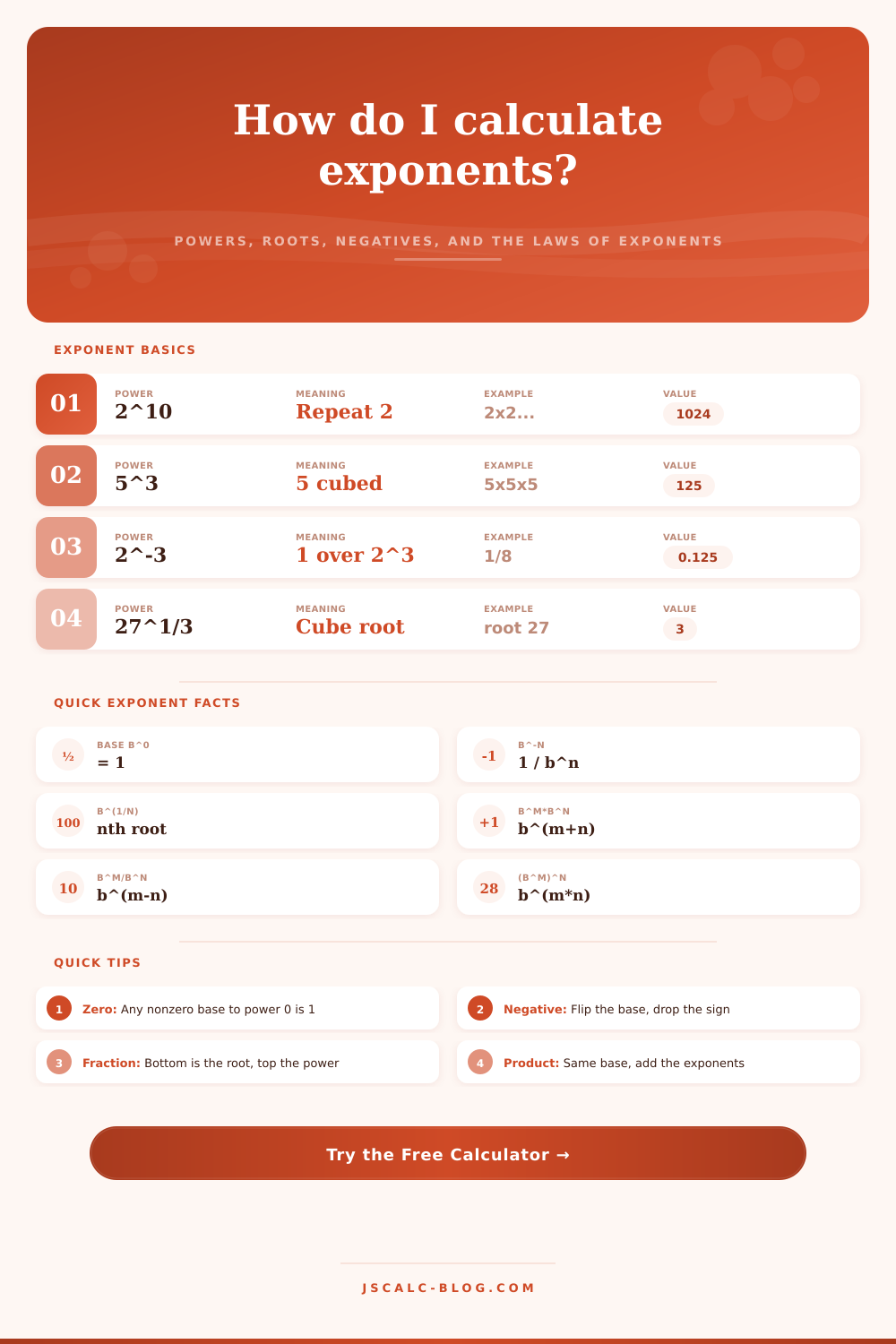
The one that trips people up are negative exponents, where you expect the answer to be negative but most of the time it’s not. A negative exponent just flips the fraction, so you’re dividing by the number (not multiplying). So, for example, $2^{-3} = 1/8$, not -8. The calculator does this flip for you behind the scenes. However, knowing the rule helps you avoid mistakes when the answer turns out to be a decimal less than one.
Fractional exponents have a little more trickiness as well, since they also correspond to roots: if you have an exponent of 1/2, that means a square root; 1/3 corresponds to a cube root, etc. If you type in a fraction for your input, what you’re asking the tool to do is take a root and then raise it to some other power. These are two operations wrapped into one symbol.
Algebra stays clean and organized thanks to the laws of exponents. Multiply exponents to raise a power to another power. Add exponents to raise a base to the same exponent multiple times. Subtract exponents to divide same bases. Until you apply them to variables, they feel like an arbitrary set of rules. To help your memory, this table gives some concrete examples of each law, hopefully enough to remember what goes where. (It’s too easy to mistake the power-of-a-power rule for the product rule.) Memorizing it abstractly often fails, but writing it down typically does the trick after one try.
Logarithms are simply exponents turned backwards, solving for an unknown exponent. When you know the base and the end result but need to find the exponent, you’re doing inverse math. The calculator has that mode as well (using natural logs), handy for finding out how many days it will take your money to double at a specific interest rate, or other financial calculations. Plug in the base rate and desired amount, and the calculator spits out the time factor. You don’t need to memorize the log formula; just remember it is looking for the missing part of the math string.
For instance, if the number is so big or small as to be hard to read, then it shows up in scientific notation. In scientific notation, the number is separated into a mantissa and power of ten. Because it’s used regularly in engineering and science, it makes sense that this would show up on calculators, saving space while also preventing counting mistakes. If you want to look at the magnitude of things without having to wade through a sea of trailing zeros, then this display comes in handy. From astronomical distances to atomic scales, numbers are still manageable.
Failing that, there’s a tendency to mess up the order of operations or read a fraction incorrectly. When faced with something complicated, be sure to double-check whether your exponent goes in the numerator or the denominator. If you turn on the breakdown view, the calculator walks you through its logic and can confirm what you did by hand. You’ll see where it took the root, for example, and where it applied the power. Over time, this kind of transparency builds intuition. You begin to pick up on patterns as the numbers behaves.
In sum, exponents measure the rate of change and scale. They express how something grows or shrinks. Or turns around. With that in mind, the calculator becomes our way to see such change. And when you get comfortablely letting the calculator do the math, then you can turn your attention to what the rate of growth means for your problem or project. If you learn to read the numbers, they will speak to you. Small starts could of lead to great results.