Mixed Fraction Calculator
Add, subtract, multiply, and divide mixed numbers such as 2 1/2 and 1 3/4. See every step: convert to improper fractions, find the least common denominator, apply the operation, simplify by the GCD, and return to a mixed number and decimal.
⅙Real Mixed Number Presets
🔢Enter Two Mixed Numbers
Reads as 2 1/2. Leave whole at 0 for a plain fraction.
Reads as 1 3/4. Denominators cannot be zero.
🧮Working Values
📊Fraction to Decimal Quick Reference
| Fraction | Decimal | Percent | Common Use |
|---|---|---|---|
| 1/2 | 0.5 | 50% | Half cup, half hour |
| 1/3 | 0.3333 | 33.3% | Thirds of a recipe |
| 2/3 | 0.6667 | 66.7% | Two-thirds full |
| 1/4 | 0.25 | 25% | Quarter cup, quarter inch |
| 3/4 | 0.75 | 75% | Three-quarter board |
| 1/8 | 0.125 | 12.5% | Eighth inch on a ruler |
| 3/8 | 0.375 | 37.5% | Drill bit sizing |
| 5/8 | 0.625 | 62.5% | Plywood thickness |
| 1/16 | 0.0625 | 6.25% | Fine ruler marks |
🔄Mixed to Improper Examples
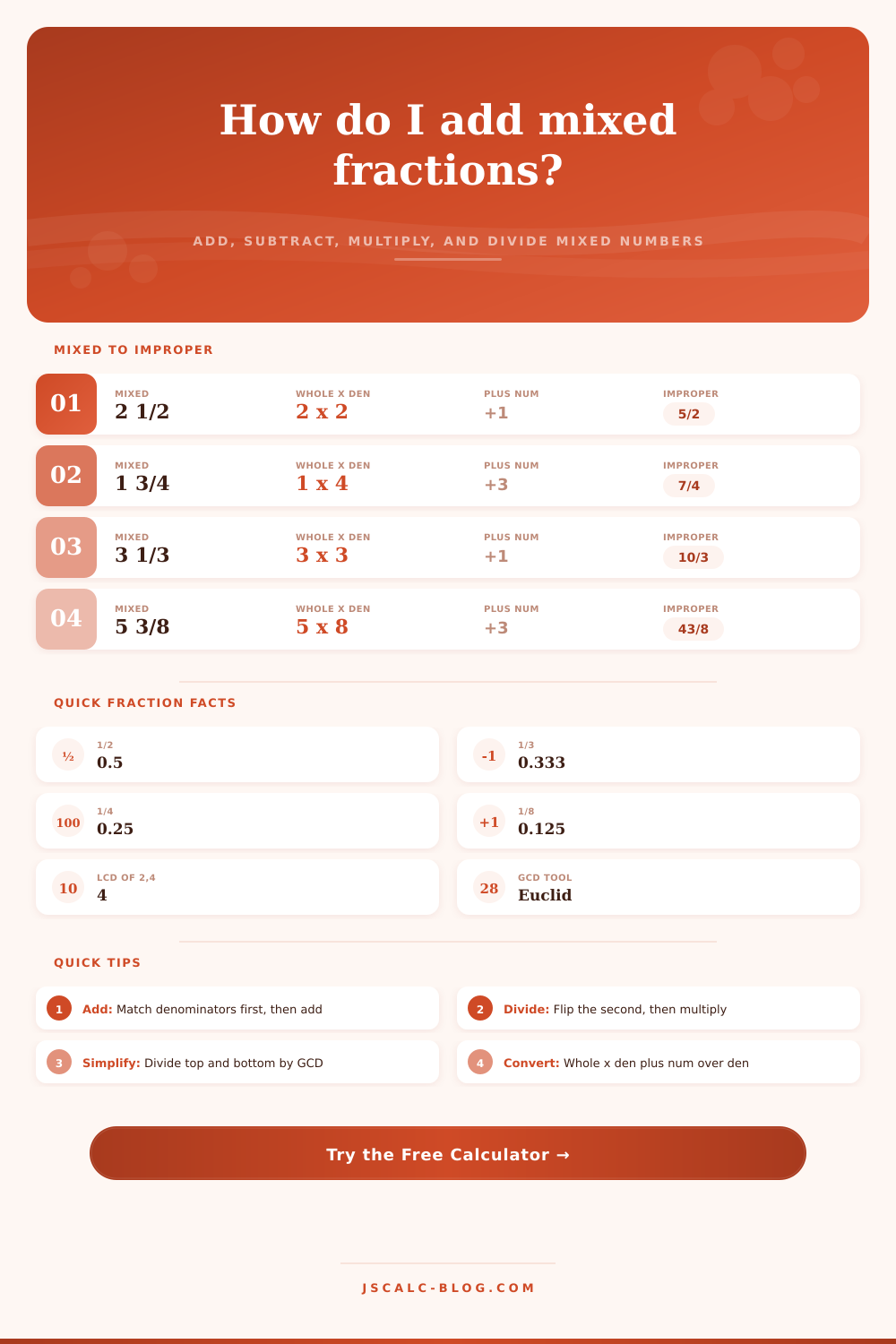
| Mixed Number | Whole × Denominator | Add Numerator | Improper Fraction |
|---|---|---|---|
| 2 1/2 | 2 × 2 = 4 | 4 + 1 = 5 | 5/2 |
| 1 3/4 | 1 × 4 = 4 | 4 + 3 = 7 | 7/4 |
| 3 1/3 | 3 × 3 = 9 | 9 + 1 = 10 | 10/3 |
| 5 3/8 | 5 × 8 = 40 | 40 + 3 = 43 | 43/8 |
| 4 2/5 | 4 × 5 = 20 | 20 + 2 = 22 | 22/5 |
| 7 5/8 | 7 × 8 = 56 | 56 + 5 = 61 | 61/8 |
🍳Common Cooking and Measurement Fractions
| Amount | Fraction of Cup | Tablespoons | Teaspoons |
|---|---|---|---|
| Quarter cup | 1/4 | 4 tbsp | 12 tsp |
| Third cup | 1/3 | 5 1/3 tbsp | 16 tsp |
| Half cup | 1/2 | 8 tbsp | 24 tsp |
| Two-thirds cup | 2/3 | 10 2/3 tbsp | 32 tsp |
| Three-quarter cup | 3/4 | 12 tbsp | 36 tsp |
| Full cup | 1 | 16 tbsp | 48 tsp |
🗂Operation Rules and Comparison Grid
| Operation | Step 1 | Step 2 | Step 3 | Example In | Example Out |
|---|---|---|---|---|---|
| Add (+) | To improper | Match LCD | Add numerators | 2 1/2 + 1 3/4 | 4 1/4 |
| Subtract (–) | To improper | Match LCD | Subtract numerators | 5 3/8 – 2 1/4 | 3 1/8 |
| Multiply (×) | To improper | Multiply tops | Multiply bottoms | 3 1/3 × 1 1/2 | 5 |
| Divide (÷) | To improper | Flip second | Then multiply | 4 2/5 ÷ 1 1/10 | 4 |
| Simplify | Find GCD | Divide both | Rewrite mixed | 10/4 | 2 1/2 |
| Scale whole | To improper | Whole as n/1 | Multiply tops | 1 1/2 × 3 | 4 1/2 |
⚙Full Formula Breakdown
📋Denominator Reference
| Pair | GCD | LCD | Why It Matters |
|---|---|---|---|
| 2 and 4 | 2 | 4 | Halves fit into quarters |
| 3 and 4 | 1 | 12 | No shared factor, product is LCD |
| 4 and 8 | 4 | 8 | Quarters fit into eighths |
| 5 and 10 | 5 | 10 | Fifths fit into tenths |
| 6 and 8 | 2 | 24 | Share a factor of 2 |
| 8 and 16 | 8 | 16 | Common on rulers |
💡Practical Mixed Fraction Tips
At some point in your life, someone’s going to ask for one and three-quarter cups of flour, and all you’ll own are half-cup measures. It’s a tiny little pain-in-the-ass moment, but cooking, carpentry! It applies to any trade. Any trade have many moments when being exact is crucial.
What most folks will do here is pull out their calculator app and get a decimal. That’s great for an estimate. But it sucks as actual measurement. If you’re not yet thinking in cups, how exactly do you go about scooping up 0.75 of a thing? Mixed fractions solve this problem by bridging the gap between the thing and its pieces. They anchor numbers back down to physical world instead of allowing them to drift off into decimals.
Why Mixed Fractions Help in Real Life
Then you type your values into calculator (above) and it does all the work for you. The great thing about that is it doesn’t force you to do all the math in your head, no more manually converting everything to improper fractions! But, it also helps you understand the topic. You still has to convert them, and knowing why you have to do it makes you better at this stuff instead of relying on the calculator.
If I give you an example such as 2 1/2, what am I showing you? It is a fraction with a whole part and a remainder part. To be able to add or subtract these kinds of numbers, you have to line up the bottom numbers. That’s where people makes mistakes. They’ll look at 1/2 + 1/3 and they think: “Well I gotta add ’em.” This is mathematically incorrect, because you’re trying to add two numbers whose slices are different sizes. You have to figure out their lowest common multiple first. It’s like trying to add apples and oranges. So you chop each into eighths… now you can count how many there are altogether.
But multiplication has its own set of rules, which doesn’t require any common denominators at all. Just multiply the top and then multiply the bottom. And the calculator will walk you through it step by step so you see the raw fraction break down into its lowest form, based off the largest number that goes into both. Why does it matter? Because without that step, your fractions are likely to grow into some messy disaster, such as 143/56. No one wants to imagine a fifty-sixth of anything. It’s always about getting back to a nice neat mixed number that you can understand and even use out in the real world.
The part that confuses students (and DIYers) the most is dividing fractions. The rule is to flip the second fraction and multiply, but not everyone understands why. When we’re dividing by a fraction, what we’re asking is “how many of these pieces go into my total?” If we turn the divisor upside down, then we have turned that question into a multiplication one, which is simpler to work with. Whether you’re cutting wood for a custom shelf or doubling a recipe for a large party, the same logic apply.
The page lays that out nicely in a reference table, demonstrating how the standard fractional measurements, such as eighths and quarters, translate back and forth between decimals. This is useful context, as it relates the otherwise abstract math to something concrete like measuring cups and rulers.
Forgetting about the whole number portion when doing math is one thing many people do incorrectly. When multiplying 2 1/2 times 2 for example, some will just ignore the whole number and think that they can simply double the fraction which would be 3/4 but not add in the wholes. That is a big mistake. Before performing any operation with your mixed number you have to think of it as an entire unit. The calculator avoids this issue by automatically converting the input to an improper fraction. It forces the whole numbers into play right away by making them part of the numerator. That removes all ambiguity and also makes it less likely to make slip-ups on basic math operations.
But looks is another factor that makes using mixed numbers better in some situations. For instance, in construction, measurements are almost exclusively spoken as mixed numbers when professionals communicate on the job site. “Two feet, three-quarters of an inch” versus “two point seven-five inches.” The former is easier to imagine at a glance and sounds more human; the latter is robotic-sounding. If you’re a professional and your job involves speaking about measurements (whether in the kitchen or on the construction site), keeping them in mixed form keeps things fast and clear.
Learning how to operate the machine isn’t really about following directions; it is about grasping the principles behind the math. This process has less to do with learning formulas then understanding what the numbers mean. What’s a fraction? It is a part of a whole. How does one mix fractions? With caution, because they have to be matching parts. The principle doesn’t change whether you’re using this for work or schoolwork. You begin by breaking it down into parts, line up those parts in relation to each other, add (or subtract, or multiply, or divide), and then reduce everything back to something manageable. It is the same cycle that turns an odd ratio into useful direction.
If you can solve the equation, you find your missing quarter-cup measuring cup. Now you can get on with doing whatever it was you needed to do without having to guess. You should of checked the math twice. It would of been easier if you knew how to do it manualy. We actualy need better tools.