Overtime Pay Calculator
Split your week into regular, time-and-a-half, and double-time hours, apply FLSA weekly rules or California daily overtime, and see weekly gross, overtime premium, and multi-week period pay with a full breakdown.
🎯Real Overtime Presets
📝Pay & Hours Inputs
Base straight-time wage before any premium.
Used when pay basis is salaried nonexempt.
Holiday or 7th-day hours carved out at 2x.
Used only when California daily OT is on.
Multiplies weekly gross for pay-period totals.
🔢Overtime Formula Snapshot
📊Overtime Multiplier Reference
| Premium Name | Multiplier | Rate on $20 | Extra vs Base | Common Trigger |
|---|---|---|---|---|
| Straight time | 1.0x | $20.00 | $0.00 | Up to 40 hours weekly |
| Reduced premium | 1.25x | $25.00 | $5.00 | Some union step schedules |
| Time and a half | 1.5x | $30.00 | $10.00 | FLSA hours over 40 weekly |
| Double time | 2.0x | $40.00 | $20.00 | CA 12+ per day, holidays |
| Contract premium | 2.5x | $50.00 | $30.00 | Negotiated crunch or call-back |
⚖FLSA vs Daily Overtime Rules
| Rule Set | Overtime Trigger | OT Rate | Double-Time Trigger | Notes |
|---|---|---|---|---|
| Federal FLSA | Over 40 hours in a week | 1.5x | None federally | Daily hours do not count alone |
| California daily | Over 8 in a day or 40 in a week | 1.5x | Over 12 in a day | 7th day: first 8 at 1.5x, rest 2x |
| Alaska / Nevada | Over 8 in a day or 40 in a week | 1.5x | None standard | Daily 8-hour rule applies |
| Colorado | Over 12 in a day or 40 in a week | 1.5x | None standard | Also over 12 consecutive hours |
| Union contract | Set by agreement | 1.5x to 2.5x | Per agreement | Can exceed statutory minimums |
📈Weekly Hours to Gross Pay
| Hours/Week | Regular Hrs | OT Hrs | Regular Pay | OT Pay | Gross at $20 1.5x |
|---|---|---|---|---|---|
| 40 | 40 | 0 | $800.00 | $0.00 | $800.00 |
| 44 | 40 | 4 | $800.00 | $120.00 | $920.00 |
| 48 | 40 | 8 | $800.00 | $240.00 | $1,040.00 |
| 50 | 40 | 10 | $800.00 | $300.00 | $1,100.00 |
| 55 | 40 | 15 | $800.00 | $450.00 | $1,250.00 |
| 60 | 40 | 20 | $800.00 | $600.00 | $1,400.00 |
🗂Premium Pay Comparison Grid
| Scenario | Rate | Hours | Reg Pay | OT Pay | DT Pay | Gross |
|---|---|---|---|---|---|---|
| 45h at 1.5x | $20.00 | 45 | $800.00 | $150.00 | $0.00 | $950.00 |
| 50h at 1.5x | $20.00 | 50 | $800.00 | $300.00 | $0.00 | $1,100.00 |
| $25/h 10h OT | $25.00 | 50 | $1,000.00 | $375.00 | $0.00 | $1,375.00 |
| Holiday 2x 8h | $22.00 | 48 | $880.00 | $0.00 | $352.00 | $1,232.00 |
| Daily OT CA 9h | $24.00 | 45 | $960.00 | $180.00 | $0.00 | $1,140.00 |
| 60h crunch | $30.00 | 60 | $1,200.00 | $900.00 | $0.00 | $2,100.00 |
⚙Full Formula Breakdown
📋Overtime Reference Values
| Item | Common Entry | How It Is Used | Pay Effect |
|---|---|---|---|
| Overtime threshold | 40 hours weekly | Splits regular from OT | Hours above it earn a premium |
| OT multiplier | 1.5x standard | Rate × multiplier for OT | Adds 0.5x premium per OT hour |
| Double-time hours | 0 to 8 hours | Carved out at 2x rate | Highest pay per hour worked |
| Daily OT rule | California 8/12 | Adds OT from long days | Can raise OT above weekly math |
| Weeks in period | 1, 2, or 4 | Multiplies weekly gross | Scales to the full pay period |
💡Practical Overtime Tips
Is it worth taking off work next Monday? Do I have enough time in? It’s a good question we all ask ourselves on a Friday night after a long week of work. We’re exhausted, looking at our time sheet, trying to figure out if we put in enough hours to go ahead and call out sick the following week.
Well that’s all up to categorization. Overtime is widely considered to be any amount of hour over an 8-hour shift. This is a common misconception that leaves workers cash poor each payday. But forty-hour-per-week rule comes from Federal law, and doesn’t require eight hours per day (unless, as in California, your state has stricter hourly requirements).
How to Calculate Your Overtime Pay
And that makes a difference: Work ten hours a day for four days and you’ve put in forty hours. Zero of those hours are overtime by Federal law, since you haven’t exceeded the weekly limit. You’re paid your regular rate for every one of them. Legally speaking, you’ve got straight time (lots of it), sure, but straight time.
That’s what they don’t understand. They think the daily grind entitles them to the premium which isn’t necessarily true. If you know your total hours and your hourly rate, all you have to do is enter it into the calculator. Then it spits out the number for you. If you want to change the scenario, you can change the settings.
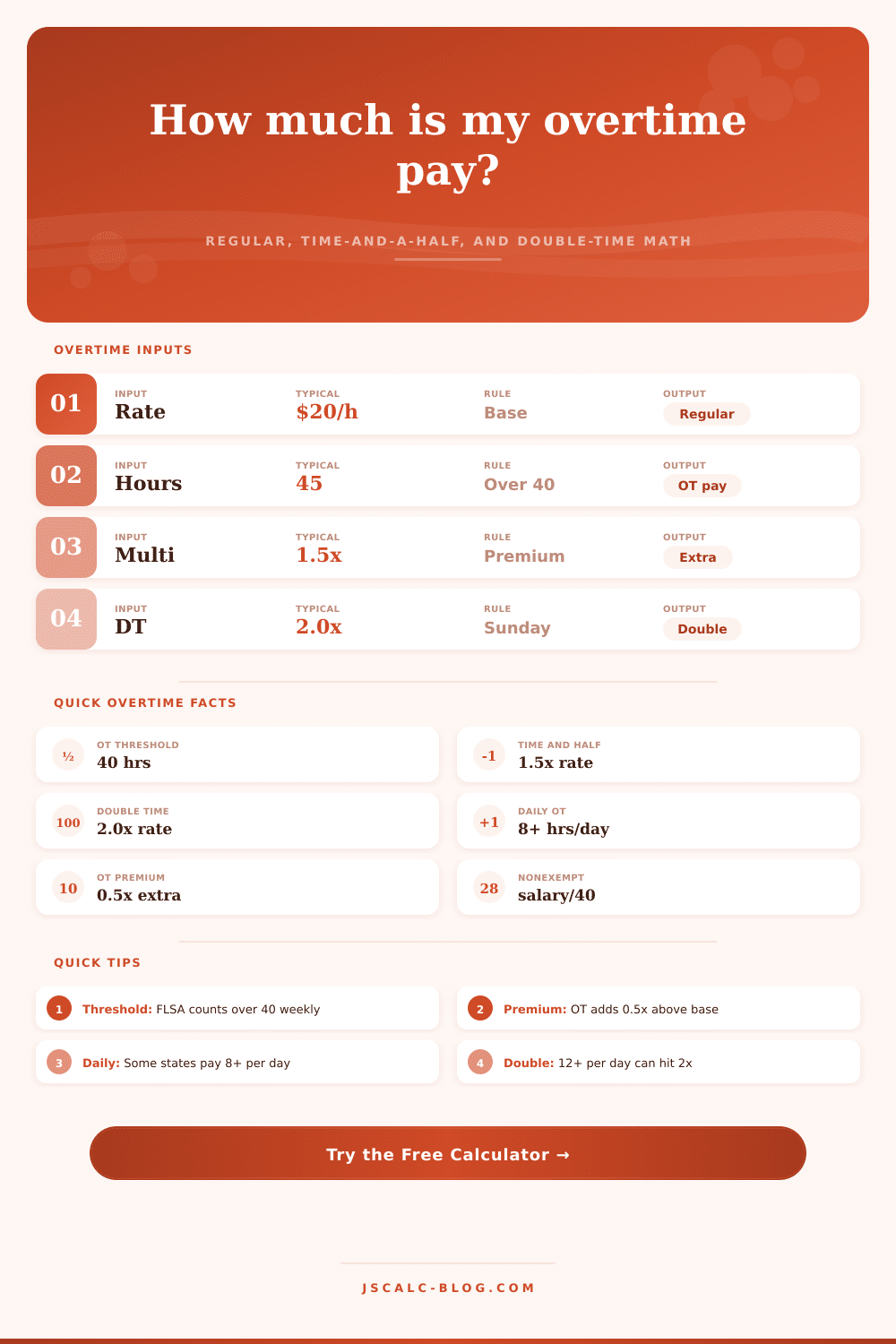
Overtime gets its own setting: the multiplier used when calculating your overtime pay. By default, this is set at 1.5x (which means time and a half). In other words, if you normally get paid $20/hr, then working overtime will result in $30/hr, not $40/hr. That’s because the premium is just ten dollars per hour, above and beyond what you already earn. Knowing this breakdown lets you see where the actual value lies in a long week.
Double Time: Double time is when some jobs pays two times their normal rate. This might happen after 12 hours in a day or perhaps on holidays, depending on state law. With this tool, you can set aside hours specifically as double time. They won’t be counted again. So if you worked eight hours on Christmas, and those hours are double time according to your contract, the tool will update the gross pay total for that appropriately.
Enter them as separate hours so that math takes into account the extra dollar amount. This is especially important when rushing through busy seasons or holidays to make sure you’re budgeting correctly.
What about the rest? How does it work for nonexempt salaried employees? These folks don’t earn direct payment per hour, but they’re still entitled to overtime pay if they exceed forty hours. You can enter your weekly salary instead of an hourly rate into the tool. It will divide your salary by forty to find your regular rate. This ensures your overtime figure reflects your actual hourly rate.
A large number of salaried employees assume they can’t recieve overtime pay because of their title alone. Only if your role meets certain administrative/executive exemptions can this be true. If you’re logging hours, odds are you fit the bill.
In addition to seeing total amount earned by week, you’ll also see a breakdown of what’s paid normally and what’s paid as “premium”. That way you have an idea if it’s realy worth it: should you put up with the fatigue to earn extra money? On paper, it may look like you’re making good money at an average hourly rate, but when you add up all the fatigue, you realize it wasn’t worth it after all.
After several weeks, you can start to see trends emerge in terms of how hard you work and whether this is sustainable long-term. Maybe you discover you’re earning less per hour working 60-hour week just to get a bonus. Maybe you would of been better off trying to negotiate a higher base rate.
For certain locations, the daily overtime makes things even more complicated. For example, California has daily overtime rules: work more than 8 hours on any given day and you’re entitled to time and a half (even if your weekly hours aren’t that high). There’s a toggle for this type of rule so you can model what happens locally. This helps avoid underpaying yourself during weeks where you have some really long days but fewer overall hours.
It is a little detail, but it is important if you’re trying to make a budget based off changing income. Your overtime calculation isn’t just a matter of math, it’s also a matter of valuing your own time and knowing that you’re getting paid properly for it. Knowing the number off-the-top-of-your-head helps you use it when you’re negotiating a raise, or trying to review a paycheck.
Once you understand where the magic line is between 40 hours and overtime, it’s easy. Just be certain that you’re applying the correct set of rules based on your job and location. At the end of the week, you should know exactly how much those extra hours are costing you and how much they’re worth to you.