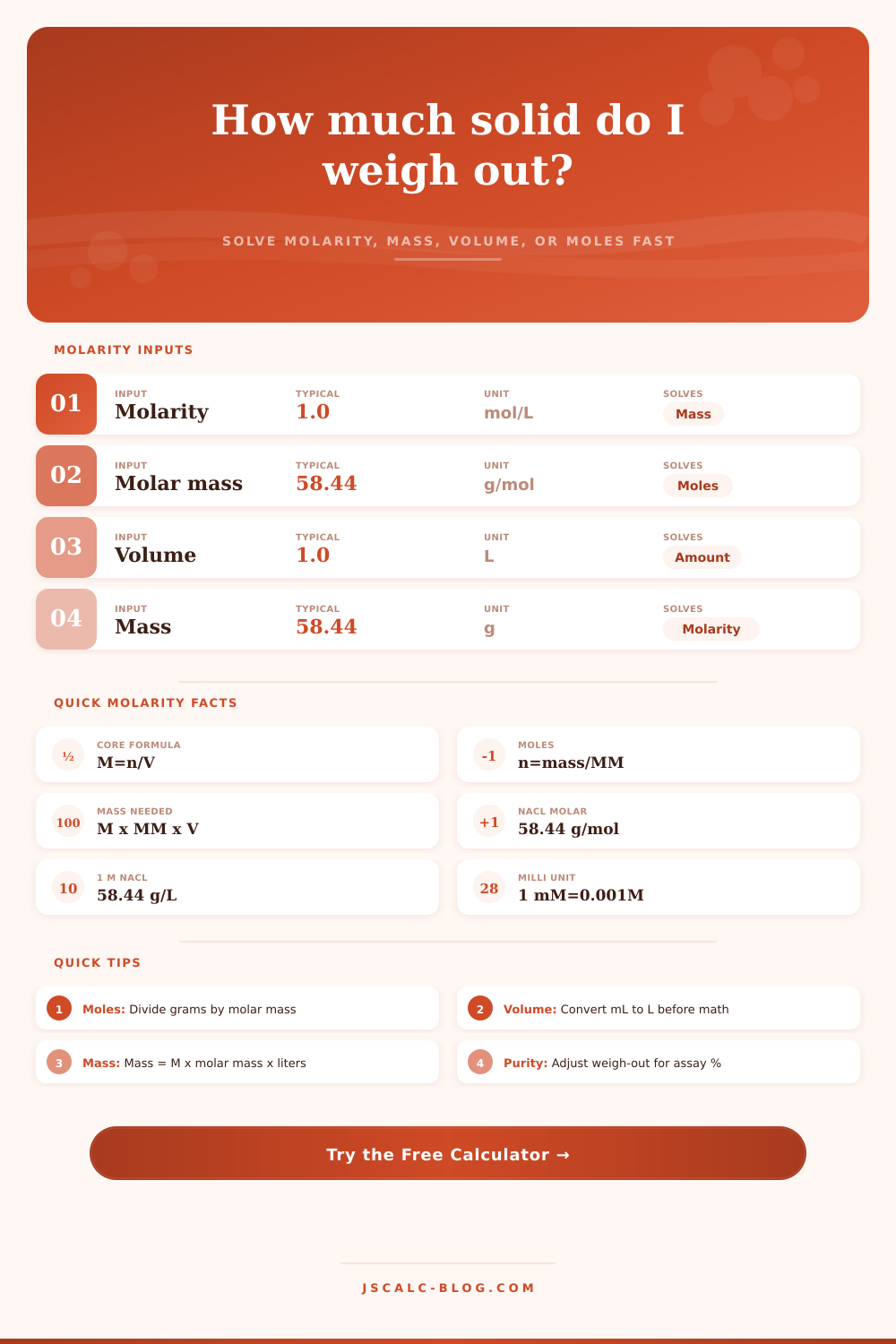
Molarity Calculator
Relate moles, mass, molar mass, volume, and concentration to work out exactly how much solid to weigh out for a target molarity, or solve for any missing value when preparing a solution.
🎯Real Solution Presets
📝Solution Inputs
The unknown field below is hidden and filled by the result.
1 mol/L = 1 M. Use 0.001 for 1 mM.
Sum of atomic weights in the formula unit.
The amount you weigh on the balance.
Total volume after dissolving and diluting.
Weigh-out is scaled up when purity is below 100%.
🔢Formula Snapshot
🧪Common Compound Molar Masses
| Compound | Formula | Molar Mass (g/mol) | Grams for 1 M / L |
|---|---|---|---|
| Sodium chloride | NaCl | 58.44 | 58.44 g |
| Glucose | C6H12O6 | 180.16 | 180.16 g |
| Hydrochloric acid | HCl | 36.46 | 36.46 g |
| Sodium hydroxide | NaOH | 40.00 | 40.00 g |
| Potassium chloride | KCl | 74.55 | 74.55 g |
| Calcium carbonate | CaCO3 | 100.09 | 100.09 g |
| Sulfuric acid | H2SO4 | 98.08 | 98.08 g |
| Ethanol | C2H6O | 46.07 | 46.07 g |
📏Molarity Unit Reference
| Unit | Symbol | In mol/L | Typical Use |
|---|---|---|---|
| Molar | M | 1 | Stock solutions and titrations |
| Millimolar | mM | 0.001 | Buffers, media, drug assays |
| Micromolar | µM | 0.000001 | Enzyme kinetics, receptors |
| Nanomolar | nM | 0.000000001 | Hormones, trace analytes |
| Molal | m | per kg solvent | Colligative properties (not mol/L) |
⚖Grams Per Liter for a 1 M Solution
| Compound | 1 M (g/L) | 0.5 M (g/L) | 0.1 M (g/L) | 10 mM (g/L) |
|---|---|---|---|---|
| NaCl | 58.44 | 29.22 | 5.844 | 0.5844 |
| Glucose | 180.16 | 90.08 | 18.016 | 1.8016 |
| HCl | 36.46 | 18.23 | 3.646 | 0.3646 |
| NaOH | 40.00 | 20.00 | 4.000 | 0.4000 |
| KCl | 74.55 | 37.28 | 7.455 | 0.7455 |
| CaCO3 | 100.09 | 50.05 | 10.009 | 1.0009 |
🗂Concentration Unit Comparison Grid
| Concentration | Meaning | Depends On | Volume Effect | Common Field |
|---|---|---|---|---|
| Molarity (M) | Moles per liter of solution | Moles and volume | Changes with temperature | General chemistry |
| Molality (m) | Moles per kg of solvent | Moles and solvent mass | Temperature independent | Freezing/boiling point |
| Normality (N) | Equivalents per liter | Molarity and n-factor | Changes with temperature | Acid-base titration |
| Mass percent (w/w) | Grams solute per 100 g solution | Both masses | Independent of volume | Industrial reagents |
| Mass/volume (w/v) | Grams solute per 100 mL | Mass and volume | Changes with temperature | Biology and clinical |
| ppm | Milligrams per liter (dilute) | Mass and volume | Slight temperature shift | Environmental testing |
| Mole fraction (x) | Moles part over total moles | All component moles | Independent of volume | Physical chemistry |
⚙Full Formula Breakdown
📋Preparation Reference
| Step | What To Do | Why It Matters | Common Slip |
|---|---|---|---|
| Weigh solid | Mass = M × MM × V | Sets the exact moles | Using mL instead of L |
| Dissolve | Add part of the solvent first | Full dissolution before topping up | Filling to volume too early |
| Bring to volume | Top up to the final mark | Molarity is per total volume | Adding solvent to a fixed amount |
| Mix and check | Invert or stir, verify label | Uniform concentration | Skipping purity correction |
💡Practical Molarity Tips
Standing above your balance, the scoop full of powdered goodness in hand, do you wonder whether or not you’re on the right track? You aren’t alone. It’s easy to get nervous with chemistry; moving from the theoretical world of stoichiometry into one of actual beakers full of liquids makes even most confident chemist cringe at their own fingers.
That’s not because of math. It’s because you has to do a lot of unit conversions before you can finally place flask on the scale.
How to Calculate Molarity
Molarity is straightforward if you ignore all the technical language: it’s a measurement of concentration… Moles of solute/liter of total solution. What’s the deal with “total solution,” though? When it says 1L solution, that doesn’t imply that you dump one liter of water into whatever it is you’re trying to dissolve. Because water takes up space, if you put some salt into a liter of water then you have more than a liter of something. That will affect amount of stuff you actualy end up putting into a liter, throwing off your eventual concentration.
The biggest mistake people make when doing these types of labs for the first time is confusing solvent and solution; always look at how much final concentration should be, as marked on your flask. When using a solid reagent, you make up a solution, and the calculator above do the math for you. It connects concentration, volume, molar mass, and mass together into one workflow. There’s no need to memorize every version of the formula. Just know that your weight in grams divided by the molar mass give you the number of moles you have.
One liter of a one molar solution of sodium chloride would require exactly 58.44 g of salt, which is its molar mass. Half a liter? Halve the mass. Need three liters? Triple it. The math scales easy. This helps you avoid spills on your lab coat and remember your homework.
For example, you can work backwards from a protocol and solve for the variable you are missing. So maybe you’re doing an experiment and you know you need fifty milliliters of a zero point five molar glucose solution, but you don’t remember what that means in terms of grams you see on the balance. No problem. This tool will swap units for you. Milliliters becomes liters. If your reagent isn’t a hundred percent pure then the purity will be adjusted appropriately. That’s another detail newbies tend to overlook, but it makes a huge difference in using expensive/impure industrial chemicals.
So what does molarity represent? It actualy measures how many particles are in a certain volume rather than how much it weigh. For example, 1kg of lead will have a very different amount of particles and volume compared to 1kg of feathers. But these two weigh exactly the same. So think of molarity as measuring the number of particles, or moles. We need to know the molar mass because it connects the microscopic world of solution molecules to the big world of balances that only show us grams. No molar mass, no bridge, just a pile of crap (well, you get the idea).
Other measures of concentration exist, too. For example, one is mass percent, which is common in industrial applications where it’s simpler to weigh something out than measure its volume. Another is molality, which doesn’t depend on temperature since it uses kilograms of solvent rather than liters of solution. But for most things, general chemistry, especially, and biology in particular, molarity wins due to the relationship between reaction rate and the crowding of molecules within some volume.
This reference table that comes along with the tool demonstrates how each unit serve a specific purpose while allowing you to avoid learning them all at once by heart.
Lab isn’t about perfection; it’s about precision. That means knowing what you’re capable of doing, knowing when you can use a volumetric flask versus a graduated cylinder. You should of know that the ideal answer is only as good as your ability to perform the technique. Use clean glassware, weigh carefully, and make sure to bring the solution up to the final volume line instead of simply adding a specific amount of water. Doing this ritual makes all the difference between a successful experiment and a dud.