Satellite Signal Delay Calculator
Calculate one-way and round-trip propagation delay from satellite altitude, slant range, elevation angle, or a direct path distance.
Orbit Presets
Signal Path
Delay Results
Calculation Breakdown
Current Orbit Comparisons
| Case | Altitude | Elevation | Slant range | One-way | Round-trip |
|---|
Elevation Sweep
For the selected altitude, the same satellite has longer path distance near the horizon and shorter path distance overhead.
| Elevation | Slant range | One-way delay | Round-trip delay | Distance vs overhead |
|---|
Delay Reference
Play an online game on a satellite link: you get instant lag. Pressing the key makes your character jump but only a fraction of a second later. By then, the enemy has already shifted position. The bullet reaches you once he’s ducked again.
The delay isn’t a technical bug: it’s just the time it takes for radio wave to hop from your computer to satellites which are hundreds or thousands of kilometers away. Knowing about this delay will make you more understanding of your users frustration, and will lead you towards designing systems that work.
Why Distance Causes Lag in Space
After that, it’s just a matter of plugging in your orbital parameters and letting the calculator do its thing. How will you do that? Where are you planning to put your satellites? Will they be a low Earth Orbit (LEO), such as Starlink‘s planned constellation? Or maybe a geostationary (GEO) satellite located far beyond the Moon?
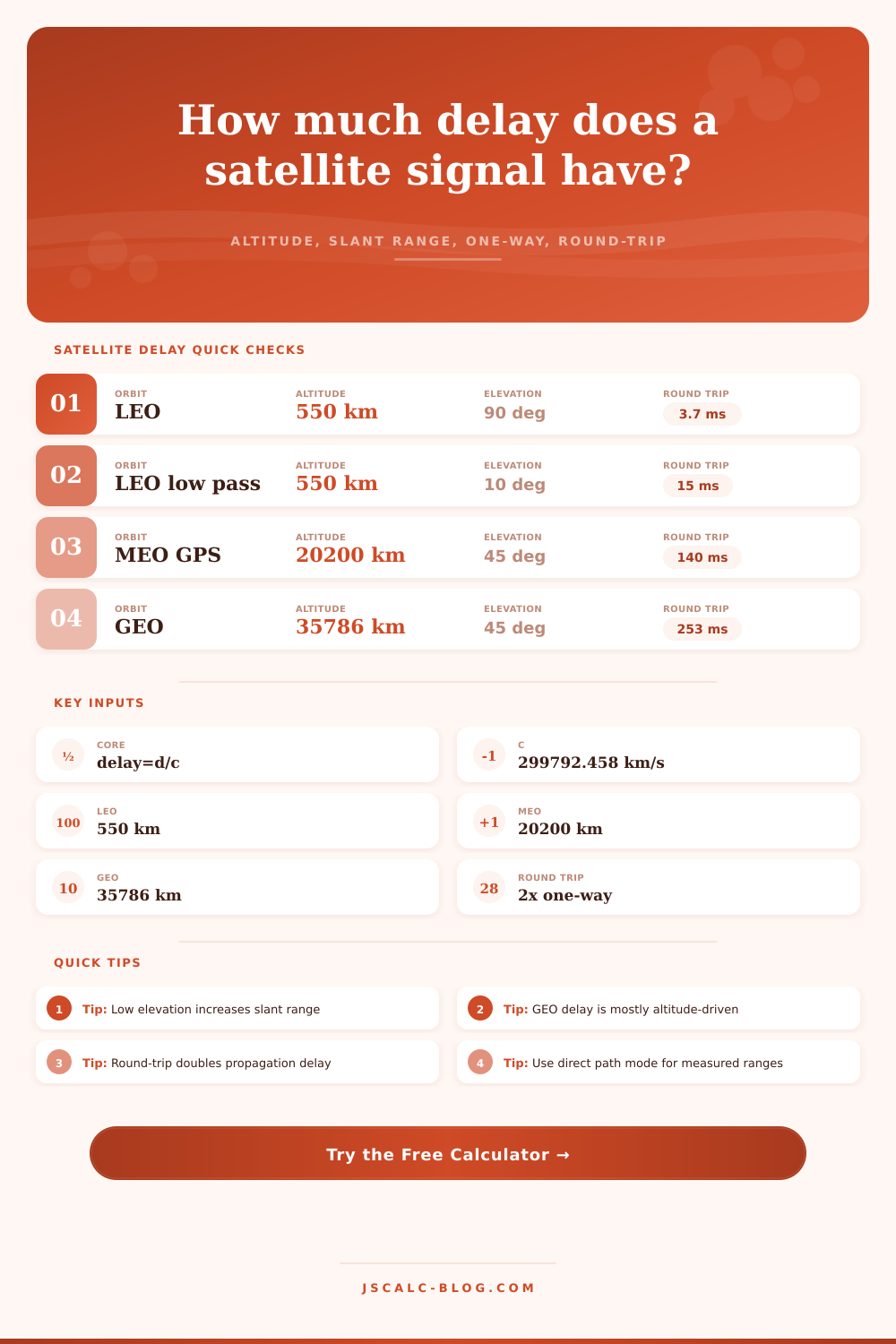
Altitude is key. For example, a LEO satellite might sit at 550 kilometers up. At that altitude, the signal delay is barely perceptible during a phone call. GEO satellites hovers around 35,786 kilometers above us. There, the signal has traveled much further. And that makes all the difference: It takes a quarter of a second to travel that distance back and forth. This is enough to kill any real-time interaction.
The other thing is most folks think it’s all about altitude. That’s not correct. Altitude is part of it, yes, but elevation angle also plays a role. If a satellite is right over my head, I am sending the signal a short way up and down. But when it is sitting low on the horizon, then I’m sending it out along a longer slant range. So the distance varies based off the geometry.
Move that angle around and you’ll see: As the satellite sinks lower so does the delay. It is a small factor, but it affects system reliability. If you can only point your antenna at satellites with low elevation angles, you’re going to pay a latency tax.
And what’s the path like? Are we talking about a one-way broadcast? Or are we talking about a round trip from the ground to a satellite and back? Those is different numbers.
And how many legs does the calculator tell us that there are? If this is a simple downlink, then there is one leg. If it’s a command-and-control loop, then there are two legs. If it’s some sort of complicated relay system, there may be even more. Every time you add a hop, you add distance. You add delay.
There’s no cheating on the speed of light. It stays constant in a vacuum. It travels at nearly 300,000 kilometers per second. No matter what you do, nothing makes the wave travel any faster. All you can do is make path shorter.
Why does that matter? For some applications it matters enough that orbital choice is critical. For example, GPS satellites fly in Medium Earth Orbit (MEO) ~20,200 kilometers above the earth. That’s far out enough that their signal have a large delay. But that works well for navigation. You’re not trying to talk back. You’re just listening.
But if you try talking via GEO for video conferencing, the echo is apparent. The person you are talking to pauses then you hear your own voice return a few hundred milliseconds later. It is disorienting.
How delay depends on altitude is shown in the reference table on the page. Don’t forget about the propagation medium. There’s no such thing as a vacuum in space, but there are the troposphere and ionosphere that signal typically passes through. Depending on the amount of solar activity and weather, these layers will slow the wave down a bit. If you’re being conservative, you can adjust for this. It is better to overestimate the delay than be surprised.
In real world systems, there’s also packet loss and jitter to contend with. The propagation delay is only the baseline. Everything else add to it.
Consider the delay like a budget. Consider how much time you get, because at some point the signal is no longer useful. For gaming it’s under 50 milliseconds. For voice it’s under 150 milliseconds. For scientific telemetry it’s seconds. Choose your hardware based on knowing your limit.
That’s where the calculator comes in. It helps you understand whether your desired orbit fits within that budget. It removes the confusion and reveals the underlying physics.
At the end of the day, it’s about distance. Best antenna? Is it the most powerful transmitter? Is it the cleanest spectrum? Sure. But if your satellite is too distant then the signal simply gets there later. That’s just how things work in space.
Our tiny rock sends our tools flying far off into space. Delay, that’s the cost of admission. Learning about it makes what had been a frustrating lag something you can manage as a design constraint. Stop trying to fight the physics and make friends with it instead. When it jumps, it jumps.