RPM to Gear Ratio Calculator
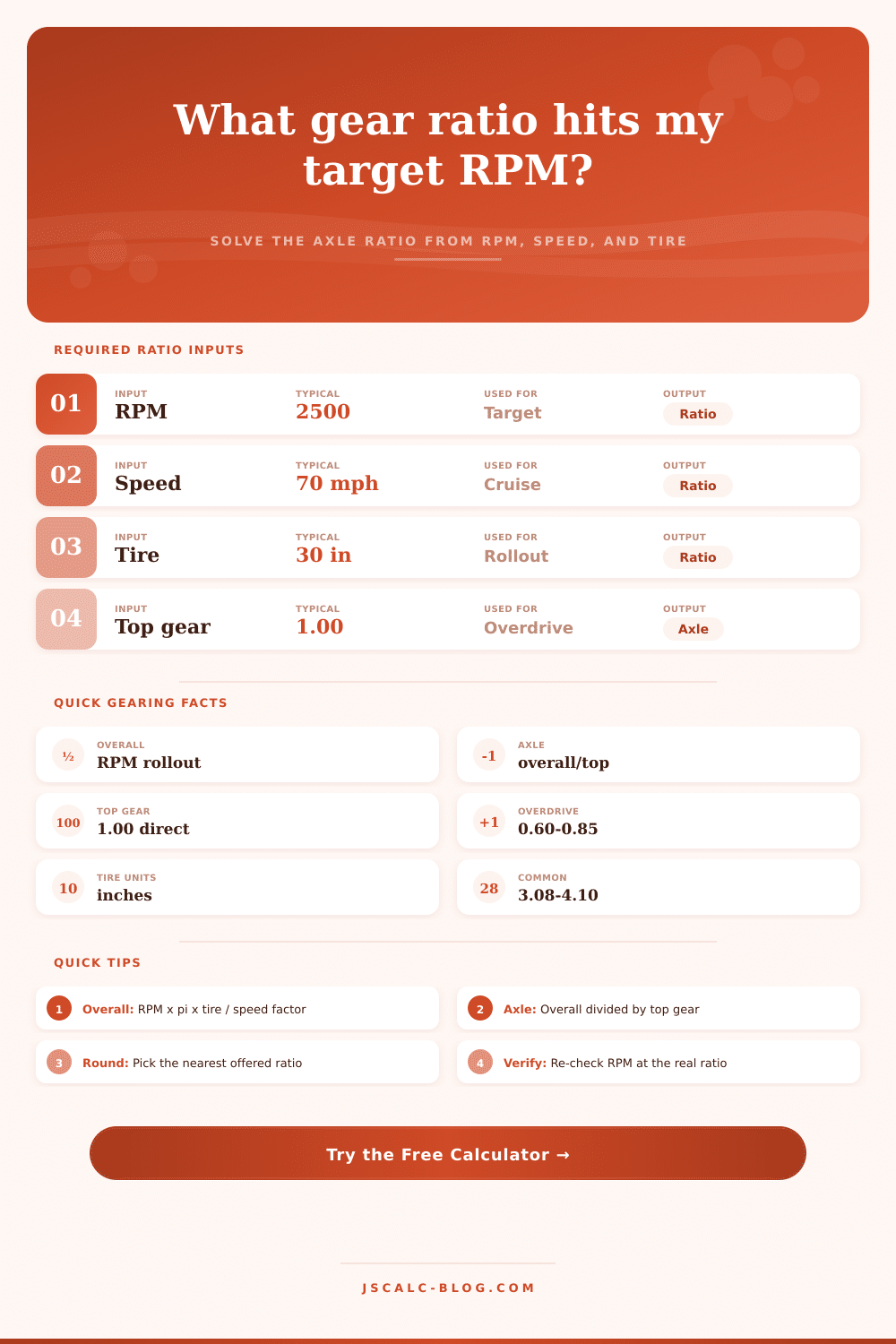
Solve the overall and axle gear ratio you need to hit a target engine RPM at a chosen cruise speed and tire diameter. This is the inverse of a speed-from-RPM calculation, and it also snaps to the nearest common ring-and-pinion ratio.
🎯Target RPM Presets
📝Gearing Inputs
The cruise RPM you want to see on the tach.
Used when method is overall diameter.
1.00 for a direct top gear, under 1.00 for overdrive.
🔢Formula Snapshot
🗂Common Axle Ratios
| Ratio | Character | Typical Use | Effect on Cruise RPM |
|---|---|---|---|
| 3.08 | Tall / economy | Highway commuters, small tires | Lowest RPM, weakest launch |
| 3.23 | Mild economy | Daily drivers, sedans | Low cruise RPM |
| 3.42 | Balanced | Stock trucks and SUVs | Moderate RPM |
| 3.55 | Balanced sport | Muscle cars, light towing | Slightly higher RPM |
| 3.73 | Sporty / tow | Performance, mid tires | Higher RPM, stronger pull |
| 3.90 | Aggressive | Track, larger tires | High RPM cruise |
| 4.10 | Very aggressive | Big tires, off-road, drag | Highest RPM, quickest launch |
📊Required Ratio by Target RPM
Overall ratio needed at a fixed 70 mph cruise with a 30 in tire and a 1.00 top gear.
| Target RPM | Overall Ratio | Nearest Common | RPM at Common | Feel |
|---|---|---|---|---|
| 1600 | 2.04 | 3.08 | 2416 | Very relaxed |
| 1800 | 2.29 | 3.08 | 2416 | Diesel cruise |
| 2000 | 2.55 | 3.08 | 2416 | Economy |
| 2200 | 2.81 | 3.08 | 2416 | Easy highway |
| 2500 | 3.19 | 3.23 | 2533 | Balanced |
| 2800 | 3.57 | 3.55 | 2784 | Sporty |
| 3000 | 3.83 | 3.90 | 3059 | Aggressive |
| 3500 | 4.46 | 4.56 | 3576 | Big tire trail |
| 4000 | 5.10 | 5.13 | 4024 | Track / drag |
🛞Tire Diameter by Size
| Tire Spec | Overall Diameter | Revs / Mile | Common Fitment |
|---|---|---|---|
| 205/55R16 | 24.9 in | 810 | Compact car |
| 225/45R17 | 25.0 in | 807 | Sport sedan |
| 235/75R15 | 28.9 in | 698 | Classic 4x4 |
| 265/70R17 | 31.6 in | 638 | Half-ton truck |
| 285/70R17 | 32.7 in | 617 | Off-road truck |
| 33x12.5R17 | 33.0 in | 611 | Jeep / trail |
| 35x12.5R17 | 35.0 in | 576 | Big-tire build |
| 37x12.5R17 | 37.0 in | 545 | Rock crawler |
🎯Nearest-Ratio Picker
If your exact required axle ratio lands between offered ratios, pick the closest stocked one.
| Exact Required | Below Option | Above Option | Recommended Pick |
|---|---|---|---|
| 3.15 | 3.08 | 3.23 | 3.08 (closest) |
| 3.30 | 3.23 | 3.42 | 3.23 (closest) |
| 3.48 | 3.42 | 3.55 | 3.42 (closest) |
| 3.65 | 3.55 | 3.73 | 3.73 (closest) |
| 3.82 | 3.73 | 3.90 | 3.73 (closest) |
| 4.00 | 3.90 | 4.10 | 4.10 (closest) |
| 4.30 | 4.10 | 4.56 | 4.10 (closest) |
⚙Inverse Gearing Breakdown
📋Reference Values
| Item | Common Entry | How It Is Used | Effect on Required Ratio |
|---|---|---|---|
| Target RPM | 1600 to 4000 | Numerator of the ratio formula | Higher RPM needs a numerically higher ratio |
| Road speed | 55 to 80 mph | Divides the ratio formula | Higher speed lowers the required ratio |
| Tire diameter | 25 to 37 in | Sets the rollout distance | Bigger tire raises the required ratio |
| Top gear | 0.60 to 1.00 | Divides overall into axle | Lower overdrive raises the axle ratio |
| Nearest snap | On or off | Rounds to a stocked ratio | Shifts actual RPM up or down slightly |
💡Practical Gearing Tips
After putting bigger tires on your truck, you discover that it’s sluggish at cruising speeds on the highway. The engine are spinning too quickly, which shows in how much farther they take you with each spin of the wheel. To keep up with speed, the drive train has to turns faster. To most people, the solution is increasing their gear ratio.
But again, there’s no room for guessing here. You want to know exactly where the needle lands before buying any part. The calculator does all the heavy lifting and solve for the exact axle ratio needed in order to reach your target RPM at a specific speed.
How to Find the Right Gear Ratio
Where most projects go wrong is understanding what goes into the equation. You spend all of your time worrying about engine RPM’s and not thinking about diameter of tires. But even a half inch difference in overall rollout changes math significantly. When you’re holding seventy miles per hour, there’s a big difference between a thirty inch tire and a thirty two inch tire.
The tool takes this into account by allowing you to either directly input the diameter or the actual tire code itself. It then calculates circumference to match from the start. It will also take into account your final drive ratio which many people completely forget about. An overdrive fifth gear running at point eight zero mean your final drive ratio needs to work harder to prevent engine from revving too high or bogging down. That’s where the output matters.
There are two key numbers there. One is your overall ratio, which is complete reduction from engine to wheels. The second is your axle ratio, which describes only the reduction within the differential alone. Since you won’t find a single ratio that matches a decimal (like three point one nine), this calculator rounds your answer down to the next most common stocked ratio. That’s awesome because it closes the loop from theory to reality.
Maybe you think you need a three point five zero ratio… But no, they don’t come stock like that. Instead, you’ve got to choose between a three point four two or a three point five five. With tool, you’ll see right away what your RPM would of be with both of these actual-world choices, allowing you to make a smart decision versus jumping blindly.
Choosing that closest ratio is something of an art form. The lower you go, numerically speaking, the more efficient you are on highway (lower RPM), but the less you have when you want to pull away or tow. Higher ratios gives instant punch, but cost you increased RPM while cruising, resulting in increased wear and noise over many thousands of miles. A guy who owns a diesel may prefer a quiet 800 RPM cruise at seventy five miles per hour, even if he has to back off his launch slightly. A track day junkie will gladly trade fuel economy for a 4.10 gear that holds the turbo spooled up and engine in its power band.
In the end, it all comes down to how you use it, not just what the numbers suggest is a perfect fit. For the record, I used ideal rolling conditions for this calculation. Actual-world conditions such as tire pressure, loaded weight, and temperature all has some effect on the effective size of the rubber. But, those effects are small compared too the basic mismatch in gears caused by swapping wheels and forgetting to change final drive ratio. Work backwards from engine rpm you want and you’ll be assured the vehicle will behave as you expect on the road.
The mental spreadsheet is great. But it’s nice to have a specific reference, one that keeps you out of expensive visits back to the shop. Before you turn the wrench on axle housing, you know exactly what the tach will say so you can feel confident.
Balance is everything when it comes to gearing. It is the intangible connection between the nature of the engine and the requirements of the road. Whether it is a tow truck pulling heavy loads up mountains or an everyday driver built for high mileage, dialing in the gear ratios makes all the difference in how your creation drives and connects to road.
Feel those RPM’s lock on a happy pace during highway cruising speed; you know you’ve got some good math going on there. Every rig strives for that blissful blend between power and peace.