Bolt Torque Calculator
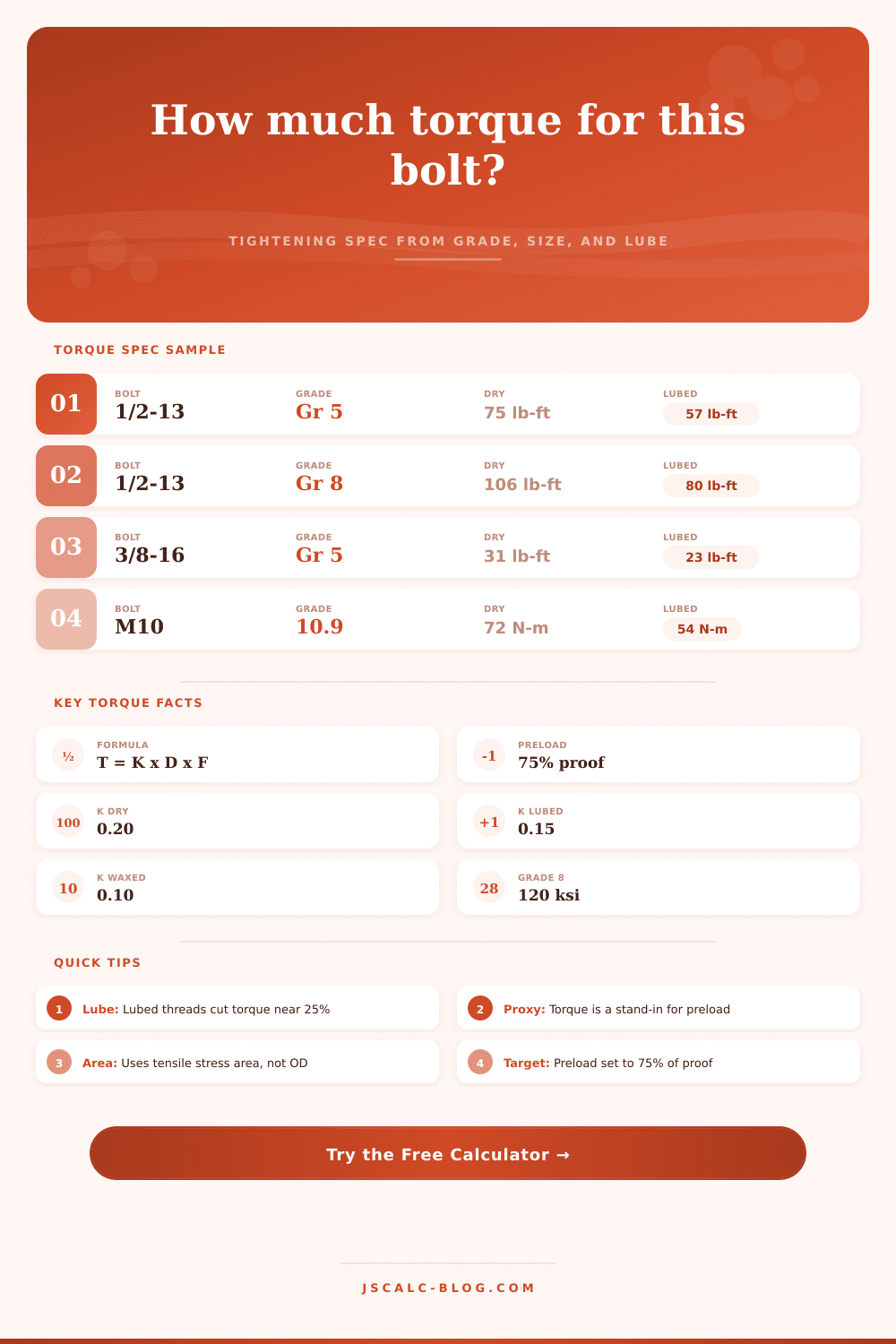
Find the recommended tightening torque for a fastener from its grade, nominal diameter, and lubrication. Torque is set to reach a target preload of 75% of proof load using T = K × D × F.
🔧Common Bolt Presets
📝Fastener Inputs
Used only when lubrication is set to Custom K.
Reusable joints commonly target 75%; permanent joints up to 90%.
Overrides the built-in area when set to Custom.
🔢Torque Equation Snapshot
📊SAE Torque Spec Chart (lb-ft, dry K = 0.20)
| Bolt Size | Stress Area (in²) | Grade 2 | Grade 5 | Grade 8 |
|---|---|---|---|---|
| 1/4-20 | 0.0318 | 5 lb-ft | 8 lb-ft | 12 lb-ft |
| 5/16-18 | 0.0524 | 11 lb-ft | 17 lb-ft | 25 lb-ft |
| 3/8-16 | 0.0775 | 20 lb-ft | 31 lb-ft | 44 lb-ft |
| 7/16-14 | 0.1063 | 32 lb-ft | 49 lb-ft | 70 lb-ft |
| 1/2-13 | 0.1419 | 49 lb-ft | 75 lb-ft | 106 lb-ft |
| 9/16-12 | 0.1820 | 70 lb-ft | 109 lb-ft | 154 lb-ft |
| 5/8-11 | 0.2260 | 97 lb-ft | 150 lb-ft | 212 lb-ft |
| 3/4-10 | 0.3340 | 172 lb-ft | 266 lb-ft | 376 lb-ft |
🌐Metric Torque Spec Chart (N·m, dry K = 0.20)
| Bolt Size | Stress Area (mm²) | Class 8.8 | Class 10.9 | Class 12.9 |
|---|---|---|---|---|
| M6 | 20.1 | 10 N·m | 15 N·m | 18 N·m |
| M8 | 36.6 | 25 N·m | 36 N·m | 43 N·m |
| M10 | 58.0 | 50 N·m | 72 N·m | 84 N·m |
| M12 | 84.3 | 88 N·m | 126 N·m | 147 N·m |
| M14 | 115 | 140 N·m | 200 N·m | 234 N·m |
| M16 | 157 | 219 N·m | 313 N·m | 365 N·m |
| M20 | 245 | 426 N·m | 610 N·m | 713 N·m |
| M24 | 353 | 737 N·m | 1055 N·m | 1233 N·m |
🧴Nut Factor K by Lubrication
| Thread Condition | Typical K | Torque vs Dry | Notes |
|---|---|---|---|
| Dry, plain steel | 0.20 | Baseline | As-received, mill scale |
| Zinc plated | 0.18 | –10% | Common hardware finish |
| Lightly oiled | 0.15 | –25% | Machine oil on threads |
| Moly / anti-seize | 0.12 | –40% | Molybdenum disulfide |
| Waxed / heavy lube | 0.10 | –50% | Wax or PTFE coatings |
📐Proof Strength Reference
| Grade / Class | Proof Strength | Tensile Strength | Common Range |
|---|---|---|---|
| SAE Grade 2 | 55 ksi | 74 ksi | Up to 3/4 in |
| SAE Grade 5 | 85 ksi | 120 ksi | 1/4 to 1 in |
| SAE Grade 8 | 120 ksi | 150 ksi | 1/4 to 1-1/2 in |
| Metric 8.8 | 580 MPa | 800 MPa | M5 to M36 |
| Metric 10.9 | 830 MPa | 1040 MPa | M5 to M36 |
| Metric 12.9 | 970 MPa | 1220 MPa | M5 to M36 |
⚙Full Formula Breakdown
🗂Grade Comparison Grid (1/2-13, dry)
| Bolt Size | Area (in²) | Grade 2 Torque | Grade 5 Torque | Grade 8 Torque | Grade 8 Clamp |
|---|---|---|---|---|---|
| 1/4-20 | 0.0318 | 5 lb-ft | 8 lb-ft | 12 lb-ft | 2862 lb |
| 5/16-18 | 0.0524 | 11 lb-ft | 17 lb-ft | 25 lb-ft | 4716 lb |
| 3/8-16 | 0.0775 | 20 lb-ft | 31 lb-ft | 44 lb-ft | 6975 lb |
| 7/16-14 | 0.1063 | 32 lb-ft | 49 lb-ft | 70 lb-ft | 9567 lb |
| 1/2-13 | 0.1419 | 49 lb-ft | 75 lb-ft | 106 lb-ft | 12771 lb |
| 5/8-11 | 0.2260 | 97 lb-ft | 150 lb-ft | 212 lb-ft | 20340 lb |
| 3/4-10 | 0.3340 | 172 lb-ft | 266 lb-ft | 376 lb-ft | 30060 lb |
💡Practical Torque Tips
For most folks, a bolt is something you turn to make sure it’s tight. For decades, cheap hardware has taught you that a part only fails when it break all the way through.
But on a boat, especially one that use suspension arms, engine heads, or other structural joints, torque has nothing to do with tight. It has everything to do with tension. A bolt’s real task is to be a spring that clamps two things together so they never separate even under load. Too much tension and the bolt stretches beyond its elastic limit and breaks. Too little and the joint shake itself loose. That’s why a torque spec exists. It is not about how hard you tighten it, but about getting the tension righter.
Why Bolt Tension Matters More Than Tightness
To get the right answer, you can drop your bolt diameter and grade into the calculator at the top of this page, along with the condition (lubricated or not) and it’ll do all the math for you. There’s no need to know how to do the math (physics!), but knowing what goes in helps avoid expensive error.
By far the biggest single input is the so-called ‘nut factor’ K, which represent head-friction and thread-friction. Friction consumes approximately nine-tenths of whatever torque you supply; only one-tenth are used for stretching the bolt and creating the desired clamping force. That’s where lube makes such an enormous difference. Now take a dry mill scale covered steel bolt. Its friction coefficient is pretty high. It is probably somewhere around.2. That means you has to push harder to gain the same amount of turn. When you add an oil or anti-seize compound, the coefficient go way down. It might go to.15 or below. What happens then? Well, strangely, your threads slip easier so there’s more stretch with less turn.
If you try to run an oiled bolt through a dry spec, you’ll turn that sucker well beyond the tension it was meant to be at and will either rip the shank off or break the thread clean out. Once you set the finish, the tool automatically adjust the numbers and saves you from having to guess if that drop of grease tightens the connection or loosens it.
Another thing folks commonly get confused about is bolt strength (they just assume more dia = more capacity). Surprisingly, a half inch Grade 2 bolt is significantly weaker than a half inch Grade 8 bolt. The grade refers to how much the steel can be stressed until it will yield (stretch). More grade means you can have higher target preloads. That is to say: your joint will be clamped down hard and stay that way without any permanent change in shape. So why does this matter? If you’re building something in a high-vibration environment, such as with industrial machinery or motorcycles, you want some amount of stretch. You need enough to hold the joint rigid but not so much that you risk metal fatigue and playing Russian roulette.
This is where the reference table on the page come into play. You can see just by looking at it how torque needs to greatly increase for each step up in material strength. And that’s why it’s so risky to change your bolts and not check the spec. That “standard” bolt from the hardware store may have all of the same characteristics, except the inside, which will never be able to stand the same amount of tension. The wrong grade gets one of two results: either an over-tightened connection (and a catastrophic failure) or an under-tightened one (which is looser than it should of been).
For joints you intend to reuse, you typically pre-load them between about 75 percent of their proof load. That gives you some slack to be able to unfasten and still not deform the joint. For more permanent installs, near 90 percent isn’t uncommon, though you need to monitor it closely with more than just a torque wrench.
Friction between a fastener and its surrounding material depends greatly on the surface temperature, humidity, and roughness. Because of this, torque is only an imperfect indicator of how tight something actualy is. Ultrasonically measuring it works better, as does angle tightening (both used in critical aerospace situations), but for mechanical and much automotive work, the best practical answer is sticking with a calculated torque value based off known conditions.
The goal is always consistent clamp force, but the amount of torque you perceive is merely what you’re paying in order to achieve it. With steel’s strength limits factored-in and the friction coefficient of your lubricant taken into account, the joint will maintain its integrity precisly as planned by the engineer. It is about precision tension, not brute strength. That’s the difference between a haphazard guess and a lasting, trustworthy connection.