Rear Gear Ratio Calculator
Pick the best rear axle ratio for your tire diameter, transmission top gear, and driving goal. See highway cruise RPM at your speed, plus the taller ratio a bigger tire needs to hold the same engine speed.
🚗Real Gear Ratio Presets
📝Drivetrain Inputs
Overall (loaded) tire height, not just the wheel size.
Used only when top gear is set to Custom.
Original tire size when the current ratio was chosen.
Used only when target mode is Custom.
🔢Formula Snapshot
📊Cruise RPM by Ratio (Your Tire & Speed)
| Axle Ratio | RPM at 65 mph | RPM at 70 mph | RPM at Your Speed | Character |
|---|---|---|---|---|
| Enter values above to build the cruise RPM comparison. | ||||
🗂Common Axle Ratios & Use
| Axle Ratio | Best For | RPM at 70 (30in) | Feel | Trade-off |
|---|---|---|---|---|
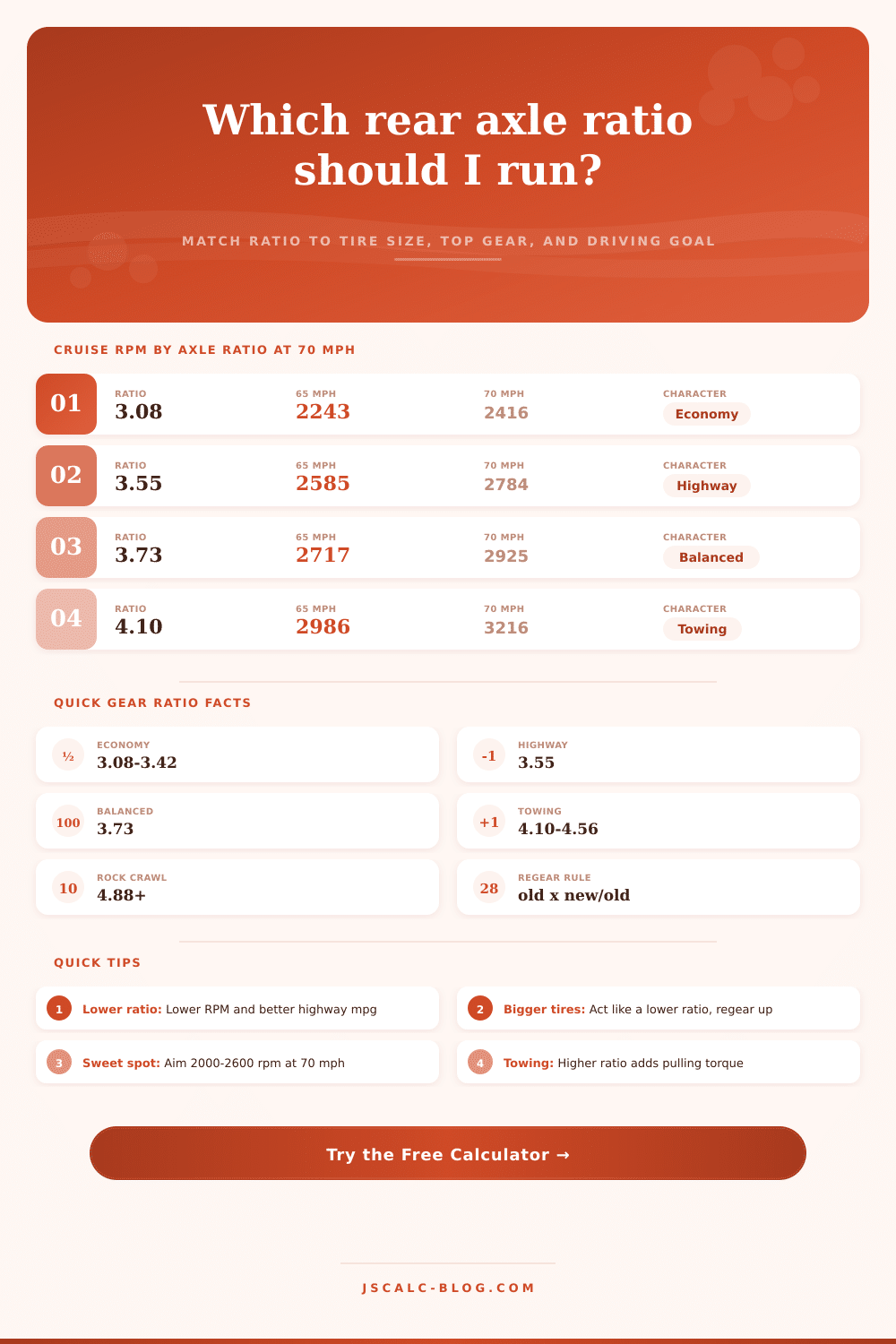
| 3.08 | Freeway commuters | 2416 | Relaxed, quiet | Sluggish off the line |
| 3.42 | Light daily driving | 2682 | Easy cruising | Soft when loaded |
| 3.55 | Balanced highway | 2784 | Smooth, efficient | Mild launch |
| 3.73 | All-around use | 2925 | Versatile | Slightly higher RPM |
| 3.90 | Performance street | 3059 | Snappy launch | More cruise RPM |
| 4.10 | Towing and hauling | 3216 | Strong pull | Lower highway mpg |
| 4.56 | Big tires, off-road | 3576 | Great low speed | Buzzy on highway |
| 4.88 | Rock crawling | 3827 | Massive torque | Poor freeway economy |
🛞Tire Size Regear Guide
| New Tire | From 3.73 @ 31in | From 4.10 @ 33in | Effect on RPM | Typical Fix |
|---|---|---|---|---|
| 31 in | 3.73 (no change) | 3.85 | Baseline | Keep stock gears |
| 33 in | 3.97 | 4.10 (no change) | Drops ~6% | Regear to 4.10 |
| 35 in | 4.21 | 4.35 | Drops ~11% | Regear to 4.10-4.56 |
| 37 in | 4.45 | 4.60 | Drops ~16% | Regear to 4.56-4.88 |
| 40 in | 4.81 | 4.97 | Drops ~23% | Regear to 4.88-5.13 |
🎯Goal to Ratio Recommendation
| Driving Goal | Target RPM at 70 | Ratio Range | Why |
|---|---|---|---|
| Highway economy | 2000 - 2400 | 3.08 - 3.55 | Low RPM saves fuel and noise |
| Balanced daily | 2400 - 2800 | 3.55 - 3.90 | Good launch without buzzing |
| Towing and hauling | 2800 - 3200 | 4.10 - 4.56 | More torque multiplication |
| Off-road and crawl | 3200+ | 4.56 - 5.13 | Control and grunt at low speed |
⚙Full Formula Breakdown
📋Reference Values
| Item | Common Range | How It Is Used | Effect on Cruise RPM |
|---|---|---|---|
| Axle ratio | 3.08 to 4.88 | Multiplies driveshaft turns | Higher number raises RPM |
| Top gear | 0.63 to 1.00 | Overdrive multiplier | Lower overdrive lowers RPM |
| Tire diameter | 28 to 40 in | Sets rev per mile | Taller tire lowers RPM |
| Cruise speed | 60 to 80 mph | Miles per hour | Faster speed raises RPM |
| Effective final | axle × top gear | Combined highway ratio | Sets true cruise RPM |
💡Practical Gear Ratio Tips
Some folks tow with their trucks. Some want more power, some want better gas mileage on a long run. Not everyone understands the math behind rear axle gears. Tire size, transmission gearing and engine RPM comes into play. Most of us guess until it just doesn’t feel right in the truck.
With this calculator, you input what tires you have, your top gear ratio and what kind of driving you do and it does all calculations for you. You’ll know exactly where your cruise RPMs will be at high speed without having to swap gears twice because you forgot how big an impact overdrive realy has.
How to Choose the Right Gear Ratio for Your Truck
In theory, this is an easy concept. As a general rule of thumb, the higher the rear axle ratio, the slower the speed and more greater the increase of torque delivered to your wheels. That 4.10 is going to give you more power, but it requires you to run engine further up the tachometer to get to any set road speed. Conversely, a lower number such as 3.08 will do just the opposite. Low engine revs equals quiet cruising, but when it comes time to climb a hill or merge into traffic, you’re feeling pretty sluggish.
The trick is finding sweet spot between the engine screaming at seventy miles per hour and staying within its power range. Today’s cars targets about two thousand to twenty-five hundred RPM at cruise because it provides good efficiency, yet has some head room if you want to pass other car.
Since changing out your rubber changes your final drive ratio, tire size becomes a big part of this equation. Even if you don’t touch your axle gears, putting on larger tires makes your final gear numerically lower. What does that mean? Your engine will idle quieter, and when you accelerate, it won’t feel like you’re flooring it as hard because the driveshaft moves car farther with every turn of the engine. That’s why off-roaders bumping up to thirty-five inch or larger tires often end up regearing their axles upward so they have some of lost performance back.
Use the tool on this page to enter your old tire diameter and then the new one so you can see exactly what ratio you’ll want to keep your cruise RPMs where they were before. A lot of people buy bigger wheels only to find truck feels like a boat on the interstate.
The other thing that throws folks for a loop is the ratio at which they are actualy going through the gears. They think because they have six speeds or eight speeds that it’s all direct drive up front like in years past. But the reality is most new transmissions is designed to be more fuel efficient and end up with very tall final drive ratios. So instead of going directly from 1:1 up top on a 6 speed or 8 speed, the overdrive may only be running as low as 0.7 or lower. What that translates into is that your driveshaft makes fewer turns for every turn of the engine in top gear. When you’re guessing at your requirements without accounting for this variable, your guesswork is going to be off by a mile. Know your transmission first before you can accuratly assess the impact of the axle ratio on your actual driving experience.
Ultimately the ratio selection comes down to compromise. Unless you’re towing a load up the side of a mountain, or running a very wide-ratio transmission with a locking diff to climb grades, you won’t have max towing capacity along with max highway efficiency. Anchor the choice in something you actually do day-to-day, not what you would of like to someday do on the weekend.
Do you drive two hundred miles to work every week? That is on the lower end: 3.08 or perhaps 3.42. Do you trailer something regularly? You’ll want that torque multiplication from a higher number such as 4.1 to haul butt under load but avoid lugging motor. The chart above breaks all this out so you can grasp the tradeoff and understand how each translates to both character and RPM. Without anchoring it back into how you drive daily, the numbers can be confusing and you will get lost in them.
To begin with, simply fill out the fields with your current tire size (or whatever you plan to run) and the cruising speed you would like to achieve. Choose your transmission style or manually enter any custom overdrive ratios if applicable. Then just select from the options of economy, tow, off-road crawl, etc. Or, adjust the suggested axle ratio down as needed until it meets your needs. To really dial it in, you may want to manually set a target RPM too, depending on how much power you prefer versus engine sound at certain speeds.
After finding a ratio that seems appropriate for what you do, you’ll then be able to see what the nearest common gear sets is for your particular axle model. Ideally, you’ll be near the correct ratio. It is better to aim for something close rather than trying to find a perfect one that isn’t even available from the factory.
Gear ratios aren’t a quest for perfection; they’re a match of mechanical advantages with our lives. It’s a journey where each piece of the puzzle connects with all other pieces. This includes everything from tires to overdrive and axles to engine RPMs. When you get it, and I mean really get it, then you’ll know how they all work together and it will make sense. And that’s when it stops being a guessing game and becomes a comfortabley choice.