Gear Ratio Differential Calculator
Find your axle ratio from ring and pinion tooth counts, then compare an old versus new regear for cruise RPM change, the ratio a bigger tire needs to restore gearing, and the resulting speedometer error.
🎯Real Gear Presets
📝Gear and Regear Inputs
Larger crown wheel on the axle carrier.
Small drive gear on the pinion shaft.
Used when source is set to enter ratio directly.
🔢Formula Snapshot
🔧Common Ring and Pinion Combos
| Ring Teeth | Pinion Teeth | Exact Ratio | Marketed As | Typical Use |
|---|---|---|---|---|
| 39 | 13 | 3.00 | 3.00 | Overdrive highway cruiser |
| 40 | 13 | 3.077 | 3.08 | Fuel-focused daily driver |
| 41 | 12 | 3.417 | 3.42 | Diesel and light towing |
| 39 | 11 | 3.545 | 3.55 | Balanced stock setup |
| 43 | 12 | 3.583 | 3.58 | Highway with mild tires |
| 41 | 11 | 3.727 | 3.73 | Popular all-round regear |
| 41 | 10 | 4.100 | 4.10 | Bigger tire and towing |
| 37 | 9 | 4.111 | 4.11 | Trail and 33in tires |
| 41 | 9 | 4.556 | 4.56 | Heavy tow and 35in tires |
| 39 | 8 | 4.875 | 4.88 | Rock crawl and 37in tires |
📊Regear RPM Effect at 65 mph
| New Ratio | vs 3.55 | RPM Change | 2000 to | Tire Needed vs 30in | Best For |
|---|---|---|---|---|---|
| 3.08 | 0.868x | -13.2% | 1735 rpm | 26.0 in | Highway economy |
| 3.42 | 0.963x | -3.7% | 1927 rpm | 28.9 in | Diesel cruise |
| 3.73 | 1.051x | +5.1% | 2101 rpm | 31.5 in | All-round street |
| 4.10 | 1.155x | +15.5% | 2310 rpm | 34.6 in | 33in tires and tow |
| 4.56 | 1.285x | +28.5% | 2569 rpm | 38.5 in | 35in tires and tow |
| 4.88 | 1.375x | +37.5% | 2749 rpm | 41.2 in | 37in crawl builds |
🛞Tire Size Compensation From 30in
| New Tire | Factor | 3.08 Needs | 3.55 Needs | 4.10 Needs |
|---|---|---|---|---|
| 31 in | 1.033x | 3.18 | 3.67 | 4.24 |
| 32 in | 1.067x | 3.29 | 3.79 | 4.37 |
| 33 in | 1.100x | 3.39 | 3.91 | 4.51 |
| 35 in | 1.167x | 3.59 | 4.14 | 4.78 |
| 37 in | 1.233x | 3.80 | 4.38 | 5.06 |
| 40 in | 1.333x | 4.11 | 4.73 | 5.47 |
⚙Full Formula Breakdown
🗂Ratio Use-Case Comparison
| Ratio | Sample Teeth | RPM at 65 mph | Feel | Tire Pairing | Primary Use |
|---|---|---|---|---|---|
| 3.08 | 40 / 13 | Lowest cruise | Relaxed, tall | 28 to 30 in | Highway economy |
| 3.42 | 41 / 12 | Low cruise | Torquey diesel | 30 to 32 in | Light towing |
| 3.55 | 39 / 11 | Moderate | Stock balance | 29 to 31 in | Daily driver |
| 3.73 | 41 / 11 | Slightly higher | Snappy street | 31 to 33 in | All-round regear |
| 4.10 | 41 / 10 | Higher cruise | Strong launch | 33 to 35 in | Tow and off-road |
| 4.56 | 41 / 9 | High cruise | Heavy pull | 35 to 37 in | Serious towing |
| 4.88 | 39 / 8 | Highest cruise | Low-speed grunt | 37 in plus | Rock crawling |
📋Reference Values
| Input | Common Range | How It Is Used | Effect On Result |
|---|---|---|---|
| Ring teeth | 37 to 43 | Numerator of the ratio | More teeth raises the ratio |
| Pinion teeth | 8 to 13 | Denominator of the ratio | Fewer teeth raises the ratio |
| New ratio | 3.08 to 5.13 | Compared to old ratio | Sets regear RPM change |
| Tire diameter | 28 to 40 in | Effective gearing factor | Bigger tire lowers gearing |
| Cruise RPM | 1600 to 2600 | Scaled by ratio change | Shows new engine speed |
💡Practical Gearing Tips
Next thing you know, you’re pulling out of the trailhead with freshly-treaded tires and your engine is screaming at sixty-five miles per hour. You probably didn’t mean to do it, but you swapped low-speed torque for highway noise.
In the shop, gear ratios is never purely mathematical calculations. They’re a balance between how you want vehicle to behave versus what it’ll realy feel like on the road. That trade-off exist within the differential itself. The differential take the turning force from the engine and turns it into rotating motion at the wheels through a powerful and simple mechanical relationship.
How Gear Ratios Work
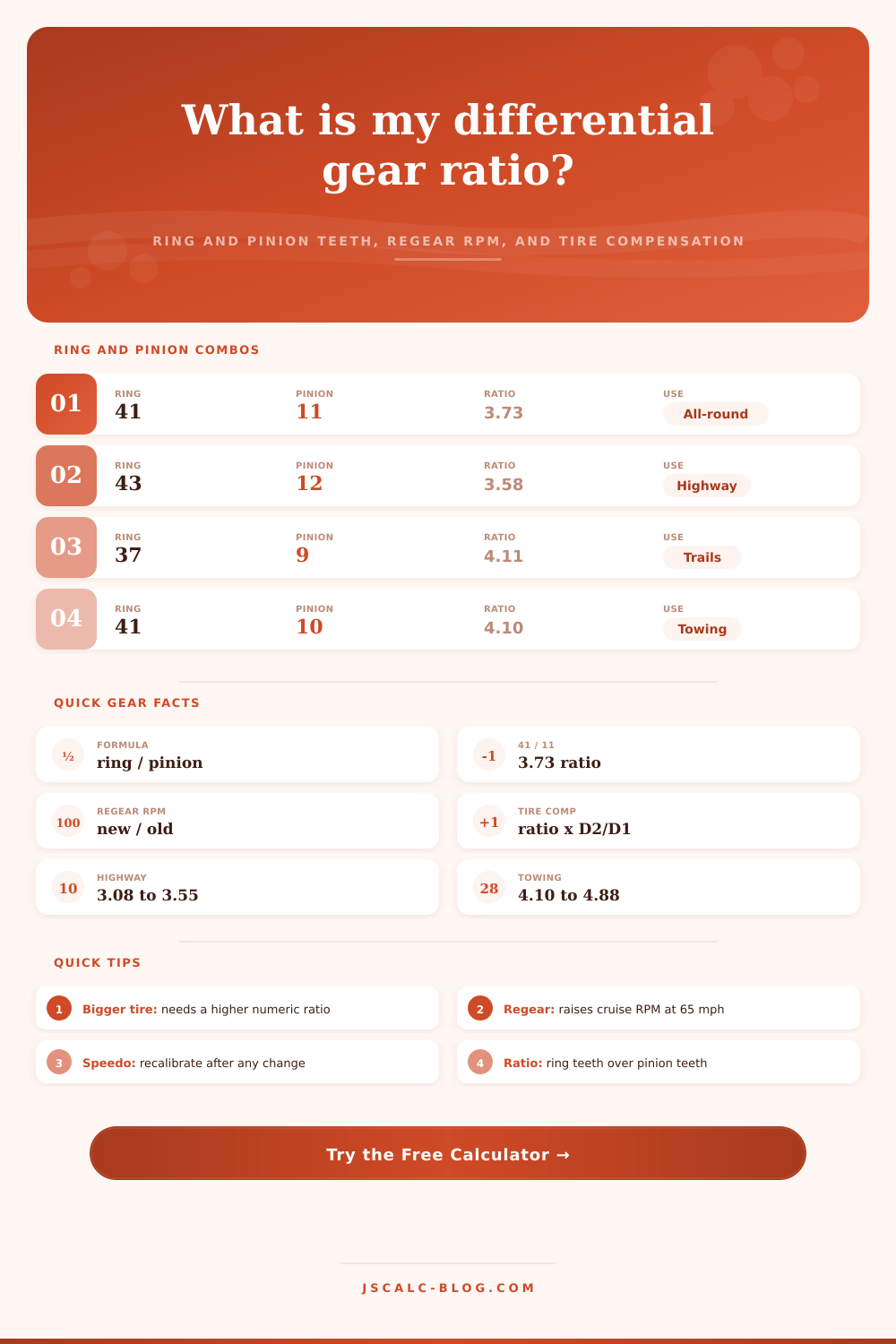
But here’s where it gets real. Here’s where the brutally simple calculation comes into play: You take the number of teeth on your big ring gear and you divide that number by the number of teeth on your little pinion gear. So if we’ve got a forty-one tooth ring that meshes with an eleven-tooth pinion, the math spit out a three-point-seven-three ratio. This translates to roughly three and three-quarters turns of the axles for each complete rotation of the driveshaft.
Seems easy right? But folks get all freaked-out when they see those numbers because they don’t remember that these ratios aren’t anything other than multipliers of speed and torque. They are just multipliers for torque and speed. That changes when you do. Replace your current numerical ratio by one digit; going from a three-point-five-five to say a four-point-one-zero. You get instant launch power. You will have no problem towing.
But the trade-off is what speed engine spins at any particular road speed. On the freeway, you’re running faster; more gas burned, more noise in the cab. Most folks don’t realize they went wrong until they are sitting in stop-and-go traffic three hours after installing it.
The equation becomes more complex still when considering tires, since rubber itself is also a form of gearing. Larger tires effectively reduce your gear ratio without having to modify any metal components. For example, a wheel with a 33-inch tire will rotate fewer times per mile than a 30-inch wheel. Essentially, the larger tires causes the wheels to spin at a lower speed different than the engine.
Plug in the measurements for your old and new setups into the above calculator and it will do all the math for you (you don’t have to guess how much adjustment is necessary). You’ll typically want to pair an increased tire size with an equivalent increased ratio to maintain same feel. These adjustments also take their toll on your speedometer accuracy. Factory clusters is calibrated to specific gear ratios and tire sizes. If you go up in size with your rubber but fail to adjust your gear and recalibrate your module, your speedometer will read low. Think you’re cruising along at fifty-five? More likely, you’re crushing it at sixty. This matters if you want to avoid tickets. It also affects your shift points if you drive a manual and your fuel economy calculations.
That’s laid out in the reference table on the page which makes it easy to see how various ratios fit different uses. Highway cruising gear is going to be a three-point-zero-eight ratio, for example, keeping the RPMs down and the ride comfortabley. And a four-point-eight-eight ratio is going to find its home on a rock crawler where max leverage is desired at walking speed. No single number is best. It all depends on where you spend your time. The right one for you are up to you.
There are a lot of fans who fall into the trap of “more is better”… I.e., more torque = faster. True enough until you hit the highway and find that the engine can’t breathe at those rpm levels for extended periods of time… Or else it just vibrates itself into oblivion trying to maintain such high rpms. The diesel, with its huge torque at low revs, tends to like taller gear ratios; conversely the high-revving V8 can gets away with being in shorter ratios without suffering quite so bad on the freeway.
Ultimately, it’s all about compromise with gear choice. There is no such thing as having the same diff housing for silent highways as it does for crawling rocks. Instead, there’s finding that happy medium for what you do most often. You should of looked at those ratios first. Regear to tow more because you want to tow? Regear for speedometer accuracy after lifting up? Either way, you can control the experience once you understand how tire size, pinion teeth, and ring teeth affect your vehicle. It makes something that was previously guesswork into a calculated modifcation. And when you get those numbers dialed in, you’ll finally be able to hear that screaming engine settle back down to its smooth quiet cruise.