Gear Ratio Calculator: RPM & Speed
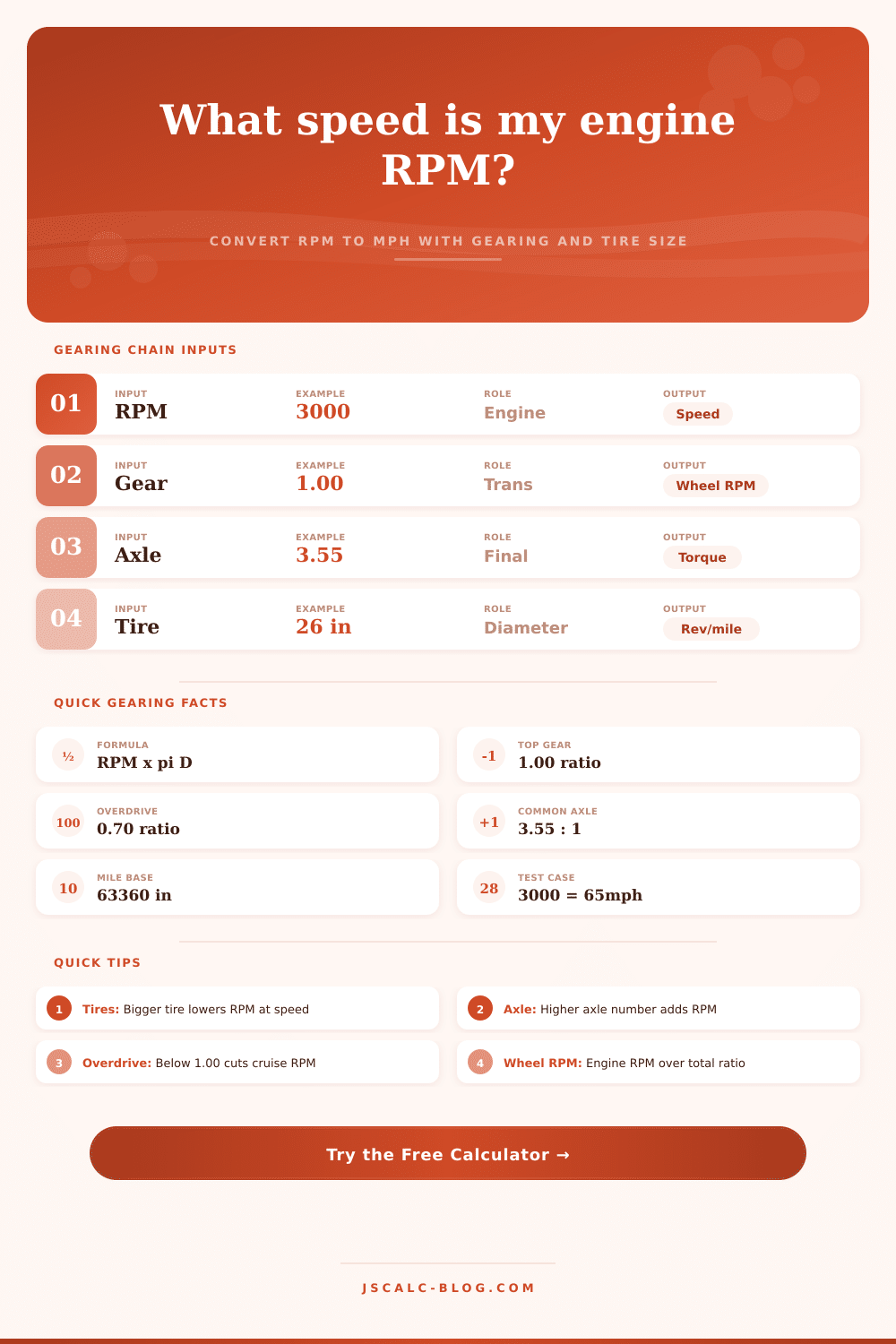
Convert engine RPM into road speed, or road speed back into engine RPM, using transmission gear ratio, final drive axle ratio, and tire diameter. See wheel RPM and tire revolutions per mile too.
🏁Real Gearing Presets
⚙Gearing Inputs
Used when the mode is speed from engine RPM.
Used when the mode is engine RPM from speed.
Top gear is often 1.00, overdrive is below 1.00.
Overall unloaded tire height, not the wheel size.
Spec fields build diameter as (2 × width × aspect / 25.4) + wheel.
🔢The Gearing Chain
📊RPM vs Speed in Each Gear
| Engine RPM | 1st (3.20) | 2nd (1.95) | 3rd (1.30) | 4th (1.00) | 5th (0.85) | 6th (0.68) |
|---|---|---|---|---|---|---|
| Calculate to fill this grid using your axle ratio and tire diameter. | ||||||
Speeds shown in the selected unit at a fixed axle ratio and tire diameter from your inputs. Each column is one transmission gear ratio.
🗂Common Final Drive Axle Ratios
| Axle Ratio | Character | Typical Vehicle | RPM at 70 mph * |
|---|---|---|---|
| 2.73 : 1 | Tall economy | Highway sedan | 2250 rpm |
| 3.08 : 1 | Balanced cruise | Sport coupe | 2540 rpm |
| 3.42 : 1 | All-round | Half-ton truck | 2820 rpm |
| 3.55 : 1 | Slightly sporty | Muscle car | 2930 rpm |
| 3.73 : 1 | Quicker launch | Tow package | 3080 rpm |
| 4.10 : 1 | Strong low end | Off-road 4x4 | 3380 rpm |
| 4.56 : 1 | Deep crawl | Big-tire rig | 3760 rpm |
* Reference values use a 1.00 top gear and a 28.5 in tire. Your own tire size shifts these numbers.
🛞Tire Diameter and Revs Per Mile
| Tire Size | Diameter (in) | Revs Per Mile | Fits Wheel |
|---|---|---|---|
| 195/65R15 | 25.0 in | 807 rev/mi | 15 in |
| 205/55R16 | 24.9 in | 811 rev/mi | 16 in |
| 225/45R17 | 25.0 in | 808 rev/mi | 17 in |
| 245/45R18 | 26.7 in | 756 rev/mi | 18 in |
| 275/55R20 | 31.9 in | 632 rev/mi | 20 in |
| 33x12.50R17 | 33.0 in | 611 rev/mi | 17 in |
| 35x12.50R17 | 35.0 in | 576 rev/mi | 17 in |
Revs per mile = 63360 / (π × diameter). Larger tires turn fewer times per mile, lowering RPM at any speed.
📈How Gearing Changes Affect Cruise RPM
| Change | Direction | Effect on RPM | Effect on Speed |
|---|---|---|---|
| Numerically higher axle | 3.55 to 4.10 | Raises RPM | Lower per given RPM |
| Numerically lower axle | 3.73 to 3.08 | Lowers RPM | Higher per given RPM |
| Add an overdrive gear | 1.00 to 0.70 | Lowers RPM | Same speed, less RPM |
| Fit taller tires | 28 in to 35 in | Lowers RPM | Higher per given RPM |
| Fit shorter tires | 31 in to 26 in | Raises RPM | Lower per given RPM |
📐Full Formula Breakdown
💡Practical Gearing Tips
Before you know it, you’re moving too fast because of a gearing disconnect, and dash light turns red. If you’ve swapped out a rear end or changed tires, that’s what happens to you. Your engine sounds as though it’s doing eighty but your speedo read sixty-five. That’s where gearing comes into play. There’s an unexplained gap between the road and your gauge. And it’s more than just acceleration: It’s knowing where your power realy lives.
After entering in your configuration, calculator works things out for you (above). But knowing what goes into it is far more important. The first thing is tire size. That’s typically forgotten. Bumping up to larger off road tires raise everything on top of your transmission. So now that larger tire take up more space with every turn. This means your engine doesn’t have to spin as many times to go a mile. Highway cruising rpm will decrease, and the ride will quiet down a bit. But your speedo is no longer accurate. It was set for smaller rubber. Now you’re driving faster then indicated. You are looking at the needle tickin’ away on the tachometer.
How Gearing Works for Your Car
This is where final drive ratio (also called the axle ratio) come into play. This is the number of times the driveshaft revolves for each revolution of the wheel. So a low number such as two point seven three would be considered tall gearing; this is efficient on the highway since you can run at low engine speeds while traveling at seventy miles an hour. But it will feel sluggish when launching off the line from a dead stop. There’s just not sufficient amount of torque multiplication at wheels so your engine doesn’t have any traction. Flip that up to something higher such as four point one zero and you’ll immediately experience that torque. It launch hard, and towing heavy loads is no problem. However, the engine work harder to maintain speed, making it louder as you cruise on interstate.
So then we have transmission gear ratios to close gap between launch and cruise. Typically top gear is 1.0, direct drive, no multiplication or reduction. Then there are overdrive gears going below one. These provide another layer of gearing down just for highway cruising. The table of references on the page details what happens as different axle ratio change your RPM at a set speed. As you can see changing from a three point five five to a three point seven three will increase your engine speed almost four hundred RPM at seventy miles per hour. Big deal, that’s lots more noise and heat on a long run.
First thing to know: What am I measuring here? Tire revolutions per mile means the distance traveled for every turn of the tire. Wheel RPM is how fast axle is spinning. The two numbers, when combined with speed of your engine, form a complete image. For a track car you want high wheel RPM so power can be delivered as quickly as possible. In a commuter sedan, you want low tire revs per mile so that engine remains relaxed.
Most people guess when they should of change their tire size or swap gears for better performance (most of us estimate). We trust our gut but it’s not accurate unless the numbers match up with how we think. Many folks think replacing their brakes or making suspension stiffer will help make up for bad gearing. It won’t. You might feel faster, but if the overall ratio leaves engine in the best power range for less than a heartbeat, you’ll never feel like you’re going any faster. You’ll just feel jumpy because the math doesn’t give a shit what you think. It gives a shit about circumference and rotation.
Before swapping axles and installing a lift kit, plug your numbers into this thing first. Look how it affects your cruising RPM. Check if that set of new tires puts you in overdrive at illegal speeds. Gearing is a tradeoff. You don’t get everything; fast launches or quiet highway rides. You rarely get both unless you are skilled with a manual transmission. Decide what’s most important to you and let engine do what it was built to do. If you know where your power actualy lies, the dashboard light will remain green.