Retirement Countdown Calculator
Count down to the day you clock out for good. Enter a retirement date or a target age and see the exact years, months, days, weeks, remaining workdays, and paychecks left until your retirement.
🎯Retirement Countdown Presets
📝Countdown Inputs
Age mode uses birth date plus target age.
Used when mode is target retirement date.
Used when mode is target retirement age.
Switch the fourth result card view.
🔢Countdown Snapshot
📊Countdown Unit Equivalents
| Unit | Amount Left | How It Is Found | Notes |
|---|---|---|---|
| Enter values above to see the countdown in every unit. | |||
💵Paychecks Left By Frequency
| Pay Frequency | Checks Per Year | Formula | Paychecks Left |
|---|---|---|---|
| The paycheck estimates appear after calculation. | |||
🗓Milestones On The Way
| Milestone | Days From Today | Reached On | Status |
|---|---|---|---|
| Milestone dates appear after calculation. | |||
🗂Retirement Age Reference Grid
| Scenario | Typical Age | Key Feature | Social Security | Best For |
|---|---|---|---|---|
| FIRE early exit | 45 to 50 | Large savings first | Not yet eligible | Aggressive savers |
| Early retirement | 62 | Earliest SS claim | Reduced benefit | Health or lifestyle |
| Rule of 55 exit | 55 to 59 | Penalty-free 401k | Bridge with savings | Job separation |
| Medicare start | 65 | Health coverage | Near full age | Coverage gap close |
| Full SS age | 66 to 67 | Full benefit | 100 percent | Born 1960 or later |
| Delayed credits | 68 to 70 | Larger checks | Up to 132 percent | Longevity planners |
⚙Full Formula Breakdown
📋Reference Values
| Item | Common Entry | How It Is Used | Effect On Countdown |
|---|---|---|---|
| Retirement date | Any future date | End point of the countdown | Sets every unit and card |
| Target age | 50 to 70 | Birth date plus this many years | Builds the date in age mode |
| Work days per week | 4 or 5 | Which weekdays are on the clock | Raises or lowers workdays left |
| Pay frequency | Biweekly common | How often a check arrives | Sets paychecks left total |
| Today | 2026-07-05 | The count-from date | Moves every remaining figure |
💡Practical Countdown Tips
On your final day at the office, the alarm doesn’t ring; but your mind knows exactly when that moment will come. The countdown to freedom feels tense: part anticipation for a morning without an alarm, and part dread of finishing off all those last item. Knowing exactly how much time is left will change the way you use those final minutes. It makes retirement… Which before was an abstract idea, into a real finish line that you can see, measure and control.
There’s a math calculator that does all this for you (above), all you have to do is plug in your desired age (or target date) and the countdown begins. If you want to know how many paychecks are left before retirement (because you’re hoping to wait til benefits max out), you can calculate based on reaching age X. It sounds like a minor detail, but it makes a big difference; rounding up to Jan 1st from the actual day you were born shifts your paycheck total by a few months. That’s enough time to decide if you’d rather collect that money now for some extra time off, or keep working one more quarter and get paid for it.
Counting Down to Retirement
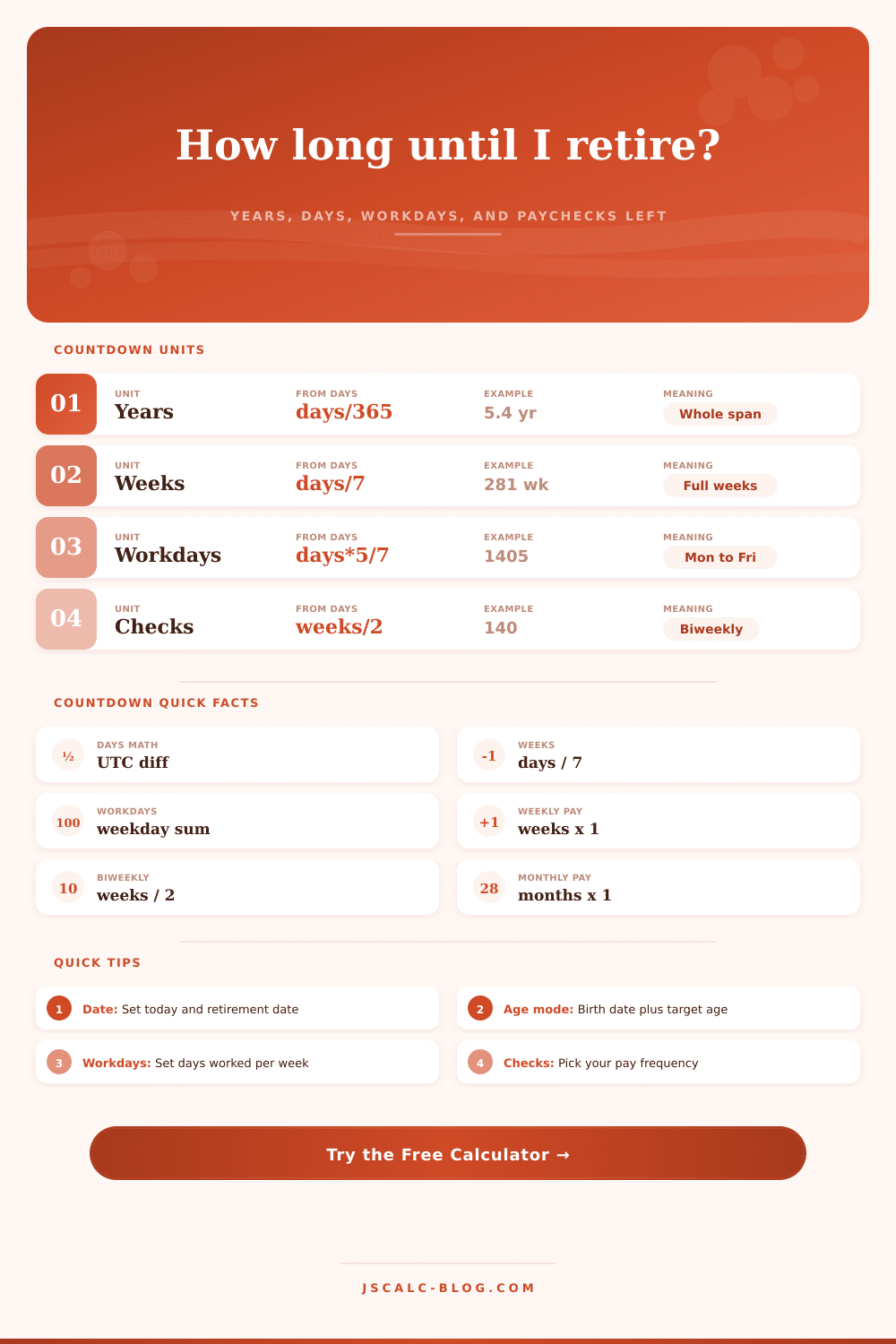
Everyone forgets that calendar days is not workdays. The calculator breaks out your total number of calendar days from your total number of workdays (the days on which you should be in the office), taking into account if you work more than 5 days a week (4? 6?). Why is this important? Because your sick days and vacation accrue based on workdays, not calendar days. Got two-hundred days remaining? If all but eighty of those are Fridays, where you’ll sneak out at noon, that’s something you’ll need to consider in your plan for getting out. Your exit strategy help you ration your time off so you don’t burn through it before the final week.
Another piece of the puzzle is how often you get paid, and for some reason, it’s oddly emotional. I find myself getting closer to the finish line not just when hitting the annual milestones, but also as each check gets crossed off list. If you’re on a monthly salary, then seeing that countdown timer decrease by one every couple of weeks seems far more tangible than looking at calendar months. That clock creates a rhythm in your exit planning and you begin identifying which tasks will fit inside the next pay period. In other words, you establish artificial deadlines along your transition timeline.
But the decimal years number also makes us think in a psychological way. Five point four years sounds different then five years and five months. The former feels more like a fractional distance to travel, whereas the latter feel like a series of distinct seasons to endure. This is significant for financial planning. Market volatility compounds over ongoing time, not just full years. If you’re nearer the finish line than you thought, knowing exactly how far you still have to go can help you tweak your asset allocation. If it’s only going to be another 18 months (rather than two full calendar years), maybe you’ll wait before taking that dicey stock gamble.
But here’s what I like: The reference section on the page outlines common retirement ages and their associated benefits. This way, you can get a sense of where you stand relative to social security rules. So say you’re thinking about exiting early, at age sixty-two. Know this: You can see exactly how many paychecks are left before eligibility kicks in. The truth about when full benefits kick in vs. When penalties set in won’t sugarcoat things for you. The math doesn’t mince words; it removes the hazy concept of “soon” and instead replaces it with hard data points that determine your cash flow. Will retiring at age sixty-five provide sufficient funds to cover the time between now and when Medicare begins? Or should you delay longer to avoid health insurance costs?
We tend to think about planning for retirement as a financial issue. But it’s also a logistical issue. It’s just that you’re managing a collection of responsibilities, energy, and time. The beauty of the calculator is that it simplifies the time aspect, providing concrete markers around which to plot important milestones. Want to take off six months from work? Schedule your going away party now. Want to renovate the house? Plan that three years ahead (instead of vaguely “someday”). Why? Because clarity takes away fear; most things that scare us are much scarier when we aren’t sure exactly how many there will be. When we know the number, we can be intentional today and ready for tomorrow.
It’s not the time in your career you want to spend guessing about time. It’s the time you want to spend wisely with the time you have left. When you’ve got that number, then you don’t guess anymore. With the finish line in sight, you begin closing loops on personal goals and work relationships. The countdown no longer becomes stressful, it becomes a focus tool. Days tick down in front of you and you’re not afraid … just quietly confident youll know precisely when the alarm stays off.