Solar Panel Angle Calculator
Find the best fixed tilt angle in degrees from horizontal using your latitude, with separate summer and winter settings, a seasonal two-setting plan, and the equator-facing direction for your hemisphere.
📍Real City & Latitude Presets
☀Site & Tilt Inputs
Enter the absolute value of your latitude. Use the hemisphere field for N or S.
🔢Tilt Rule Snapshot
📊Latitude Band to Tilt Angle
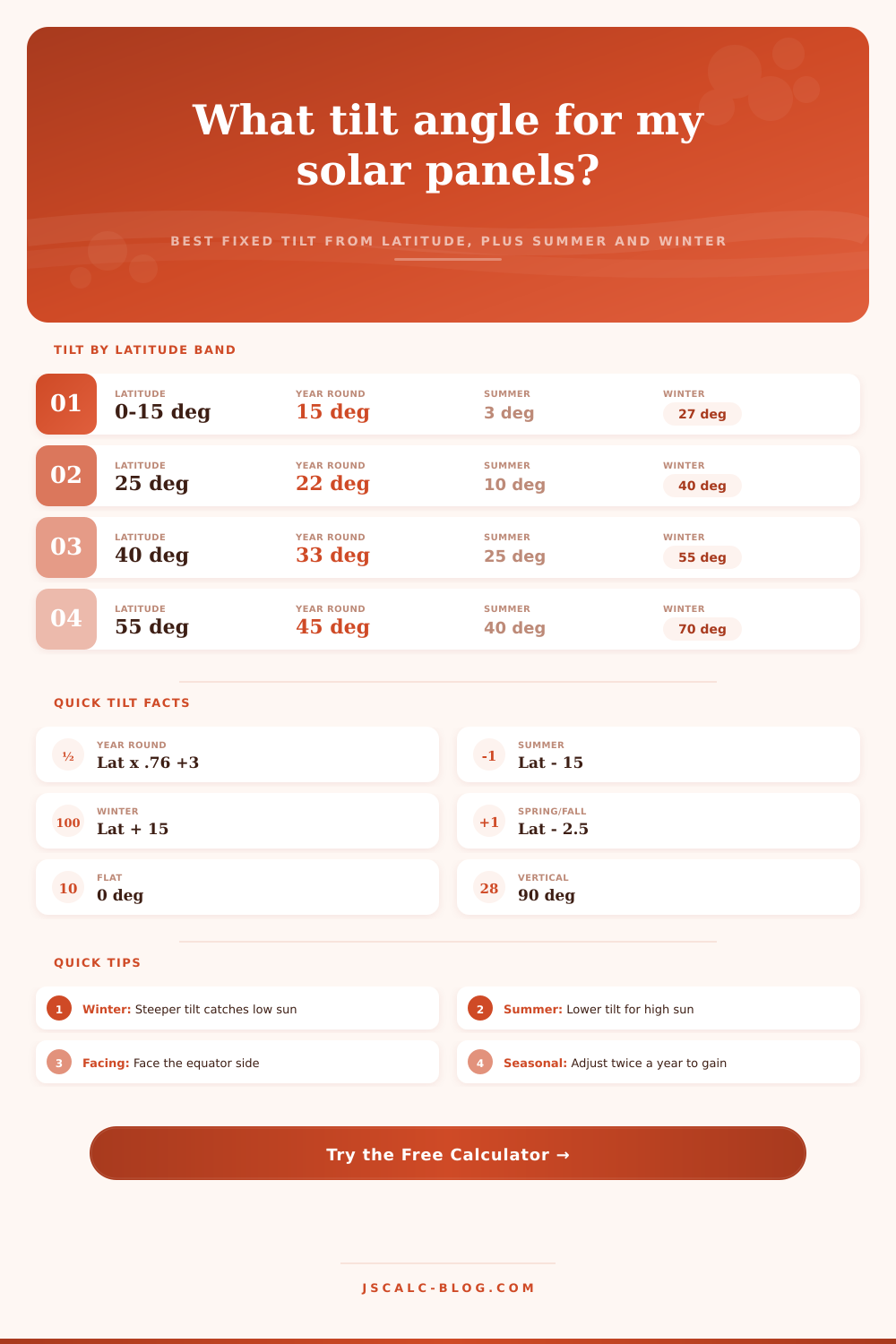
| Latitude Band | Year-Round Tilt | Summer Tilt | Winter Tilt | Notes |
|---|---|---|---|---|
| 0° to 15° | 3° to 15° | 0° to 3° | 15° to 30° | Near-flat with a tilt for drainage |
| 15° to 25° | 15° to 22° | 3° to 10° | 30° to 40° | Low tilt, strong summer output |
| 25° to 40° | 22° to 34° | 10° to 25° | 40° to 55° | Common residential range |
| 40° to 55° | 34° to 45° | 25° to 40° | 55° to 70° | Seasonal adjust pays off most |
| 55° to 66° | 45° to 53° | 40° to 51° | 70° to 81° | Steep winter tilt, low winter sun |
🗂Latitude vs Seasonal Tilt Grid
| Latitude | Year-Round | Summer | Winter | Spring / Fall | Facing (N Hemi) |
|---|---|---|---|---|---|
| 0° | 3.1° | 0° | 15° | 0° | Level / south |
| 10° | 10.7° | 0° | 25° | 7.5° | South |
| 20° | 18.3° | 5° | 35° | 17.5° | South |
| 25.8° | 22.7° | 10.8° | 40.8° | 23.3° | South |
| 34° | 29.0° | 19° | 49° | 31.5° | South |
| 40.7° | 34.0° | 25.7° | 55.7° | 38.2° | South |
| 47.6° | 39.3° | 32.6° | 62.6° | 45.1° | South |
| 51.5° | 42.2° | 36.5° | 66.5° | 49.0° | South |
| 61.2° | 49.6° | 46.2° | 76.2° | 58.7° | South |
📐Roof Pitch to Tilt Degrees
| Roof Pitch | Rise : Run | Tilt Degrees | Feels Like |
|---|---|---|---|
| 2:12 | 2 in per 12 | 9.5° | Low-slope roof |
| 4:12 | 4 in per 12 | 18.4° | Gentle slope |
| 5:12 | 5 in per 12 | 22.6° | Moderate slope |
| 6:12 | 6 in per 12 | 26.6° | Common house roof |
| 7:12 | 7 in per 12 | 30.3° | Steeper slope |
| 8:12 | 8 in per 12 | 33.7° | Steep roof |
| 12:12 | 12 in per 12 | 45.0° | Very steep roof |
🧭Facing Direction by Hemisphere
| Hemisphere | Face Toward | Compass Azimuth | Why |
|---|---|---|---|
| Northern | True south | 180° | Sun tracks across the southern sky |
| Southern | True north | 0° / 360° | Sun tracks across the northern sky |
| On the equator | Level or slight tilt | Either way | Sun passes nearly overhead |
⚙Full Tilt Rule Breakdown
📋Quick Reference Values
| Setting | Rule Used | Best For | Effect on Tilt |
|---|---|---|---|
| Year-round refined | L × 0.76 + 3.1° | One fixed angle | Balances all seasons |
| Summer | L − 15° | May to August peak | Lower, flatter panel |
| Winter | L + 15° | November to February | Steeper panel |
| Spring / fall | L − 2.5° | Equinox months | Close to latitude |
| Seasonal plan | Summer & winter | 2 adjustments a year | Higher annual yield |
💡Practical Tilt Tips
The solar panel is flat-mounted. This one’s an aesthetic error: You drop serious money on these things and install them flat, to match how your roof looks. But here’s the thing, in addition to wattage, angle make all the difference. Or at least it should, especially when you’re in a long winter slog and really could of use some juice.
Enter this calculator, which will save you some guesswork (and missed potential) by taking your latitude and converting it to a precise recommended angle for maximum light capture. Simply enter your coordinates, select whether you want a year-round setup or something seasonal… then watch it spit out the best degree for photon-capture.
How to Find the Best Angle for Solar Panels
Everything hinges on your latitude because the location of the sun in your sky all year round depends on it. So if you’re closer to the equator, the sun will hang relatively high over your head most days of the year. Therefore, you should place your panels relatively flat so they can catch more direct sunlight without shading each other. Head north or south and the sun sinks lower toward the horizon. This means you need a steeper angle to get at it.
The tool applys an improved formula that essentially takes your latitude, multiplies it by about zero point seven six, then throws a couple of degrees on top of that. That’s not some random number; it’s a little tweak designed to smooth out the curve of the year’s energy output. You want less of a big swing from June to December. That is what this coefficient does by balancing out those winter lows and summer highs. It is a slight tweak, but it makes sense.
Things start to get interesting with seasonal changes. Yes, having a set angle would certainly be convenient, but the sun do not remain stationary. During summer months, the solar arc will be steep and high up. Adjusting your panel tilt down around fifteen degrees less than your latitude will allow you to snag all of that overhead sunlight without dedicating precious space to a vertical mount.
Now flip to winter; here the opposite becomes true entirely. The sun crawls low across southern sky during our northern hemisphere winters. You need to face that weak light directly instead of letting it slide off surface. You will have to increase the angle quite a bit, leaving a buffer of about fifteen degrees, to make sure they faces the sun straight on. The page’s reference table spells all of this out nicely for various bands of latitude, illustrating just how dramatic these seasonal swings can become based off location.
The other side of the equation is facing direction. Aim true north in the southern hemisphere, true south in the northern. It sounds obvious, but here is where homeowners gets tripped up. They aim for magnetic south instead of true south. If there is a large amount of declination at their location, this will cost them a couple percent in efficiency. The calculator has this covered. It knows what hemisphere you’re located in and does the math automatically. This takes this possible mistake out of the equation completly for you.
So is it worth it? Is it worth buying an adjustable mount and going through the extra effort? Not typically if you’re installing a system in your home. Most folks will not see a substantial improvement in kw-hr output and the hassle of having to adjust the mounting of the panels twice per year makes the convenience factor small. A properly calculated fixed angle represent the sweet spot between easy & effective.
Any kind of solar installation has trouble with shadows. And a poorly-angled solar install makes that issue worse. A shallow tilt in winter months can cause snow to slide off slowly (or not at all) and debris to collect on top. A steep angle may cast a shadow over nearby roof areas, or you may break local setback regulations. The sweet spot is somewhere between these two.
The tool will help you figure out where that is, while still maximizing the amount of sun collected, but without introducing other problems. Or rather, the tool will help you calculate that sweet spot… taking into account the realties of your roof’s pitch. Most homes were never designed with ideal solar angles in mind. A six-to-twelve pitch is typical in most neighborhoods, which translates to about twenty-six degrees. The calculator allows you to see what that looks like compared to a perfect angle, and then help you determine if you’re okay compromising that way, or if you want to spend money on more adjustable rack setups.
So how does this apply? Well, in the end, there’s no perfect array optimization… Just thoughtful decisions based off where you live and what makes sense. If you want more production in the summer (for air conditioning) or winter (to heat your home), the formula doesn’t change… You simply swap out the variables to fit your goal. Plug it into the tool as a starting point, tweak if necessary to suit your local microclimates, and let the sun take care of the rest.