Depreciated Building Value Calculator
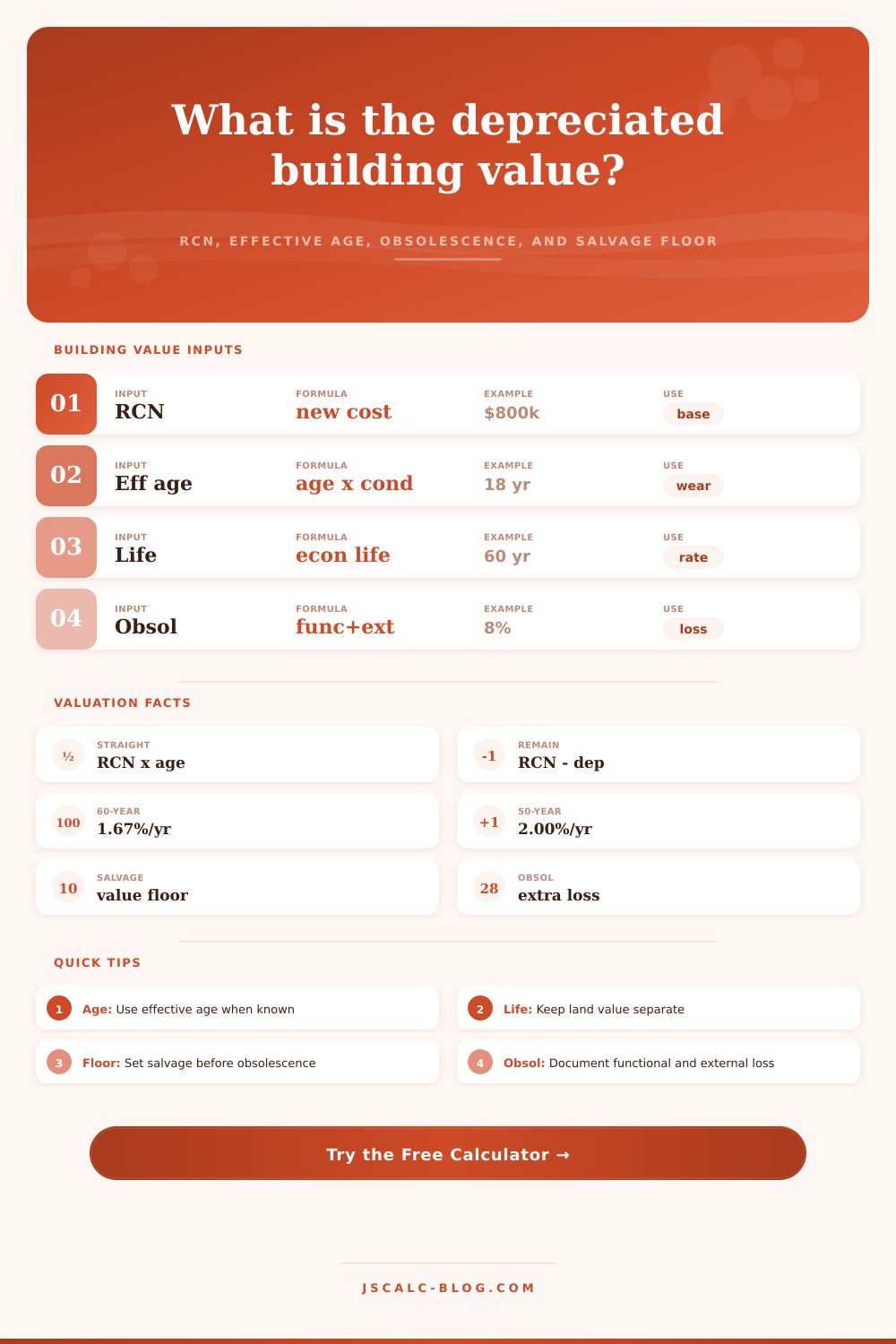
Estimate depreciated building value from replacement cost new, actual age, effective age, economic life, condition, physical depreciation, functional obsolescence, external obsolescence, and an optional salvage floor.
🎯Building Presets
📝Valuation Inputs
Use building-only replacement cost. Keep land value separate.
Calendar age since original construction or major rebuild.
Use the appraiser's effective-age estimate when available.
Economic life is the full expected income/useful life.
All methods use the age-life cost approach ratio.
Optional floor for residual structural or shell value.
Layout, ceiling height, utility, or design deficiency loss.
Market, location, traffic, zoning, or outside economic loss.
🔢Current Valuation Snapshot
⚙Formula Breakdown
📊Building Type Reference
| Building type | Common economic life | Condition focus | Typical obsolescence | Use in calculator |
|---|---|---|---|---|
| Single-family residence | 50 to 70 years | Roof, systems, finishes | Low to moderate | Residential cost approach |
| Small rental building | 45 to 60 years | Units, plumbing, turnover | Moderate | Income property support |
| Retail strip center | 35 to 50 years | Facade, layout, parking | Functional and external | Commercial comparison |
| Warehouse shell | 40 to 60 years | Clear height, dock doors | Functional | Industrial valuation |
| Office building | 40 to 60 years | Lobby, HVAC, floor plate | Functional | Renovation analysis |
| Medical clinic | 35 to 50 years | MEP systems, layout | Functional | Special-use support |
| School or civic building | 50 to 75 years | Envelope, code, systems | Functional | Public asset estimate |
| Heavy industrial plant | 30 to 50 years | Structure, utility, process | Functional and external | High obsolescence cases |
🏷Condition Factor Table
| Condition label | Age factor | Condition meaning | Effective-age effect |
|---|---|---|---|
| Excellent / like new | 0.55 | Recent major rebuild or near-new systems | Actual age is cut sharply |
| Very good / renovated | 0.70 | Strong upkeep with modernized major components | Actual age is reduced |
| Good / maintained | 0.85 | Normal maintenance and limited deferred repairs | Slightly younger than actual age |
| Average / typical | 1.00 | Ordinary wear for the market and building type | Matches actual age |
| Fair / deferred work | 1.25 | Visible deferred maintenance or dated systems | Older than actual age |
| Poor / heavy wear | 1.55 | Major repairs needed, weak building systems | Much older than actual age |
| Severe / near end | 1.85 | Heavy deterioration or near-replacement condition | Age approaches economic life |
🗂Method Comparison Grid
| Method | Age basis | Formula | Best use | Strength | Watch item |
|---|---|---|---|---|---|
| Straight-line using effective age | Observed effective age | RCN x EA / life | Appraisal age-life method | Direct and common | Depends on EA support |
| Condition-adjusted effective age | Actual age x factor | RCN x adj age / life | No separate EA estimate | Reflects condition | Factor is judgmental |
| Actual-age straight-line | Actual age | RCN x actual / life | Simple screening | Easy to audit | Ignores maintenance |
| Blended observed and condition age | 70% observed, 30% condition | RCN x blend / life | Cross-checking inputs | Smooths extremes | Still needs support |
📉Age-Life Depreciation Quick Table
| Economic life | Effective age | Physical rate | Remaining life | Per $1M RCN dep. |
|---|---|---|---|---|
| 40 years | 10 years | 25.0% | 30 years | $250,000 |
| 40 years | 25 years | 62.5% | 15 years | $625,000 |
| 50 years | 15 years | 30.0% | 35 years | $300,000 |
| 50 years | 30 years | 60.0% | 20 years | $600,000 |
| 60 years | 12 years | 20.0% | 48 years | $200,000 |
| 60 years | 36 years | 60.0% | 24 years | $600,000 |
| 75 years | 30 years | 40.0% | 45 years | $400,000 |
💡Practical Valuation Tips
An old house is bought for its structure. The high ceilings and hardwood floors are signs that it may have something of value. But the paint are not exactly representative of the true condition.
Then as you realize what the real value is, you start calculating what once looked good. What’s the replacement cost new? How much value is depreciated? If there is one more then the other, you’ve got yourself a deal (or not).
How to Value an Old House
It’s about the effect of time on your asset. It is not necessarily about amount of time. After entering the data (roof area, rain fall), the calculator do the rest; no longer do you have to convert numbers into percentages yourself.
But more importantly, why did we divide? Why? And why should you knows the whys? Physical depreciation are easy. Take today’s replacement cost for the same structure and subtract the fraction representing how much longer the building will be used after this point. If a 22-year-old home last 60 years, for example, it’s burnt through approximately 37 percent of the economic lifetime of the structure. It is simple mathematics.
So why is this all so complicated? Because “calendar” age doesn’t necessarily reflect effective age. A well-maintained building will age slower than an unmaintained building. Even though the foundation may be 50 years old, the interior of a renovated clinic look new. There’s a rating system to account for this. It adjusts the effective age. So it makes the depreciation align with its true age instead of its deed date. Otherwise, you could undervalue a beautifully restored property or overvalue a neglected eyesore.
You want to know what you’re measuring. You’re measuring the remaining utility, not time.
There’s also the issue of things becoming outdated. That doesn’t mean things will stop working because you didn’t take care of certain items (like windows). Instead, it’s functional obsolescence: The building just doesn’t work for today’s lifestyles. Examples include low ceilings for an office or a single stall bathroom in a rent house. Those are internal problems, which means money can fix these defects; but only if you act. Until then, this bring down value.
Then there’s external obsolescence. This come from factors outside the property, such as highway construction near your home or a new factory across town. You can’t paint them away. They’re outside your property lines. These are things you separate out on the calculator, too, so you know what factor contribute the most toward the bottom line.
The danger here is most folks will try to apply one discount rate across the board on everything. That’s problematic because it masks which individual issues can actualy be resolved. When you split out external vs functional losses, you establish a log of what choices were made. You may have lots of physical damage but the external market are robust.
The salvage floor then comes into play as a buffer to avoid values falling below a suitable residual level (for the structure or the land). That helps eliminate negative valuation where markets is distressed. The tool anchors your assumptions with reference tables.
How long will it take? That depends on what you build. For example, a concrete shell of a warehouse will last longer then an ornate retail strip center. Why? Concrete is durable; aesthetics change over time. Get this one wrong and everything that follows will be skewed. Don’t apply a commercial timeline to a residential cottage. The inputs depend on the context.
The second way is in valuing the building at its depreciated cost, recognizing that, in reality, a building has lost some of its value because of age. How do we value it? The calculator structure the process for us. It compels you to look at the cracked foundation, the aging electrical wiring, and the downward-trending neighborhood. And when you lay eyes on those figures, your intuition stops being a guess.
Now you’re certain about how worn down the building’s become and what friction exists between it and the market. That clarity helps your hunches feel like a fair position. Next time you accept (or make) an offer, you can point to the math as the clincher. Sure, the structure might still stand strong. But now there’s the data.
You should of checked the luxurius finishings too.