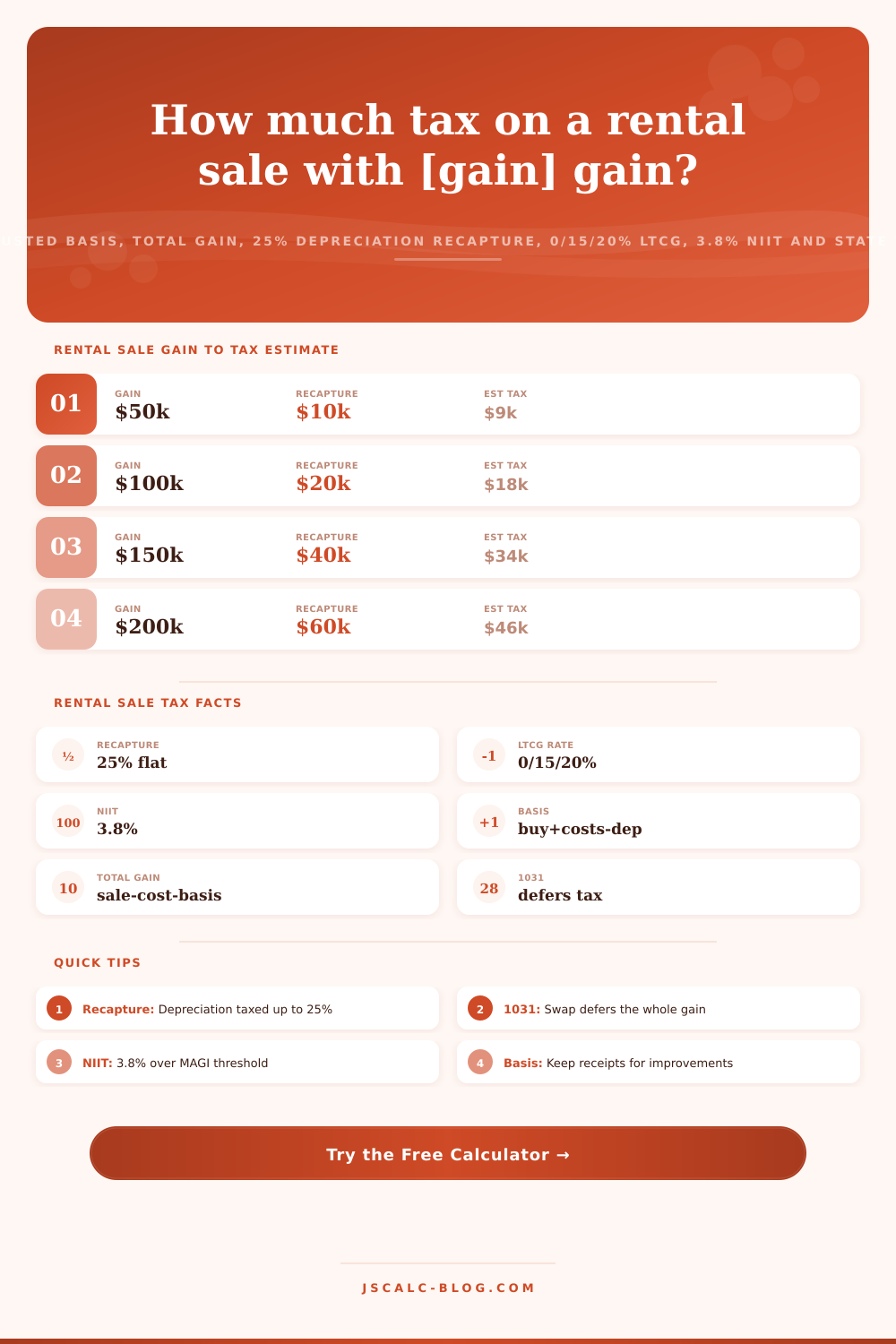
Capital Gains Tax Calculator on Sale of Rental Property
Estimate the total federal and state tax when you sell an investment property. This tool builds your adjusted cost basis, finds the total capital gain, then splits it into unrecaptured Section 1250 depreciation recapture taxed at 25 percent and long-term capital gain taxed at 0, 15, or 20 percent, adds the 3.8 percent Net Investment Income Tax when it applies, layers in state tax, and shows your net proceeds after tax.
🎯Real Rental Sale Presets
📝Property and Sale Inputs
What you originally paid for the rental property.
Title, escrow, transfer tax and legal fees at purchase.
Roof, additions, remodels; not routine repairs.
Depreciation claimed or allowable over the holding period.
Gross contract price the buyer pays for the property.
Agent commission, staging, title and closing costs at sale.
Sets the long-term gain brackets and NIIT threshold.
Other taxable income; picks your 0, 15, or 20 percent bracket.
Your state rate on the gain; use 0 for no-income-tax states.
Auto adds 3.8% when income plus gain tops the MAGI threshold.
🔢Formula Snapshot
📊2024 / 2025 Long-Term Capital Gains Brackets
| Filing Status | 0% Rate Up To | 15% Rate Range | 20% Rate Over |
|---|---|---|---|
| Single | $47,025 | $47,026 to $518,900 | $518,900 |
| Married filing jointly | $94,050 | $94,051 to $583,750 | $583,750 |
| Married filing separately | $47,025 | $47,026 to $291,850 | $291,850 |
| Head of household | $63,000 | $63,001 to $551,350 | $551,350 |
🏢Depreciation Recapture at 25 Percent
| Depreciation Taken | Recapture Rate | Recapture Tax | Notes |
|---|---|---|---|
| $20,000 | 25% max | $5,000 | Small condo, short hold |
| $50,000 | 25% max | $12,500 | Single-family, mid hold |
| $80,000 | 25% max | $20,000 | Long-held rental |
| $120,000 | 25% max | $30,000 | Larger multi-unit |
| $150,000 | 25% max | $37,500 | Fully depreciated hold |
| $200,000 | 25% max | $50,000 | Nearly 27.5-year hold |
💵3.8 Percent NIIT MAGI Thresholds
| Filing Status | MAGI Threshold | NIIT Rate | Applies To |
|---|---|---|---|
| Single | $200,000 | 3.8% | Lesser of gain or excess MAGI |
| Married filing jointly | $250,000 | 3.8% | Lesser of gain or excess MAGI |
| Married filing separately | $125,000 | 3.8% | Lesser of gain or excess MAGI |
| Head of household | $200,000 | 3.8% | Lesser of gain or excess MAGI |
🗃Income and Filing to Tax Comparison Grid
| Income Level | Filing Status | LTCG Rate | NIIT Applies | Example Gain | Est. Federal Tax |
|---|---|---|---|---|---|
| $40,000 | Single | 0% | No | $100,000 | $7,500 |
| $80,000 | MFJ | 0% | No | $120,000 | $9,000 |
| $120,000 | Single | 15% | No | $270,800 | $48,620 |
| $150,000 | MFJ | 15% | Yes | $200,000 | $45,600 |
| $220,000 | Single | 15% | Yes | $150,000 | $29,650 |
| $300,000 | MFJ | 15% | Yes | $300,000 | $71,900 |
| $450,000 | Single | 20% | Yes | $400,000 | $94,720 |
| $600,000 | MFJ | 20% | Yes | $494,000 | $123,572 |
| $700,000 | Single | 20% | Yes | $488,000 | $106,744 |
⚙How the Tax Is Built
💡Ways to Lower the Bill
When you sell a rental property, it produces cash. But not all of it is yours. There’s also taxes: long-term capital gains, depreciation recapture, and (depending on where you live) state taxes. Don’t assume amount you sold it for minus the purchase price equals your net proceeds. That assumes no depreciation deductions. But you took those deductions! They reduced your cost basis, yet increased your future tax liabilitys.
The calculator above calculates that for you. It divides up the gain into chunks and identifies which portion is taxable at what rate. Why does that matter? Because some of the gain is taxed at a lower rate then other portions.
How to Calculate Taxes When Selling Your Rental Property
The starting point for this calculation are your adjusted cost basis. Add up all your capital improvements and closing costs on top of the purchase price. Next, subtract out all dollars of depreciation that you’ve claimed while owning property. The result is the taxable gain.
You claim depreciation deductions while earning income (which the IRS requires to be paid back when you sell). This principle are known as unrecaptured Section 1250 gain. It’s taxed at a flat rate of twenty-five percent; which is higher than normal long-term capital gains tax rates. Because most investors don’t understand this expense they overestimate how much profit will be taxed at a fifteen or twenty percent rate.
Then, depending on your income and filing status, you’ll get the remaining portion of your gain, taxed at your marginal tax rate. If you have little income and are a single filer, this could be nothing, you’d pay no tax on long-term gains. Someone in a higher bracket will owe fifteen or twenty percent. Today’s thresholds dictate your rate.
The calculator also take into account other income earned that year. A big sale may kick your total income into a higher bracket. Part of your gain will then be subject to higher taxes. This can make a huge difference when you’re earning six-figures.
In addition, top earners needs to account for the so-called Net Investment Income Tax. This tax imposes an additional three-point-eight percent on modified adjusted gross income over two hundred thousand dollars for single filers or two hundred fifty thousand dollars for married joint filers. It is applied to the lower of amount above the threshold or your net investment income.
And then there’s state taxes. Several states impose no income tax; many others classify capital gains as ordinary income and charge a rate higher than ten percent. Plug in your state rate to the calculator and you’ll get realistic net proceeds.
But planning can lower this bill. If it’s a like-kind exchange, you’ll be able to defer the depreciation recapture AND the capital gains. The catch is that proceeds need to be invested in a new qualifying property within tight timetables. OR, if you convert a rental to your primary residence, maybe you’ll be able to use an exclusion. To qualify, you have to occupy the place for two out of the previous five years. Single filers can exclude two hundred fifty thousand dollars of gain. For married folks filing jointly, that becomes five hundred thousand dollars.) This rule doesn’t ever exclude depreciation recapture; which makes timing key.
Check out the reference table for details on how filing status and income level impact the bottom line. They can be difficult to estimate manually. There’s a recapture rule that many landlord get wrong. There are also multiple rates and multiple thresholds. Putting all those things into one space takes the guess work out of the transaction.
Use a pre-set scenario to understand how the numbers will change. Then tweak based off your own circumstances. The numbers is estimates and meant to be used for planning only. Each real estate sale is different, there are local regulations and passive loss considerations. Double check the final number with a qualified tax pro before closing. Knowing exactly what you’ll owe before signing the papers = selling smart.