5 Band Resistor Color Code Calculator
Decode a 5 band resistor with three significant digit bands, a multiplier band and a tolerance band into resistance in ohms, kohm or Mohm. Read the tolerance percentage, the minimum and maximum resistance range, and the nearest E24 or E96 standard value, or reverse a resistance back into its band colors.
⚡Choose a Mode
🎯Common Resistor Presets
📝Band Selectors
Left-most band, the first digit of the value.
Second digit band of the resistance value.
The extra digit band that 5 band resistors add.
Powers of ten applied to the three digits.
The band set slightly apart from the others.
Enter the number, then pick its unit at right.
Ohm, kilo-ohm or mega-ohm for the value above.
Sets the fifth band color in the reversed code.
Chooses the preferred-value ladder to snap to.
Draw the physical band stripes under the form.
🔢Formula Snapshot
📋Color to Digit Chart
| Color | Digit (Bands 1-3) | Multiplier (Band 4) | Tolerance (Band 5) |
|---|---|---|---|
| Black | 0 | x1 | — |
| Brown | 1 | x10 | ±1% |
| Red | 2 | x100 | ±2% |
| Orange | 3 | x1k | — |
| Yellow | 4 | x10k | — |
| Green | 5 | x100k | ±0.5% |
| Blue | 6 | x1M | ±0.25% |
| Violet | 7 | x10M | ±0.1% |
| Grey | 8 | — | ±0.05% |
| White | 9 | — | — |
| Gold | — | x0.1 | ±5% |
| Silver | — | x0.01 | ±10% |
📊Multiplier Band Chart
| Band 4 Color | Multiplier | Power of Ten | Example (digits 100) |
|---|---|---|---|
| Black | x1 | 10^0 | 100 ohm |
| Brown | x10 | 10^1 | 1 kohm |
| Red | x100 | 10^2 | 10 kohm |
| Orange | x1000 | 10^3 | 100 kohm |
| Yellow | x10k | 10^4 | 1 Mohm |
| Green | x100k | 10^5 | 10 Mohm |
| Blue | x1M | 10^6 | 100 Mohm |
| Gold | x0.1 | 10^-1 | 10 ohm |
| Silver | x0.01 | 10^-2 | 1 ohm |
📏Tolerance Band Chart
| Band 5 Color | Tolerance | Grade | 1 kohm Range |
|---|---|---|---|
| Violet | ±0.1% | Precision | 999 - 1001 ohm |
| Blue | ±0.25% | Precision | 997.5 - 1002.5 ohm |
| Green | ±0.5% | Precision | 995 - 1005 ohm |
| Brown | ±1% | Standard 5 band | 990 - 1010 ohm |
| Red | ±2% | General | 980 - 1020 ohm |
| Gold | ±5% | Common 4 band | 950 - 1050 ohm |
| Silver | ±10% | Loose | 900 - 1100 ohm |
🧩E-Series Standard Values
| Series | Tolerance | Values per Decade | Sample Values |
|---|---|---|---|
| E6 | ±20% | 6 | 10, 15, 22, 33, 47, 68 |
| E12 | ±10% | 12 | 10, 12, 15, 18, 22, 27 |
| E24 | ±5% | 24 | 10, 11, 12, 13, 15, 16 |
| E48 | ±2% | 48 | 100, 105, 110, 115, 121 |
| E96 | ±1% | 96 | 100, 102, 105, 107, 110 |
| E192 | ±0.5% | 192 | 100, 101, 102, 104, 105 |
🗃Full Color Reference Comparison
| Color | Digit | Multiplier | Tolerance | Temp Coeff | Notes |
|---|---|---|---|---|---|
| Black | 0 | x1 | — | 250 ppm | Never a first digit |
| Brown | 1 | x10 | ±1% | 100 ppm | Most common 5 band tol |
| Red | 2 | x100 | ±2% | 50 ppm | General precision |
| Orange | 3 | x1k | — | 15 ppm | Digit or multiplier |
| Yellow | 4 | x10k | — | 25 ppm | Digit or multiplier |
| Green | 5 | x100k | ±0.5% | 20 ppm | Precision parts |
| Blue | 6 | x1M | ±0.25% | 10 ppm | Precision parts |
| Violet | 7 | x10M | ±0.1% | 5 ppm | Tightest common tol |
| Grey | 8 | — | ±0.05% | 1 ppm | Ultra precision |
| Gold | — | x0.1 | ±5% | — | Multiplier or tol only |
⚙Formula Breakdown
💡Reading and Buying Tips
Colored rings are exactly what they say they are. A 5 band resistor color code calculator will convert them into precise value of a component so you don’t have to solder incorrect part on your board. Reading those bands isn’t really about memorizing charts, but rather seeing pattern that manufacturers use to identify exact components.
Four bands is seen on older resistors since that format was good enough for previous circuits. When tolerances were looser, two digits plus a multiplier plus a tolerance was all that was needed, but five band resistors include a third significant digit which enables manufacturers to print closer values at a one percent tolerance level. That’s why precision components nearly always have five bands.
How to Read Resistor Color Bands
The 1st through the 3rd rings represent these numbers. The 4th ring show what factor or power of ten these numbers will be multiplied by. The 5th ring tell you how much actual resistor might differ from its printed value.
The calculator does the math for you but it’s a two step calculation to read this code. Build a three-digit number from color bands by multiplying the 1st digit by one hundred, the 2nd digit by ten, and the 3rd digit by one. Then multiply by ten to the number on the multiplier band (exponent).
However, each of the colors have a corresponding number. Black is zero, brown is one, red is two, orange is three, and yellow is four. Green is five, blue is six, violet is seven, grey is eight, and white is nine. Those same colors becomes exponents in the multiplier band with gold for times zero point one and silver for times zero point zero one (to get down to small resistances).
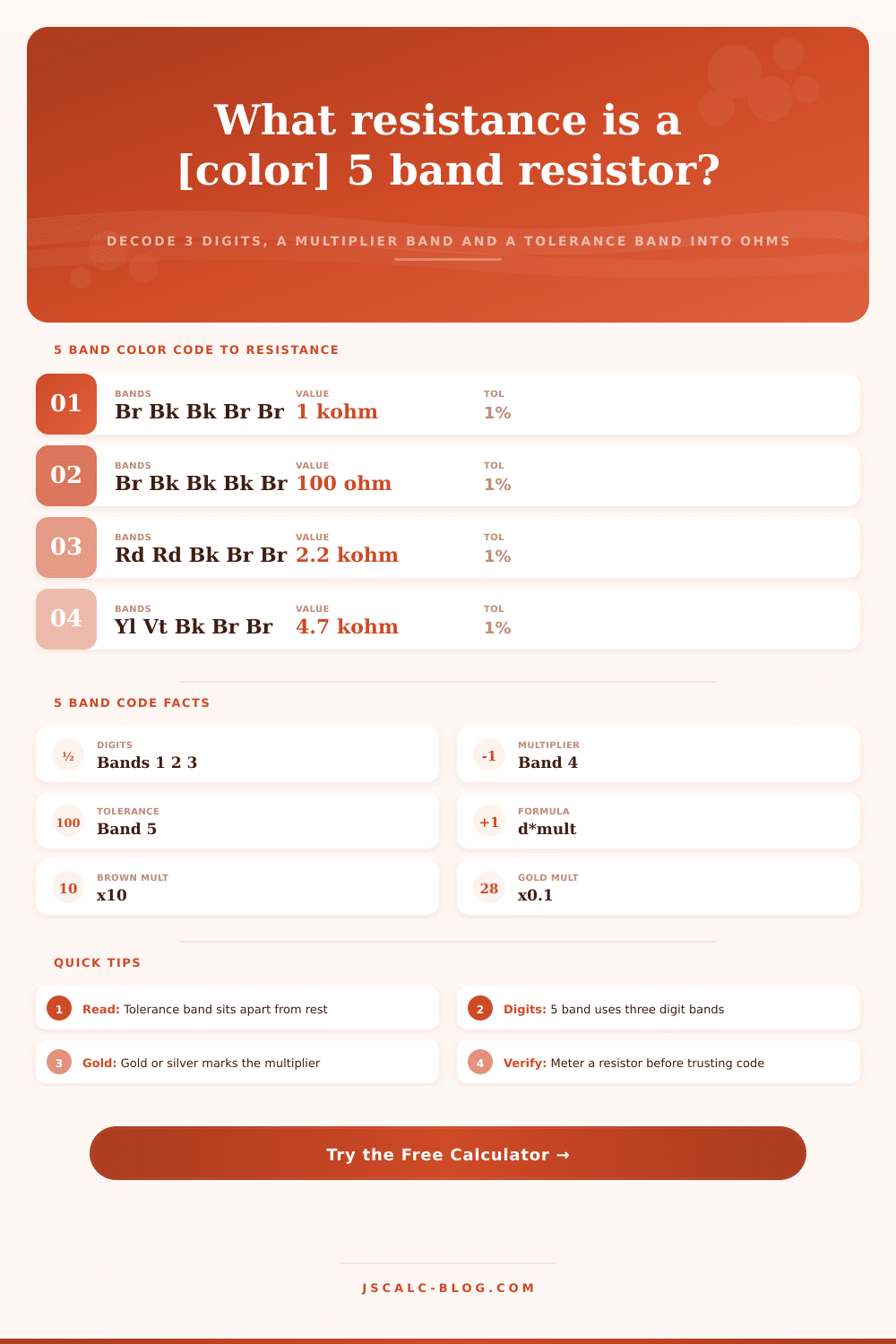
So for instance, take a resistor that has banded brown-black-black-brown-brown. That would be ones-zero-zero-zero for the first three bands (making number one-hundred), then ten because next band is brown. This makes resistance one-hundred times ten, or one-thousand ohms (a.k.a. One-kilohm).
The last band is the tolerance, and in this case it’s one-percent (+/-). This single resistor show the whole process. The fifth band indicate how far off a resistor can be and still be considered okay.
The colors of the tolerance bands are: brown = one percent, red = two percent, green = zero point five percent, blue = zero point zero two five percent, violet = zero point one percent, grey = a very tight zero point zero five percent. Five and ten percent (looser tolerances) is held for gold and silver. Running that through the tool give you an actual range of values instead of just a percentage.
In our example above with a one kilohm resistor at one percent, that will show as nine-hundred-ninety-ohms min and one-thousand-ten-ohms max. Any value within that band is therefore known to be not a problem but a perfectly healthy resistor.
The tool returns its results expressed just as an engineer might utter it: it gives you the resistance in whatever size range it’s in, with mega-ohms for resistances over a million, kiloohms for those over a thousand, and the rest in straight ohms. It’ll snap each answer to the nearest value on a preferred value ladder.
Resistors aren’t actualy made at all points. They’re only made in discrete steps known as E series. This means a value will decode somewhere close to the next E24 for five percent parts, or the next E96 for one percent parts. That next-closest standard value is a handy sanity-check on your readout.
If you already have a resistance in mind and are designing a circuit, reverse mode comes in handy. Plug in the resistance you want (say four point seven kilohms at one percent), and it will calculate tolerance ring, the multiplier and the digit bands. That’s great if you’re rooting around in a drawer full of random resistors, as you can match color stripes on the one in hand with your desired value rather than having to measure each possibility. And it helps learn the system: you get to see where that value you recognize translates into strips.
There are two tricks that keep your decoder on point. First, read it right: the tolerance band is on the right and a bit further away from other bands. Second, if a resistor value seem off, try flipping color order. Maybe you’re just reading it upside down. Otherwise, when one of the bands appears scorched or just too hard to decode, take the resistor out and check it with a multimeter and match against closest standard value.
A real resistor will be very near a standard value, which is an added bonus and lets you weed out damaged resistors before they wreck a build. You should of returned to that cylinder on your bench and let the bands speak clearly.