Rent Calculator From Income
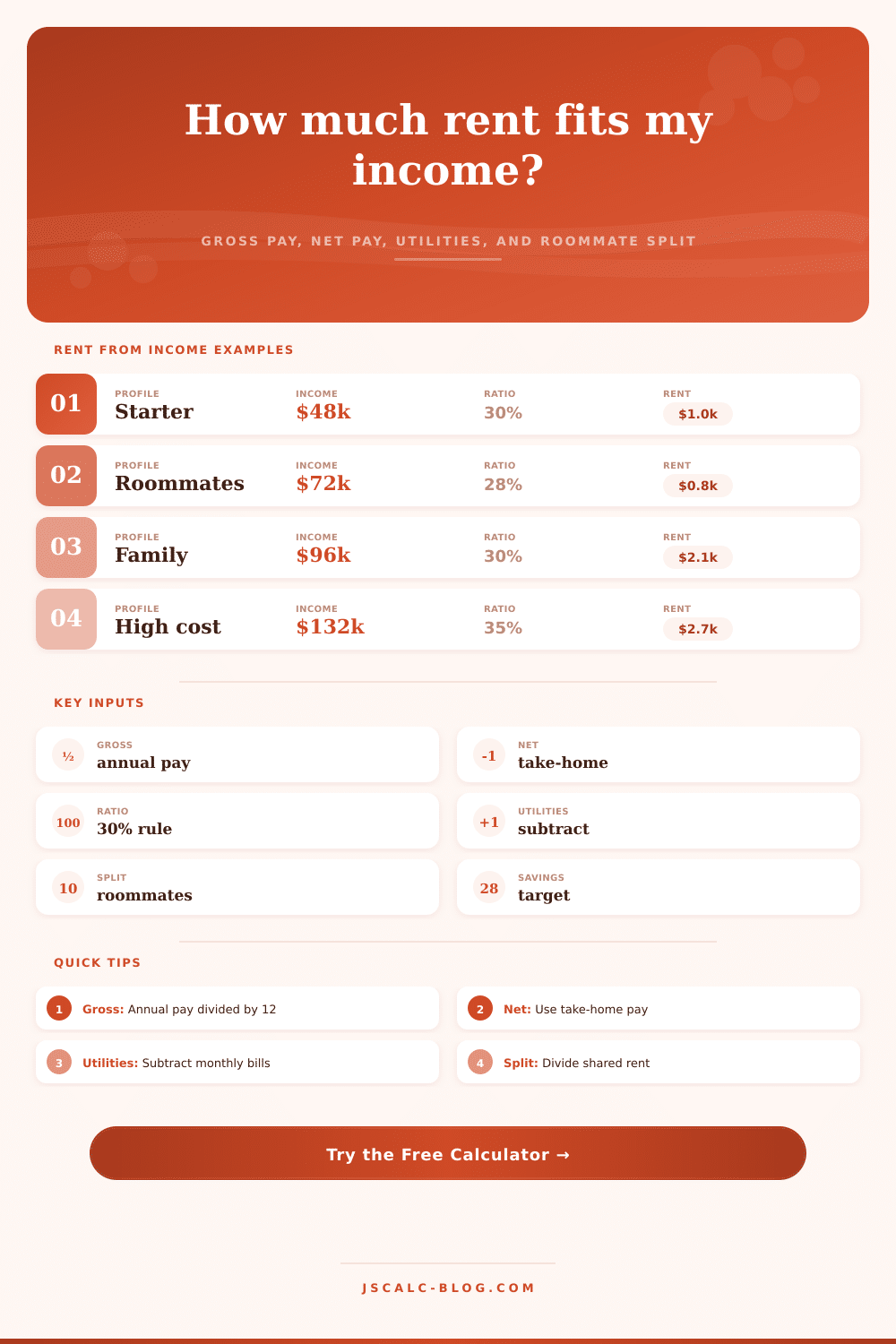
Estimate affordable monthly rent from gross annual income, net monthly income, rent-to-income ratio, utilities, insurance, debts, roommate split, pay frequency, and savings target.
🏘Rent From Income Presets
📝Income and Monthly Housing Inputs
Annual income before taxes, deductions, and benefit withholding.
Take-home pay received across a normal month.
Example: 30 means rent equals 30% of monthly income.
Used to show paycheck-level rent equivalents.
Electric, gas, water, internet, trash, or required service bills.
Monthly renter policy estimate or quote.
Student loans, car payment, credit cards, or other recurring debts.
Enter 1 when paying the full rent yourself.
Amount to reserve before setting the after-tax housing cap.
Changes only the main recommended rent card.
📊Current Income Snapshot
⚙Formula Breakdown
📋Preset Benchmark Table
| Preset | Gross annual | Net monthly | Ratio | Utilities | Debts | Split | Affordable rent | Housing outlay |
|---|
🔍Rent Ratio Sensitivity Table
| Scenario | Ratio | Gross cap | Net cap | Cash-adjusted cap | Rent after utilities | Your share |
|---|
💳Pay Frequency Table
| Pay frequency | Pay periods/year | Gross per check | Rent per check | Housing per check | Use in calculator |
|---|
🏢Common Rent-to-Income Reference
| Ratio band | Gross-income formula | Net-income variant | Utility treatment | Calculator use |
|---|---|---|---|---|
| 25% | Gross monthly x 0.25 | Net monthly x 0.25 | Subtract from cap | Conservative screen |
| 28% | Gross monthly x 0.28 | Net monthly x 0.28 | Subtract from cap | Common lender-style benchmark |
| 30% | Gross monthly x 0.30 | Net monthly x 0.30 | Subtract from cap | Default rule-of-thumb input |
| 33% | Gross monthly x 0.33 | Net monthly x 0.33 | Subtract from cap | Moderate stretch scenario |
| 35% | Gross monthly x 0.35 | Net monthly x 0.35 | Subtract from cap | High-rent-market scenario |
| 40% | Gross monthly x 0.40 | Net monthly x 0.40 | Subtract from cap | Stress comparison only |
💡Rent Calculation Tips
If you’re nervous, it’s because you have an eye on a attractive-looking apartment, but it will cost big bucks. You worry: “Will I have any money left over after paying rent?” You’ll notice many beginners begin by assuming they have enough money (which happens to be their paycheck). It doesn’t work… Especially since many will go hungry, or else dig themselves into debt.
If you put in your real take-home income, a calculator will spit out the magic number. That’s better than outdated formulas that ignore today’s prices. But that’s all vague. That’s the thirty percent rule. That also presumes housing consist entirely of rent. What about taxes? What about insurance, internet, electricity, and loan payments? Those are fixed costs. They competes with electricity and Wi-Fi for the same dollar. First subtract those costs then see what your actual ceiling is. Enter that into this tool. Now you have a practical ceiling rather than a hypothetical one.
How to Calculate Your True Rent Budget
Gross vs. Net income: Your offer letter will show you your gross income. What hits your bank account? That’s your net income. Budgeting based off gross income is a common mistake that will skew your budget upwards (because it excludes insurance + taxes). Money that doesn’t hit your bank account can’t be used to pay rent. The calculator gives you this option. Choose “net” if you want to see the real story: the one that removes the mask of pre-tax wealth.
The choice matters… Far more then the percentage ratio you pick.
You have roommates. The math shifts when you share a place, but that’s not necessarily how you think it would go. Rent gets divided evenly, but so does emotional stress? But it doesn’t necessarily divide the utilities? And some expenses remain invisible: While splitting rent helps you visualize your personal share, it doesn’t necessarily account for utilities or the emotional load. Sure, you pay less for square footage… But maybe you end up paying with your sanity (or at least your peace and quiet) because there’s an endless debate about who has what.
The social math is sloppy. But the monetary math make sense. If you’re looking to make your dollar go further, then divide the rent by the human bodies sharing the roof, and you’ll have your personal piece of the pie.
When you pay more for housing, you tend to slash other savings goals. That’s a big mistake: Small problems become big financial problems if you don’t have wiggle-room in your budget for emergencies. The calculator allows you to specify your target savings rate; and that lifts the bar on what you can afford for rent. Saving money ahead of time (before factoring in housing) puts stability above space, and though it feels restrictive initially, it give us greater freedom down the road.
You must tighten your budget in high-cost cities. If you live in a city with expensive bedrooms, you have to be more disciplined. Often, the thirty percent rule fall apart. You might need to reduce it to twenty-five (or even down to twenty) percent just to get by. That means living further from work, in an older building, or with smaller space. It’s a cost/benefit analysis of solvency vs. Comfort. Until you’re not able to pay the bills, most folks goes for comfort. Adjust expectations beforehand, that’s how you solve this issue before you sign a lease.
You should live for things, not have things livig for you. One is a home; the other is a job. Your house runs the numbers with everything included. This makes your house a tool to help you achieve what you want in life. The best apartment isn’t necessarily the one with the most amenities. It’s the one that leaves you with enough spare cash to actualy enjoy the apartment.