Rent Affordability Calculator
Check monthly rent against gross income, take-home cash flow, debts, savings goals, shared expenses, insurance, parking, and common affordability ratios.
🏠 Common renting presets
🧾 Income and monthly housing inputs
Use pre-tax income for rent-to-income and qualifying rent.
Hourly assumes 40 hours per week.
Use your actual monthly deposit amount after taxes and payroll deductions.
Enter lease rent before splitting with roommates.
Use 1 for solo renting, 2 for you plus one roommate.
📊 Ratio method quick grid
📋 Affordability ratio reference
| Ratio method | Gross income test | Debt adjustment | Best use | Caution point |
|---|---|---|---|---|
| 25% conservative | Rent is one quarter of gross income | Subtract required debt payments | High savings goals or unstable income | May limit neighborhoods sharply |
| 28% traditional | Classic housing expense benchmark | Debt still reduces available rent | Balanced household planning | Utilities can push cost higher |
| 30% common | Often used as a simple rent ceiling | Debt lowers qualifying rent | Fast first-pass rent screening | Net income must still work |
| 33% flexible | One third of gross income | Works best with low debt | Low-debt renters with stable pay | Leaves less room for savings |
| 36% stretch | Higher share of gross income | Debt can make this risky fast | Short-term or high-growth income | Residual cash needs close review |
| 40% maximum | Very high housing share | Usually only workable with tiny debt | Rare cases with strong cash reserves | Little margin for surprises |
🧮 Pay frequency conversion table
| Pay frequency | Monthly gross formula | Example input | Monthly gross |
|---|---|---|---|
| Annual salary | Annual income / 12 | $72,000 | $6,000 |
| Monthly | Monthly income x 1 | $5,000 | $5,000 |
| Twice monthly | Paycheck x 2 | $2,400 | $4,800 |
| Every 2 weeks | Paycheck x 26 / 12 | $2,100 | $4,550 |
| Weekly | Paycheck x 52 / 12 | $1,050 | $4,550 |
| Hourly wage | Hourly x 40 x 52 / 12 | $28/hour | $4,853 |
🔎 Formula breakdown
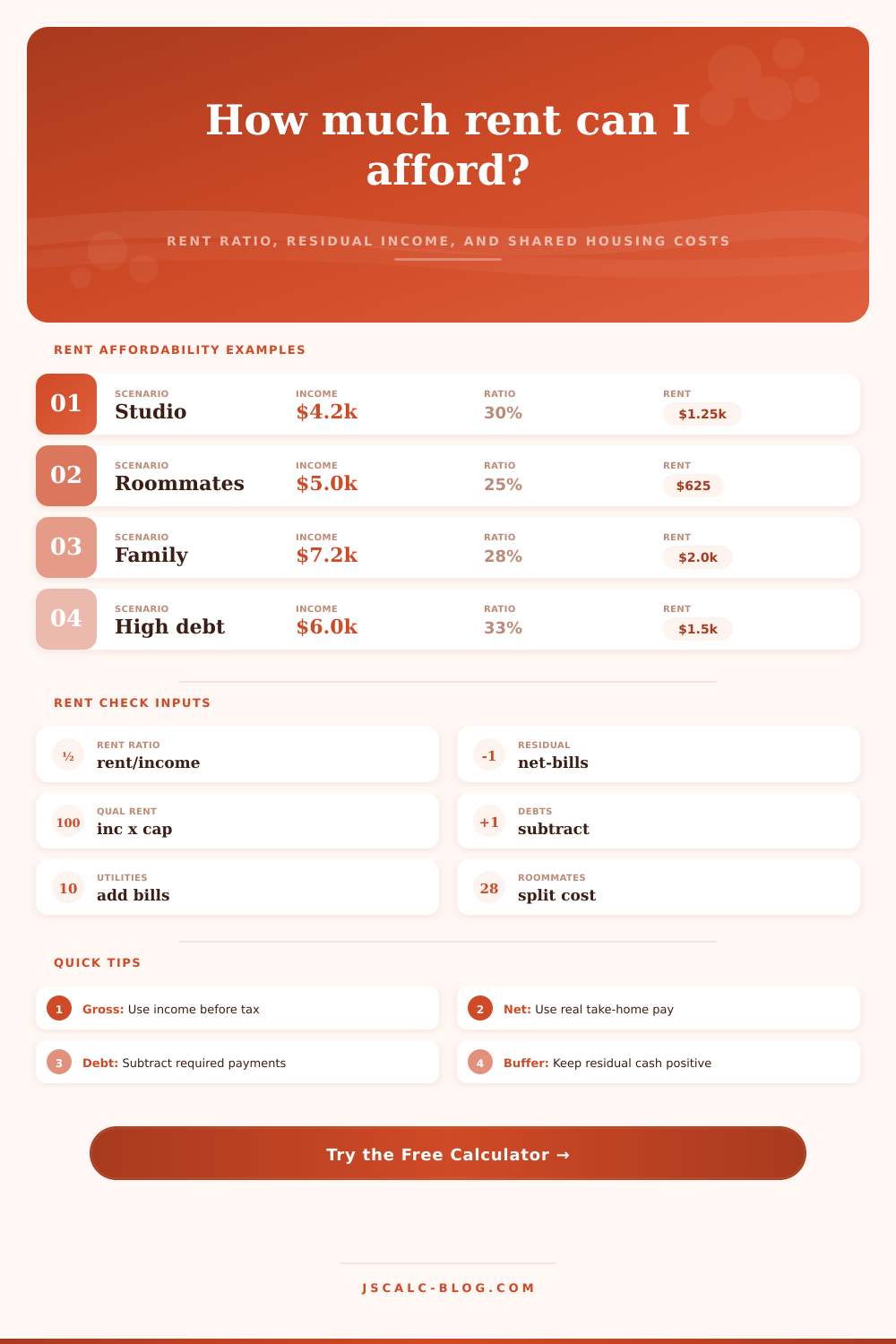
Rent-to-income = monthly rent / gross monthly income. This calculator uses total rent for the lease so the ratio shows the property-level rent burden against your income.
Residual income = net income - rent share - utilities share - insurance - parking - debt - savings goal. This is the cash left after the recurring items you entered.
Qualifying rent = gross monthly income x chosen ratio - monthly debts. This gives a debt-adjusted rent ceiling before utilities, insurance, parking, and roommate splitting.
💡 Practical renting tips
You have seen the listings before. You’ve seen them before: clean, bright rooms, listed slightly under your top price limit. According to everyone else’s rules, rent seem like it should be affordable. If it checks off all the boxes on the income verification form, it must fit budget. Sure enough, it stays within their chosen thirty percent.
But something still gives you pause as you picture yourself signing on dotted line. It’s not paranoia, your gut is telling you there’s more than meets the eye. Gross income isn’t the same thing as cash flow, and everyday financial burden doesn’t show up on any general rules list. To run the numbers based off your actual take-home pay, input your data into the calculator above. However, result will make sense only if you first understand why traditional metrics can misleed you.
Why Gross Income Is Misleading
What you keep, that’s the problem. Landlords think in terms of gross income, which stay constant regardless of your deductions or tax bracket. But since “gross” isn’t going into your bank account, you should of analyze net income instead. A “safe” rent-to-income ratio appears like this: 30% is okay if your income are large. But taxes, insurance, etc., can slash another 20% or so from your leftover cash, leaving nothing for other expenses. If you’re in debt, the ratios will shifts to match. See reference table on the page.
Most people don’t consider these adjustments. They glance at that 30% cap and feel secure. Their residual balance never goes negative, right? That is wrong. Rent affordability has nothing to do with rent amounts. It has everything to do with what’s left over after rent.
Second, this calculator makes you confront that leftover amount: your remaining income. It calculates your net pay, your take-home earnings, then deducts your savings goals plus debt payments, insurance, parking, utilities and (yes) rent. Those debts, whether that’s a car loan or credit card minimums. Compete for a finite pot of money with your housing expense. After all that, the tool clearly display your leftover money, aka your financial breathing room.
When that number is positive, you can afford unplanned expenses such as an oil change; when it’s negative, you’re already running a deficit before the month begins. That sounds like a minor detail, but it’s important: Your long-term stability depend on it.
That’s where the roommates preset helps; shared living is a whole different ballgame. Sure, having roommates will cut down on how much money you has to spend from your personal income (you’re sharing the cost of rent and utilities), but this also adds in social risk, something that can’t be quantified by any formula. According to the calculator, costs gets split down the middle, mathematically speaking, everything is equal. In real life, nothing is equal. Perhaps one of your roommate will leave early. Maybe another is prone to forgetting to pay the electric bill. Regardless of whose head is under the bed, you’re still on the hook for the entire lease. That’s why sharing bills decreases your monthly cost but doesn’t automatically decrease your level of stress unless you fully trust your housemates. The tool rely on cooperation. Assume friction and account for a buffer accordingly.
But there’s another wrinkle: the risk of rent increases. When it comes time for lease renewal, landlords will jack up prices by five to ten percent, even if you’ve been timely with payments for years. If you’re livig paycheck-to-paycheck today, which is to say if you’re right up against the 30 percent limit, that annual bump will push you into hardship territory. Despite not changing how much money you spend. To stress-test your budget, assume your rent will increase next year. Will your remaining cash flow still hold up? If your numbers become red with just a small hike, then you’re living on the razor’s edge. You want to find out about this limit soon. Find this out before handing over a security deposit, not after getting an eviction notice.
And finally: budgeting isn’t about deprivation, it’s about avoiding desperation. Once you’ve got healthy leftover cash flow, then whether you splurge on hobbies or eating out become an expression of preference instead of sacrifice. You don’t wonder “can I afford to fix this?”; you decide “do I want to fix this?”. The difference between knowing you have agency and feeling anxious is worth trading for a (slightly) cheaper apartment/roommate. It’s easy math when you eliminate all the illusions of gross income. But getting there takes seeing the complete picture, not just the headline number.