Prorated Rent Calculator
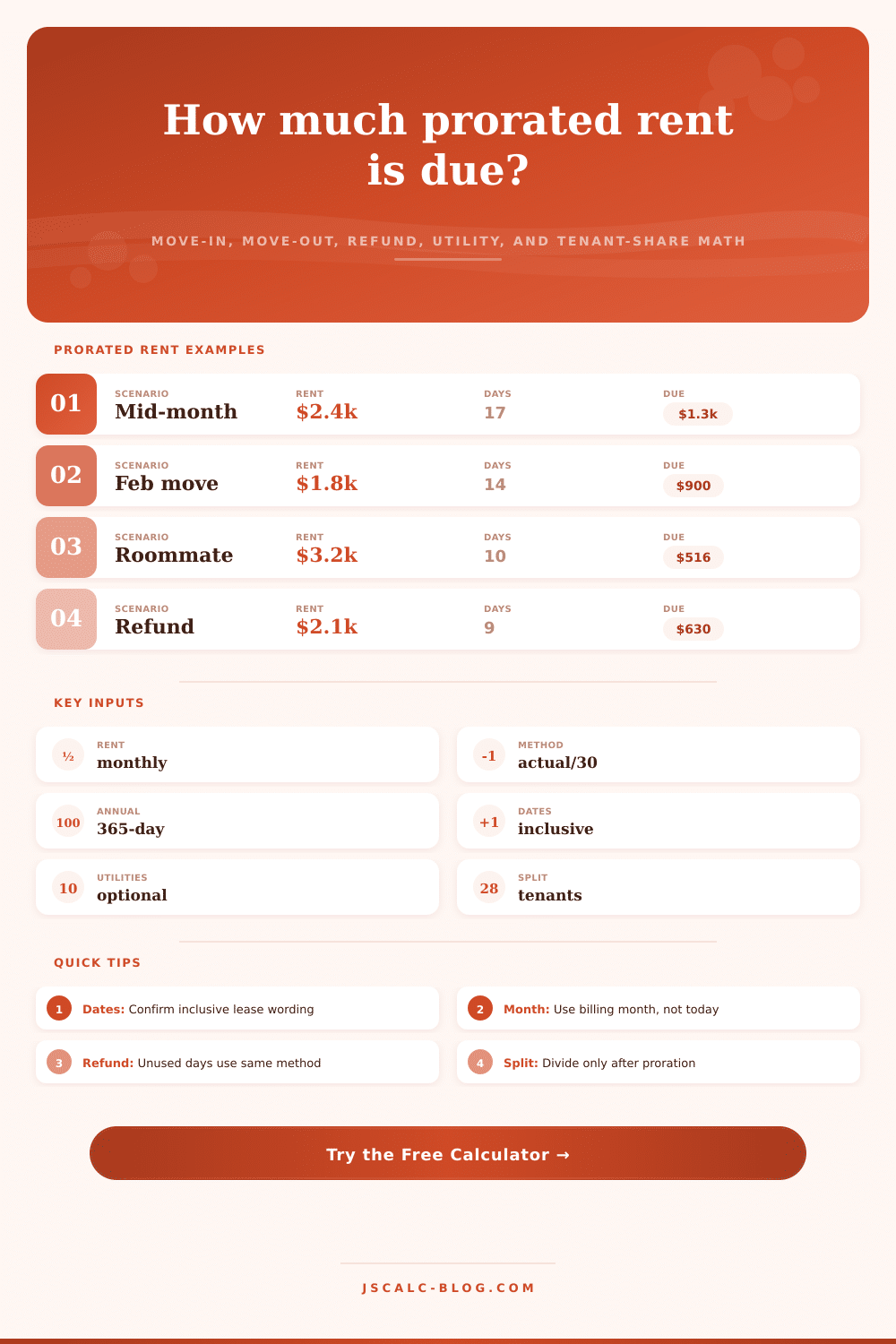
Calculate partial-month rent for move-in, move-out, tenant splits, utility add-ons, and unused-day refunds using actual-month days, a 30-day convention, or an annual 365-day daily rate.
📌Proration Presets
📝Rent Proration Inputs
Use the monthly rent being prorated, before utilities or deposits.
The month whose rent is being split.
Used to count February correctly in leap years.
Match the lease clause or local practice.
First date in the partial rent window.
Last date in the partial rent window.
Some leases charge from possession day; others start the next day.
Useful when keys are returned before the end date.
Optional recurring utilities added to the prorated total.
Shown for separation only; not included in the prorated amount.
Enter 1 for one payer, or the number of equal shares.
Refund uses the same daily rent and unused-day count.
📊Proration Snapshot Grid
⚙Formula Breakdown
📋Proration Method Comparison
| Method | Daily rent formula | Best fit | Common effect | Check in lease |
|---|---|---|---|---|
| Actual days | Rent / days in month | Most calendar-month leases | Daily rate changes by month | Look for actual calendar days wording |
| 30-day convention | Rent / 30 | Lease clauses using a fixed month | February daily basis is lower than actual | Confirm whether all months use 30 |
| Annual 365 | Rent x 12 / 365 | Annualized rent schedules | Same daily rent all year | Check if leap years are treated separately |
| Move-in due | Daily rent x occupied days | New tenant takes possession mid-month | Charges remaining occupied days | Verify key handoff date |
| Move-out refund | Daily rent x unused days | Paid month ends before final day | Credits unused portion | Verify surrender and notice rules |
| Tenant split | Total due / tenants | Equal roommate allocation | Splits after proration | Check if shares are unequal |
🗂Preset Comparison Table
| Scenario | Month | Method | Rent | Window | Occupied days | Daily rent | Rent due | Utilities | Tenant share |
|---|
📐Billing Month Day Table
| Billing month | Actual days | Actual daily rent on $2,400 | 30-day daily rent | Annual 365 daily rent |
|---|
📑Date Inclusion Guide
| Date choice | Occupied-day effect | Typical wording | Use with | Result impact |
|---|---|---|---|---|
| Include start and end | Both boundary days count | Rent starts on possession date | Move-in through month-end | Highest day count |
| Include start only | End date excluded | Rent owed through day before surrender | Move-out credits | One fewer day than full inclusive |
| Include end only | Start date excluded | Rent begins after free move-in day | Courtesy early access | One fewer day than full inclusive |
| Exclude both | Neither boundary day counts | Rare; explicit lease language only | Special adjustments | Two fewer days when range spans days |
| Out-of-month dates | Clipped to billing month | Partial month being reconciled | Ledger cleanup | No charge outside selected month |
| Same-day window | Depends on both selectors | One-day possession or return | Key exchange day | 0 or 1 occupied day |
💡Two Practical Tips
The anxiety of rolling into an apartment on the fifteenth of the month is a particular flavor. There are boxes on the porch and keys in your hand, but your wallet looks less strong then it ought to. Your landlord give you a number… Half a month‘s rent, perhaps, or maybe a full month if they’re feeling generous… And you just sign it, because dammit, you need a roof over your head.
That’s where financial clarity dies. And it doesn’t have to. Renting can become a game of understanding how rent gets divided up between partial months. This change who has the upper hand from the very beginning. Once you get past the lease jargon, the math isn’t actualy all that complicated. Basically, you’re purchasing a service (i.e., shelter) with each passing day. Each day come with its own price tag.
How to Calculate Rent Fairly
Prorates are tricky. How do you decide which calendar trumps? That is the core of the problem with proration. And that’s what the calculator above does, runs the numbers for you. Here’s how: Most folks believe there can be only one right answer when you try to divide rent by days. There isn’t.
Your lease probably states an approach that favors the landlord; typically by slightly increasing the daily amount. For example, the “actual-month” calculation split the rent by the true number of days in February (or July). It seems fair since it mirrors real life. But then we have the “thirty-day convention,” which treats each month as if it contains exactly thirty days. It’s consistent-sounding … until you learn this approach will inflate your daily cost in January but deflate it in May. Next we has the annualized approach, which applies the expense to three hundred sixty-five days. This evens out the calendar year’s highs and lows.
What’s interesting is that tenants seldom consider the matter, yet the choice make a bigger impact than most believe. Ten cents extra per day compounds during a partial move-in period. The other trap is date inclusivity. In leases, all the possible days you touch the place become included to squeeze maximum rent from you. So if your lease states rent begins on possession, then yes, you pay for the day when you unlock the door. And if your lease states rent terminates on surrender, you may pay for the day you toss keys in the mailbox.
The table on the page makes it plain: it shows how shifting those boundary days changes the total. Look at your start-and-end dates; are these dates included or excluded? It’s no pedantry. Cash coming out of your pocket. On the thirtieth, you move out. But the landlord bills to the end of the month and you’ve paid for two days worth of empty space.
These cost items is overlooked in these equations until the day the bill arrives. Maybe you have a rent line item. But maybe there’s a trash fee or a water fee too. If you’re splitting up the stay, those should be prorated as well. The tool does so by treating utilities as an additional line of rent. It splits them on a daily basis just like your primary lease. That leaves the ledger clean. You’re paying for what you use. Nothing more.
Application fees and security deposits are a different animal. They aren’t time-based rents, and they shouldn’t be mixed into your proration math. Unlike those other items, they don’t shrink based off fewer days. Keep ’em separate, avoid confusing things at deposit-back-time.
There are other problems that come up from sharing a bill with your roommate. Let’s say two people move in together mid-month. They typically calculate the total first, then divide by the number of people paying. Now let’s say one of them leaves early. We still want to know their daily rate, but now we’re looking at different days. So guess who gets screwed? Yep, the other person. Always divide by the number of people paying first, then find the total owed. Don’t start by saying, “Let’s see, the rent is $XXX/month. Half of that is… ” You will only end up arguing over rounding errors. Find the total cost for house. How many days did it sit empty? Then cut up the pie.
That’s crazy enough as it is, but why would you want to complicate things by introducing math? You’ve got boxes to pack. You have movers to deal with. You have a mattress on the floor to sleep on. The last thing you need is to bicker over fractions of pennies. Let a tool calculate the calendar quirks for you.
Before signing a lease, know what method they use. When receiving keys, ask them what dates are included. This tiny bit of precaution protects your budget at its most vulnerable moment. Renting isn’t fair, and fairness is never just given away. It’s always calculated. Verified. And paid, with open eyes.