Rent Increase Percentage Calculator
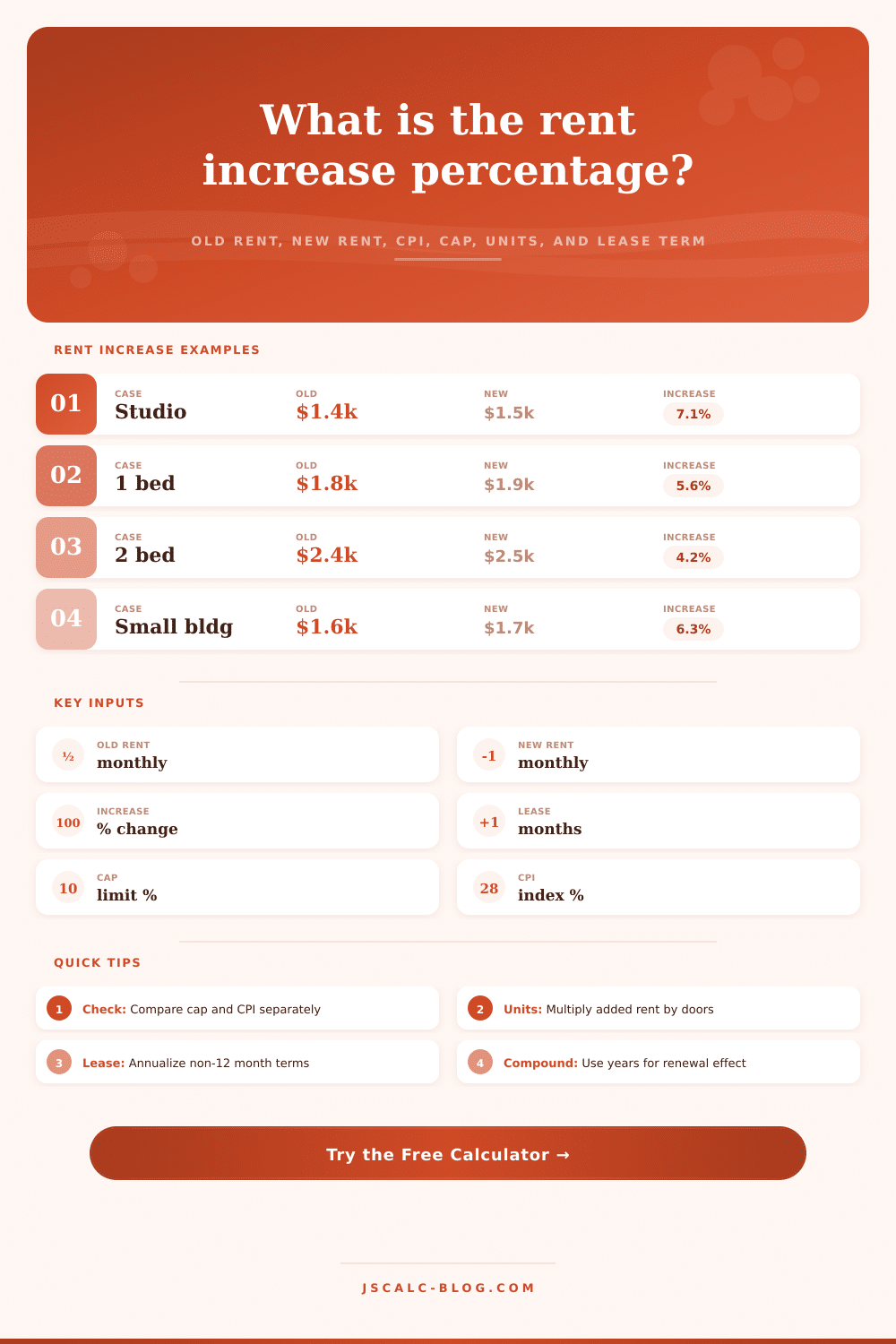
Calculate the rent increase percentage from old rent and new rent, or solve the new monthly rent from an entered percentage, then compare caps, CPI, lease months, units, and compound renewals.
🏘Rent Increase Presets
📝Rent Increase Inputs
Current monthly rent before the proposed change.
Proposed rent when calculating the percentage increase.
Used when solving new rent from a percentage.
Choose which entered value should drive the calculation.
Used for lease-term added rent and annualized rate.
Projects repeated increases over future renewal periods.
Optional benchmark cap for comparison only.
Optional inflation benchmark for comparison only.
Flags whether the rent line includes utility service value.
Applies the monthly increase across multiple similar units.
📊Current Rent Increase Snapshot
⚙Formula Breakdown
📋Preset Benchmark Table
| Preset | Old rent | New rent | Increase | Lease | Years | Cap | CPI | Units | Annual added |
|---|
🔍Cap and CPI Sensitivity Table
| Benchmark | Increase rate | Monthly rent | Monthly change | Annual added | All-unit annual |
|---|
📅Lease Term Impact Table
| Lease length | Monthly increase | Lease added rent | Annualized rate | Renewal periods in years | Compound rent |
|---|
📐Rent Increase Reference Table
| Increase band | Decimal form | New rent formula | Monthly change on $2,000 | Typical calculator use |
|---|---|---|---|---|
| 0% | 0.000 | $2,000 x 1.000 | $0 | No-change renewal |
| 2% | 0.020 | $2,000 x 1.020 | $40 | Low inflation comparison |
| 3.5% | 0.035 | $2,000 x 1.035 | $70 | CPI-style benchmark |
| 5% | 0.050 | $2,000 x 1.050 | $100 | Common renewal test |
| 8% | 0.080 | $2,000 x 1.080 | $160 | Cap comparison input |
| 10% | 0.100 | $2,000 x 1.100 | $200 | High-increase scenario |
💡Rent Increase Calculation Tips
You get the rent increase notice in the mail: There’s nothing like it, and the anxiety it causes has as much to do with math as the money. Two number appear on the page, and you want to know how big the leap from one to another is… Legal? Is it fair? It’s an automatic urge to turn immediately to the dollars involved, but before you do, stop and figure out what gap represents in percentage terms.
That percentage; not the dollar amount, is what realy matters, because that’s the number that will tell you if you has a reason to stay put … or time to begin scanning listings anew. When you’re racing with your heart pounding, you don’t want to make any arithmetic mistakes; thankfully, the calculator above take care of that.
Why You Should Use the Rent Increase Calculator
More importantly, though, it doesn’t merely divide one number by other. It requires you to view the increase from several angles at once. This give you a sense of perspective that most people lack, as most people focus only on raw percentage increase which is not nearly enough information. You need to know how much inflation has been running locally, and/or whether there’s a cap on rental hikes under state law; those figures let you compare what your landlord are asking for with what everyone else is getting in your area.
And the tool makes it easy for you to toggle between these benchmarks all at once so you can easily see just how aggressive this rent increase will be different than both the law and market.
Another variable that trips people up in surprising ways are lease length: although a 12-month and a six-month lease may have the same dollar value on a month-to-month basis, a six-month lease re-up doesn’t feel like a 12-month one; and therefore has different psychological effect on us. To account for this, calculator will automatically annualize the extra cost based off the length of your lease. This is important because shorter leases typically result in greater landlord turnover costs. Sometimes they includes these costs in their renewal prices to make up for lack of stability. In order to know whether you’re getting charged a premium for flexibility, make sure you see those figures adjusted to match.
A slight uptick in monthly rent won’t seem so harmless once you multiply that figure by the number of units in your building; or when you compound those renewals over three years. A five percent jump doesn’t sound like big deal at face value, but compound growth. Where little percentages translate to very large dollars rapidly (is where it’s at). Accepting a renewal today when you still have three years left means your total compounded increase would of been much more then fifteen percent.
This is why the tool project this forward to show you the long-term effect of signing now. It helps answer whether signing today buys you peace of mind or locks you into a path that will eventualy force you out.
Before signing on the dotted line, it’s also important to look at utilities closely, if your rent already pays for electric, garbage, and water, then that little bump in price may simply be reflecting an uptick in city fees and not actualy lining the landlord’s pockets. Breaking out the base rent from other bundled services help you see where they’re charging more so you know whether it makes sense to save money by moving versus the one-time cost of finding a new home.
But here’s the thing: Rent hikes are not always just math. There is people involved. You have to consider how much you care about your current neighbors and what other jobs is available in the local market. The math empowers you to ask more informed questions, and once you get your head around the percent instead of the dollar figure, you no longer respond to sticker shock with emotion but rather negotiate from a place of clarity.
You know exactly where the line is, between reasonable market adjustment vs. It is an unreasonable increase. And that line is all that separate staying home with confidence versus moving away with regret.