Renovation ROI Calculator
Estimate renovation ROI, payback period, after repair value, new equity, rent lift, annual savings, selling-cost drag, and holding-period return.
🎯Load a renovation preset
📝Enter renovation assumptions
Use current as-is market value before the project.
Base project cost before contingency.
Estimated market value lift supported by comps.
Enter zero for owner-occupied projects.
Energy, maintenance, insurance, or utility savings.
Years you expect to hold after completion.
Agent commission, credits, transfer taxes, and closing costs.
Added to renovation cost before ROI and payback.
Used for reference recovery and risk context.
Printed in the result status and comparison table.
📊Current renovation snapshot
🧮ROI and equity breakdown
| Line item | Formula | Input | Amount | Share of cost |
|---|
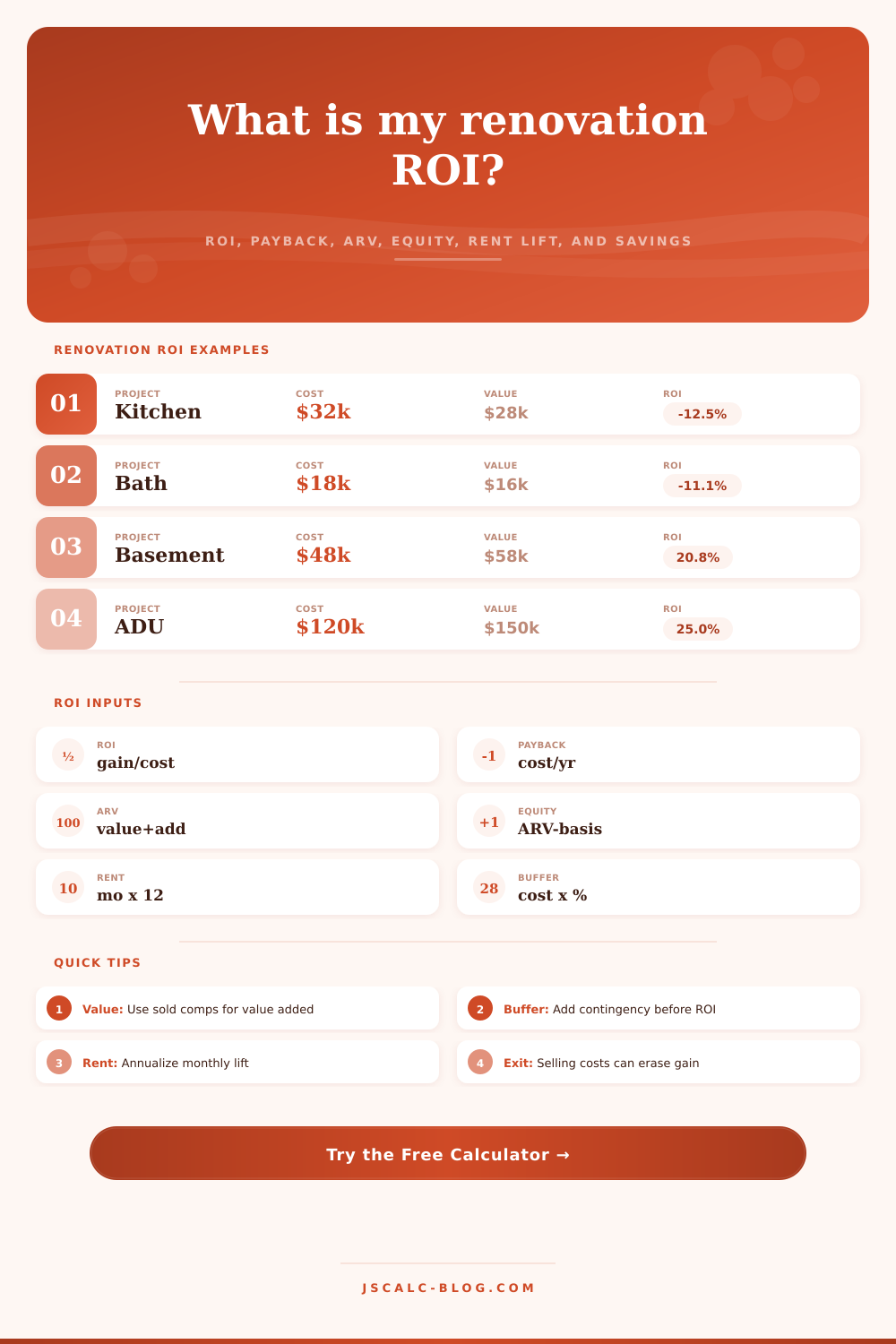
Direct ROI uses the required formula: ROI% = (value added - renovation cost) / renovation cost x 100, with contingency included in renovation cost.
📈Holding period sensitivity
| Hold years | Annual benefit | Cumulative benefit | Total gain before sale | Hold ROI | Net exit gain |
|---|
Hold ROI adds rent lift and annual savings to value added, then compares that benefit with the adjusted renovation cost.
🏗Project type reference grid
Kitchen
Visible buyer appeal, strong comp support, and moderate disruption.
Bathroom
Compact scope with a clear finish-level value signal.
Basement
Adds functional area when ceiling height and egress work.
Exterior
Siding, deck, and windows can improve first impression.
Rental Suite
Often depends on legal use, rent lift, and utility separation.
📋Common renovation ROI references
| Project type | Reference recovery | Typical value driver | Rent/savings effect | Risk note |
|---|---|---|---|---|
| Minor kitchen update | 65% to 85% | Cabinets, counters, fixtures | Low to moderate rent lift | Over-finishing can flatten ROI |
| Major kitchen remodel | 45% to 70% | Layout, appliances, finishes | Moderate rent lift | Scope creep changes payback quickly |
| Bathroom refresh | 55% to 75% | Tile, vanity, waterproofing | Low to moderate rent lift | Hidden plumbing can raise cost |
| Primary suite addition | 40% to 65% | Bedroom, bath, closet | Moderate rent lift | Addition cost can outrun comps |
| Basement finish | 50% to 80% | Finished area and egress | Moderate to strong rent lift | Moisture and code details matter |
| Wood deck addition | 55% to 80% | Outdoor living area | Low rent lift | Climate and maintenance affect value |
| Siding replacement | 60% to 90% | Curb appeal and envelope | Low savings effect | Material choice affects recovery |
| Window package | 50% to 75% | Comfort and energy performance | Moderate savings effect | Payback often relies on savings |
| Energy retrofit | 30% to 65% | HVAC, insulation, controls | Strong savings effect | Utility rates drive payback |
| ADU or rental suite | 70% to 110% | Income stream and legal unit | Strong rent lift | Permits and zoning dominate risk |
📝Preset comparison table
| Preset | Project type | Current value | Cost | Value added | Rent lift | Savings | Hold |
|---|
📐Formula guide
Every home remodel has a moment. This happens when your wants collide with your wallet. You stare into a tired kitchen, dreaming of soft-close cabinets and quartz counters. And remembering… that you have to buy them.
Home renovation ROI lives in the gap between what you want and what you can afford. Renovation isn’t just about style; it’s also an investment question: will this expense pay off in dollars when you sell? Most homeowners only care about cost recovery (which is fair, since it’s a useful place to start). Does spending thirty thousand dollars increases the appraised value by thirty thousand? Generally…no, and almost never “yes.”
How to Save Money on Home Repairs
Returns depends on the nature of the project and local limit for similar work. Some projects, like a modest kitchen refresh, can recoup 70%. Others barely break even, recovering less than half their costs. To avoid guessing whether that nice new backsplash is an investment (or a vanity purchase), you can enter your own assumptions into the calculator above so it does the math for you.
Look beyond gross value added, think about net gain after expenses. Before doing any calculations on returns, it’s necessary that you add a contingency buffer. Once the drywall goes up, renovations reveals hidden problems. Outdated wiring, old plumbing, and structural surprises aren’t possibilities, they’re certainties with an older home.
Budgeting only for best-case scenarios will balloon your actual cost, blowing out your projected return before you’ve laid a single brick. Add ten to fifteen percent to your base estimate. This protects your margins. It turns a potential disaster into a manageable line item. This small adjustment matter more than choosing the right faucet finish.
Now: What happens if you’re not selling right away? What if you intend to hold onto the place? Metrics change completely. Equity growth begin to battle cash flow. Is a bathroom refresh worth it on paper, or does it simply add marginal resale value? That remodel may allow you to increase your rent by two hundred bucks per month which, over five years… Can grow into multiples more than your original cost.
And here’s where everyone gets confused. They view an income-increasing upgrade as a sale-day metric. They fail to account for its steady monthly gain, which builds up straight in their pockets. On the page, I’ve laid out a reference table for several kinds of project, illustrating what drives income and what drives value.
The other silent killer is cost of selling. When we trade up or flip our home, there’s commission fees paid to agents, closing credits and transfer taxes. These all eat away at gross profits. A twenty thousand dollar profit on paper could dwindle down to twelve thousand dollars once we pay exit fees. It feels as if someone stole from us. Until we run the math. The tool takes the drag into account so you don’t celebrate a win that never reaches your bank account.
What you want to know is what goes into your pocket, not what the Zillow estimate tell you. You might be updating the siding, so why not upgrade those windows as well? While that’s an understandable justification, it adds another feature. This lengthens the timeline and increases exposure to market shifts. Time is money in real estate.
The longer it take for the renovation to complete, the more holding costs you incur. Insurance doesn’t stop paying when you choose to install one additional closet. Neither does interest nor taxes. Hold the line on scope. Get ‘er done on schedule. Protect the margin. This is how you convert sweat equity to actual equity without losing either your mind or your money in the effort.
You should of planned better.