BRRRR Return Calculator
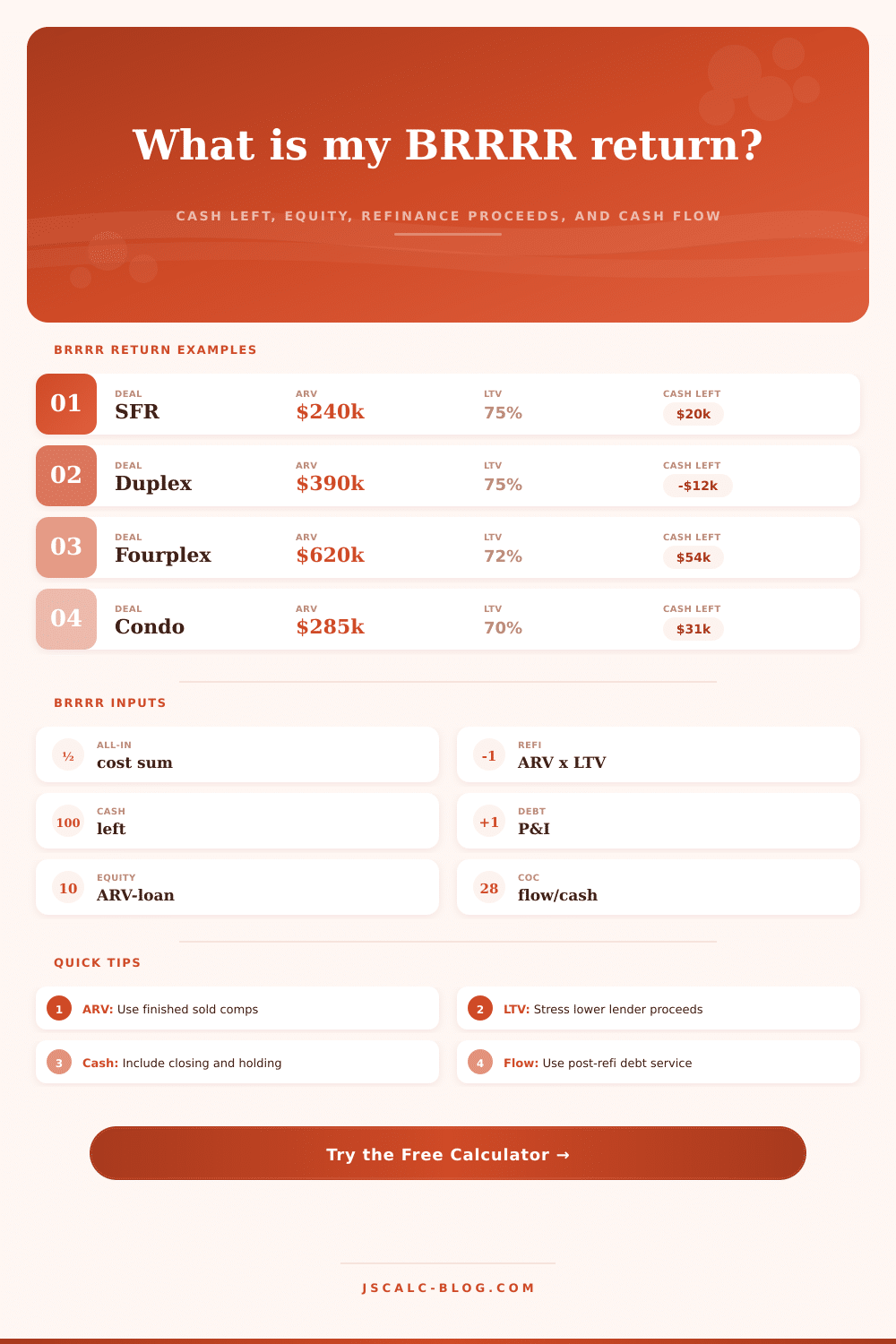
Estimate all-in cost, refinance proceeds, cash left in the deal, cash-on-cash return, equity, and post-refinance cash flow for a buy, rehab, rent, refinance, repeat scenario.
🏘BRRRR Deal Presets
📝Deal and Refinance Inputs
Contract price paid before rehab.
Repairs, turns, permits, labor, and materials.
Post-rehab value supported by completed comparable rentals or sales.
Loan-to-value used for the cash-out refinance.
Expected stabilized gross rent after rehab.
Taxes, insurance, repairs, management, vacancy, utilities, HOA, and reserves.
Annual fixed-rate estimate for the post-refinance loan.
Amortization term for principal and interest.
Purchase and refinance closing costs entered as one total.
Taxes, utilities, insurance, lender interest, and vacancy before stabilization.
Actual cash into purchase, rehab, closing, holding, reserves, and financing gaps.
The headline cash-on-cash formula still uses annual cash flow divided by cash left.
📊Current BRRRR Snapshot
⚙Formula Breakdown
📋Preset Comparison Table
| Preset | Purchase | Rehab | ARV | LTV | Rent | Rate | Cash left | Monthly flow | Equity |
|---|
🔍Refinance LTV Sensitivity Table
| Scenario | LTV | Refi proceeds | Cash left | Payment | Monthly flow | Cash-on-cash |
|---|
📈Rate and Rent Stress Table
| Stress case | Rent | Rate | Payment | Monthly flow | Annual flow | DSCR |
|---|
🏢BRRRR Reference Ranges
| Metric | Conservative check | Moderate check | Aggressive check | What changes the result |
|---|---|---|---|---|
| Refinance LTV | 65% to 70% | 70% to 75% | 75% to 80% | Loan program, appraisal, seasoning, DSCR, borrower profile |
| Cash left | 20%+ of all-in cost | 5% to 20% of all-in | Zero or cash out | ARV accuracy, rehab control, lender haircut, closing costs |
| DSCR after refi | 1.10x to 1.20x | 1.20x to 1.35x | 1.35x+ | Rent, expenses, rate, term, and loan proceeds |
| Equity margin | 20% to 25% | 25% to 30% | 30%+ | ARV, LTV, appraisal support, repair scope |
| Cash-on-cash | 0% to 5% | 5% to 10% | 10%+ | Cash left and annual cash flow after refi |
| Expense load | 45%+ of rent | 35% to 45% | Under 35% | Taxes, insurance, repairs, management, vacancy reserves |
💡BRRRR Calculation Tips
In a BRRRR deal, most first-time investors look only at equity paper gain without considering the cash they leave in property. They think, “Hey, I’ve got this house which was worth $150,000 and now it’s worth $240,000! I am rich! The problem is that lenders don’t typically lend up to that full appraised value right away, especially when it’s a newly-repaired house. They will require seasoning, as they likes seeing proof that the tenant stays. They will also nearly always cap your loan-to-value ratio at 75% or below. This means there’s a gap between the value of the house versus what the bank is willing to offer.
That’s where you’ll set your capital free … or get it trapped. Once you plug in your own numbers (i.e., costs), the calculator does all of math for you. You can then determine whether you can reuse your money or if you need a lot of cash upfront.
How to Keep Your Cash Safe in BRRRR Deals
Second, get real with your rehab budget. Paint + drywall =/= rehab budget. Your rehab budget includes permits and unexpected repairs like mold remediation. It also covers holding costs while the property is vacant and closing fees on both ends of the transaction. Underestimate this number by $10k and boom: no cash-on-cash return.
This tool will allow you to tinker around with each variable independently; including seeing what happens if you face an unexpected repair bill. Most folks think of their rehab estimate as a fixed point. They shouldn’t. It’s a range, which is a dangerous error here since there’s no wiggle room when attempting to recieve your initial investment during the refi process.
Everything hinges on one thing: the size of the refinance loan. How much money will it be? How much cash will you have after? Will it drain your cash, or will it set you free? The tool has a reference table where you can see impact of various loan-to-value (LTV) scenarios. A lower LTV protects you from risk, but at what cost?
By toggling through the calculator, you can see that if your assumed LTV is 75%, but you get a 70% LTV because of tougher underwriting standards or higher interest rates, your cash flow might not cover debt service. Stress-test the figure before writing any checks. When entering assumptions into the calculator, you can toggle between “conservative” and “aggressive.” Then you’ll be able to envision the downside case without getting your hopes up about a best-case scenario that might never pan out.
The other key variable that people frequentely neglect in their initial estimates is rent stabilization. Unless you have some sort of stabilized rental stream, you won’t be able to refinance the property, so you’ll have to find a tenant and cover mortgage payments out-of-pocket for at least a few months. Those carrying costs realy add up.
The input for monthly expenses requires you to plug in figure for maintenance, vacancy reserves, insurance and taxes. If your projected rent is too low relative to these expenses, your debt service coverage ratio will drop below what lenders require. In today’s lending climate, a DSCR < 1.2 may be enough to sink the deal. The test shows the impact of rental income variation (or interest rate changes) on the DSCR, so you know if you’re stretching it on paper-thin margins.
Cash flow rules, it’s what pays the bills now and over time builds wealth. Having a lot of equity in an investment property isn’t very meaningful if every month you’re dumping thousands of dollars back into the property just to keep the doors open. Your aim is to create a self sustaining asset: one where you’ve recouped your money (via refinancing) and one which throws off positive monthly cash flow.
That’s why you have to strike a balance between risk and reward. You need some debt to boost returns, yet not so much as that even a tiny increase in interest rate or decrease in rent pulls you into negative cash flow. That’s what makes the difference between good investors and bad ones, understanding these dynamics so you don’t end up holding onto an underwater property that you can neither afford nor sell.
All of this adds up to what I call the BRRRR strategy… An efficient way to recycle capital. It takes patience when executing, but also precision when underwriting. Don’t chase a “good-looking” deal. Drill down further into the numbers. Check the comps on after-repair value. Make sure the local rental market will support your projected income. Model various situations using the available tools. Before putting money at risk, take time to consider all sides of the situation.
If you apply such discipline to every property, you’ll improve your odds of creating a portfolio that churns out predictable returns instead of locking away your hard-earned money in dead-end assets. Your success or failure could of depend upon your ability to accurately include realistic lending constraints and hidden costs from day one.