REM Sleep Cycle Calculator
Estimate your total REM time, REM minutes per 90-minute cycle, the deep and light stage split, and the best light-sleep wake times so you rise at a cycle boundary instead of mid-REM.
💤Real Sleep Presets
📝Sleep Inputs
Wake time in wake mode, or bedtime in bed mode. Ignored when sleeping now.
Only used when the mode is set to sleep now.
Adults average about 90 minutes per full cycle.
🔢Model Snapshot
⏰Cycle-by-Cycle Wake Options
| Option | Cycles | Total Sleep | Bed / Wake Time | Total REM | Deep Sleep | Stage Split |
|---|---|---|---|---|---|---|
| Choose a mode and time above to build your wake options. | ||||||
🧠Stage Composition Per Cycle
| Cycle | N1 Light | N2 Light | N3 Deep | REM Min | REM % | Note |
|---|---|---|---|---|---|---|
| Stage minutes appear after you calculate. | ||||||
📊REM Share by Age Reference
| Age Group | Typical Sleep | REM Share | REM Minutes | Deep Trend | Notes |
|---|---|---|---|---|---|
| Infant 0 to 1 yr | 12 to 16 hr | ~50% | Very high | Rich deep | REM dominates early life |
| Child 1 to 12 yr | 9 to 12 hr | ~25% | High | Strong N3 | Deep sleep peaks in childhood |
| Teen 13 to 17 yr | 8 to 10 hr | ~23% | Moderate | Shifts later | Body clock runs late |
| Adult 18 to 59 yr | 7 to 9 hr | 20 to 25% | Moderate | Steady | REM lengthens late in night |
| Older 60+ yr | 7 to 8 hr | ~18% | Lower | Less N3 | Lighter, more awakenings |
🛏Ideal Sleep Duration & REM Comparison
| Sleep Length | Cycles | Total Min | Est. REM | REM % | Best For |
|---|---|---|---|---|---|
| 4.5 hours | 3 cycles | 270 | ~60 min | ~22% | Emergency short rest |
| 6.0 hours | 4 cycles | 360 | ~100 min | ~28% | Busy weekday minimum |
| 7.5 hours | 5 cycles | 450 | ~150 min | ~33% | Adult target sweet spot |
| 9.0 hours | 6 cycles | 540 | ~200 min | ~37% | Recovery and teens |
| 10.5 hours | 7 cycles | 630 | ~250 min | ~40% | Illness or catch-up |
| 12.0 hours | 8 cycles | 720 | ~290 min | ~40% | Children and infants |
⚙Full Formula Breakdown
📋REM Stage Reference
| Stage | Type | Share of Night | When It Peaks | Role |
|---|---|---|---|---|
| N1 | Light NREM | ~5% | Sleep onset | Drifting into sleep |
| N2 | Light NREM | ~45 to 50% | Throughout | Memory sorting, spindles |
| N3 | Deep NREM | ~15 to 20% | First half | Physical repair, growth |
| REM | Rapid eye movement | ~20 to 25% | Second half | Dreaming, memory, mood |
| Wake | Brief arousal | ~5% | At boundaries | Normal micro-awakenings |
💡Practical REM Sleep Tips
If you’ve ever slept for six or seven hours and then woken up, you’ve likely experienced the difference. In one case you woke up refreshed and ready for the day; in another, groggy and slow. The reason why has very little to do with how long you were in bed. Instead, it’s almost entirely based off when during your sleep cycle your alarm clock went off.
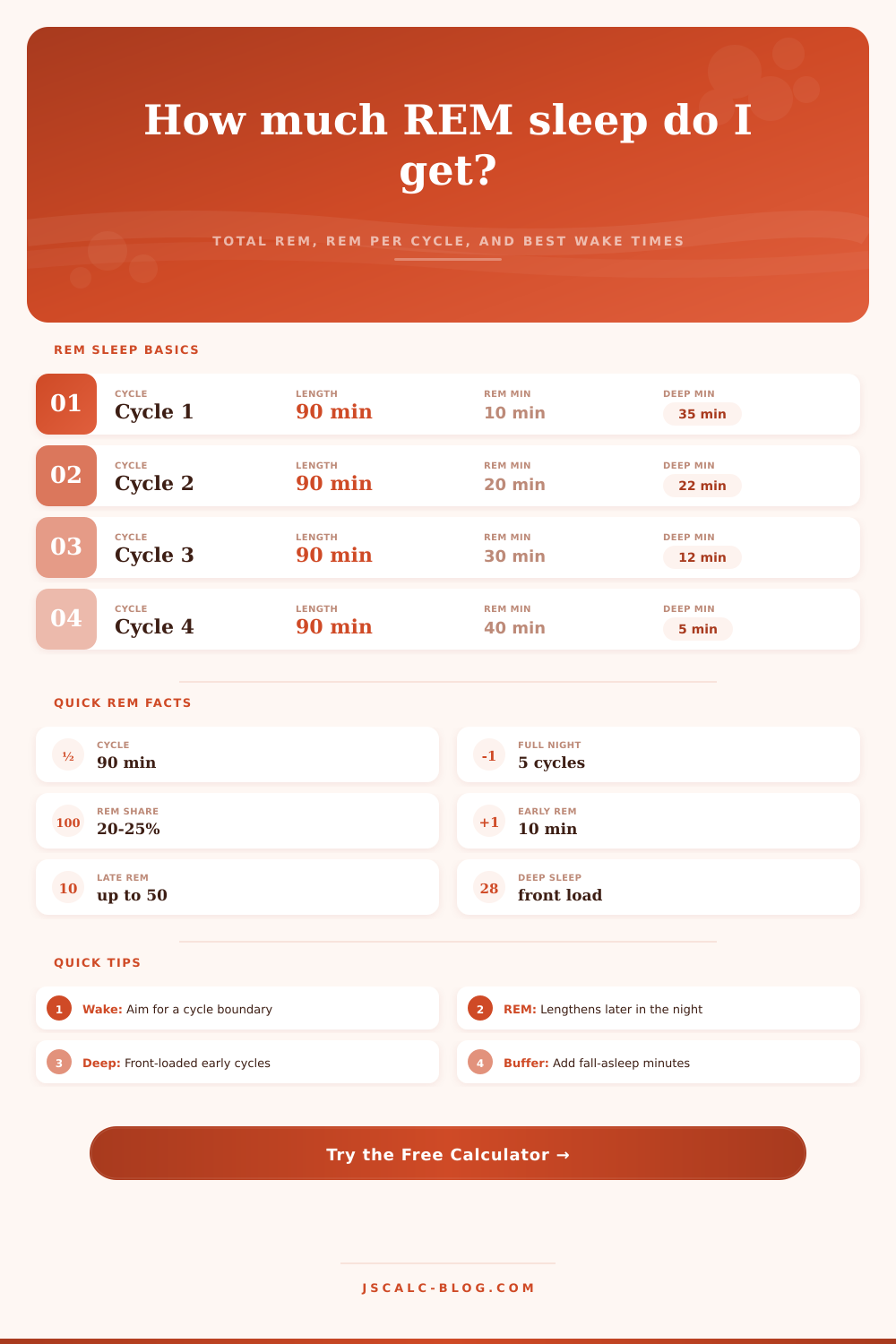
The brain isn’t humming along constantly, it pulsates in approximately 90-minute intervals. Within each interval, there are different stages. Some is deeper and more restorative. Others are where you are basicly just dreaming rapidly with your eyes closed. Interrupting that pattern in the midst of a deep one costs you big-time by making you groggy for hours afterwards. This tool is an attempt at solving that core problem.
Why Your Sleep Cycle Matters for Waking Up Fresh
Once you know how long you want to sleep (or when you want to wake up), just enter the number into the calculator above, and it’ll do the math for you. And while it won’t tell you exactly what’s going on inside your head during sleep, it will estimate your overall amount of REM time and break out what kind of sleep make up each cycle.
You may think that all sleep is created equal, that any hour-long stretch of shuteye is roughly equivalent to another one. But it’s simply not true. Deep N3 sleep dominate the first part of the night, helping restore our bodies and boost protection against illness. Later on, there’s a heavy lean into REM sleep, during which our brains consolidate memories and process our emotions. That curve is important because you can’t trade an hour of early-night sleep for an hour of late-night sleep without missing out on some of the perks.
This understanding allow you to choose what you do more wisely. One such variable is the fall asleep buffer… Probably the least considered element of planning your sleep schedule. Your alarm may be going off at precisely five cycles after putting your head on the pillow but chances are you’re dead wrong. On average, it takes a person between fifteen and twenty minutes to finally move into Stage 1 sleep. If you neglect this delay, your alarm will wake you up while your brain is still whirring in an attempt to get to sleep, shaving almost a quarter hour from your overall sleep. The app adds your predicted onset time prior to the start of the first cycle.
It turns out that your age has an unexpectedly big influence on what your nights will look like. Babies have up to half of their sleep time spent in REM; they’re building brain connections at a breakneck pace, after all. As we reach adulthood, that portion decline to about twenty percent, although those minutes are still very rich. As we get older, there can be another decline, not just in the amount of deep sleep, but in the amount of REM as well, which leads to a lighter, more fragmentary night’s sleep. The calculator takes your age into account when it makes its estimates. So you’ll see something closer to your actual physiology instead of some sort of generic average number that your body won’t ever actualy live up to. This is explained nicely in the table on the page that references the data above.
The pattern there shows that in early cycles deep sleep happens early, but as we age it gets pushed further back into REM stage (which becomes longer in later cycles). This makes sense of why missing sleep on a long night doesn’t bother you as much as napping on one of the short ones. You are probably cutting off the cycle with the deepest sleep and the strongest dreaming and memory consolidation. It’s not simply fewer hours of sleep. It’s sleep that differ in quality. Saving those last couple of hours can matter much more then padding your start-of-night time if you’re looking for mental clarity.
Does it really matter trying to wake up right at an interval point? Ninety minutes seems like a lot of time to try and hit. Well, it depends on how you deal with sleep inertia. Does anybody ever wake up without issue no matter where in their cycle they were when the alarm clock goes off? Or do you feel groggy and heavy-headed until after drinking two cups of coffee while sitting in direct sunlight for twenty minutes? If you fall into that second camp, waking up on a cycle boundary definitely makes a noticeable difference in terms of your cognitive speed and mood in the morning. Is it magic? No. But it’s biology doing its thing.
Setting tools aside, the most effective strategy is consistency. By having a consistent bed time, your body learns what to expect, making transition between each stage more efficient and smooth. Bright screens and alcohol too late in the evening throw off the architecture, they delay the onset or suppress REM. Lifestyle choice fills up your window with noise, even though we have the ability to figure out our perfect window.
Defend the tail-end of your night. Cool the environment down, dim the lights, and let the last few cycles work uninterrupted. If waking up feels like being cut off in mid-sentence instead of completing one last sentence perfectly, it’s because you’ve been woken before reaching natural pause point between cycles. By matching your alarm to that pause, you exit deep sleep and don’t get pulled back into it before it has completed its work. Your start to the day will be sharper; your head clearer. Often this little change at the edge delivers more energy than tacking on another lousy hour of sleep.
Monitor every micron of your night? No. But honor the rhythm and guard the late hours, and allow the cycles to do their thing.