Percent Dilution Calculator
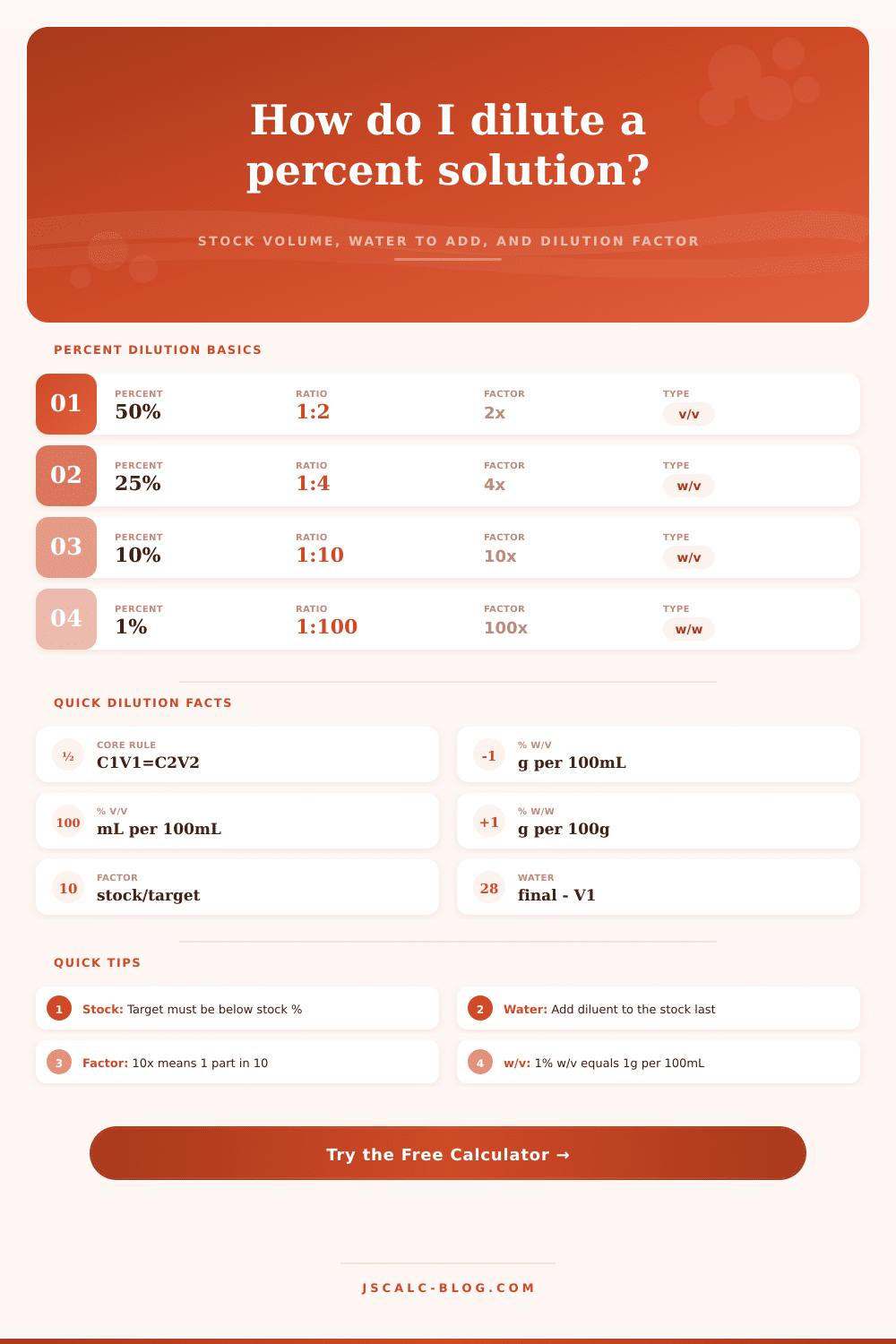
Work out how much stock solution and how much water to combine when you dilute a percent concentration. Handles % w/v, % v/v, and % w/w, plus dilution factor, ratio, and grams of solute using C1V1 = C2V2.
🧪Real Dilution Presets
📝Dilution Inputs
Choose whether the final volume is fixed or you are mixing a known stock volume with water.
The stronger solution you start from.
The weaker solution you want to make. Must be below the stock.
Total finished volume. Used in stock and diluent modes.
Only used when solving for final concentration.
🔢Formula Snapshot
📊Dilution Factor Reference
| Stock % | Target % | Factor | Ratio (Stock:Diluent) | Per 100 mL Final |
|---|---|---|---|---|
| 100% | 50% | 2× | 1 : 1 | 50 mL stock + 50 mL water |
| 70% | 10% | 7× | 1 : 6 | 14.3 mL stock + 85.7 mL water |
| 30% | 6% | 5× | 1 : 4 | 20 mL stock + 80 mL water |
| 10% | 1% | 10× | 1 : 9 | 10 mL stock + 90 mL water |
| 8.25% | 1% | 8.25× | 1 : 7.25 | 12.1 mL stock + 87.9 mL water |
| 5% | 0.5% | 10× | 1 : 9 | 10 mL stock + 90 mL water |
| 25% | 5% | 5× | 1 : 4 | 20 mL stock + 80 mL water |
🔗Percent to Ratio Conversion
| Percent | Fraction | Dilution Ratio | Factor | 1 mL Stock Makes |
|---|---|---|---|---|
| 50% | 1/2 | 1:2 | 2× | 2 mL final |
| 25% | 1/4 | 1:4 | 4× | 4 mL final |
| 20% | 1/5 | 1:5 | 5× | 5 mL final |
| 10% | 1/10 | 1:10 | 10× | 10 mL final |
| 5% | 1/20 | 1:20 | 20× | 20 mL final |
| 2% | 1/50 | 1:50 | 50× | 50 mL final |
| 1% | 1/100 | 1:100 | 100× | 100 mL final |
| 0.5% | 1/200 | 1:200 | 200× | 200 mL final |
The ratio 1:N here means one part of a 100% source diluted to N parts total. When diluting an already-weaker stock, use the stock ÷ target factor from the calculator instead.
🧴Common Dilution Recipes
| Recipe | Stock % | Target % | Type | Per 1 L Final |
|---|---|---|---|---|
| Disinfecting bleach | 8.25% | 0.1% | % v/v | 12 mL bleach + 988 mL water |
| Sanitizing bleach | 8.25% | 1% | % v/v | 121 mL bleach + 879 mL water |
| Hand rub alcohol | 99% | 70% | % v/v | 707 mL alcohol + 293 mL water |
| Surface alcohol | 91% | 70% | % v/v | 769 mL alcohol + 231 mL water |
| Saline rinse | 10% | 0.9% | % w/v | 90 mL stock + 910 mL water |
| Peroxide wound | 30% | 3% | % v/v | 100 mL stock + 900 mL water |
| Cleaning concentrate | 25% | 2.5% | % v/v | 100 mL stock + 900 mL water |
Always add the concentrate to the water, not the other way around, and confirm the label percent before mixing anything for disinfection.
⚖w/v vs v/v vs w/w Reference
| Type | Means | 1% Equals | Solute | Best For | Example |
|---|---|---|---|---|---|
| % w/v | Weight in volume | 1 g / 100 mL | Solid in liquid | Salts, sugars, powders | 0.9% saline |
| % v/v | Volume in volume | 1 mL / 100 mL | Liquid in liquid | Alcohols, acids | 70% ethanol |
| % w/w | Weight in weight | 1 g / 100 g | Mass in mass | Creams, alloys | 3% peroxide w/w |
| % w/v dilute | Keep g fixed | Same g, more mL | Solid stays | Buffer prep | 10% to 1% w/v |
| % v/v dilute | Add solvent | Same mL active | Liquid stays | Alcohol prep | 99% to 70% v/v |
| % w/w dilute | Add by mass | Same g, more g | Weigh diluent | Powder blends | 50% to 10% w/w |
For w/w work the same C1V1 = C2V2 logic applies, but you weigh the diluent in grams instead of measuring milliliters.
⚙Full Formula Breakdown
📋Reference Values
| Item | Common Range | How It Is Used | Notes |
|---|---|---|---|
| Stock percent (C1) | 5% to 100% | Divides into target × volume | Read from the concentrate label |
| Target percent (C2) | 0.1% to 50% | Sets the working strength | Must stay below the stock |
| Final volume (V2) | 10 mL to 20 L | Total finished batch | Choose the size you will store |
| Stock volume (V1) | Calculated | Measured from concentrate | Add this to the diluent |
| Diluent | Calculated | Water or solvent to add | Equals final minus stock volume |
💡Practical Dilution Tips
The recipe say to use seventy percent alcohol, and you’ve got a bottle labeled ninety-five percent. Half a cup of each doesn’t cut it; percentage is a relative measure but the volume of liquid are absolute.
To dilute something correctly, it’s less about arithmetic and more about tracking what stay constant while everything else change. Whether you begin with a concentrated batch of stock syrup or bleach, the pure active ingredient in there will be the same amount. Adding a solvent such as water stretch that amount over a greater volume. Most people struggle to visualize how much concentrate goes into how much finished product. They also struggle to know how to avoid making too little or wasting extra ingredient.
How to Dilute Correctly
Without all the jargon, it’s actualy a pretty simple equation: Target concentration x Final Total Volume = Concentration of Starting Material x Volume of Starting Material. It doesn’t matter if it’s weight/weight or volume/volume, or even weight/volume; the same relationship hold. And beauty of calculator is that it does the algebra for you, allowing you to get precise measurements while understanding why those inputs matter. But knowing why they go in help avoid expensive errors in the kitchen (or the lab).
Selecting which kind of concentration you’re working with tells it how to evaluate relationship between mass and density. If you use a volume-based recipe for one ingredient but measure it by weight, you will get something other than what you expect when it come time to bake (in this case, flour:water). The ratio won’t be correct and the bread won’t taste right.
Here’s where people go wrong: they mistake the dilution factor for volume of liquid to be added. That number doesn’t tell you how much water to add; the factor indicates simply how many times more diluted (or less concentrated) the resulting solution will be compared to original concentration. To determine exact volume required to bridge the gap from what you have to what you want, you must know just how many solute molecules remain intact. For instance, if I’m taking a ten percent stock and making it into a one percent, then my factor is ten; that means one part of that stock need nine parts of water to reach desired strength.
It works because it keeps the active ingredient intact. That is also why, when laid out in this chart with common household chemicals, we see that most cleaning solution use precise small amounts of concentrated chemical instead of a generous glug.
Consider wound care and contact lens solutions. How hard could it be? You put salt into water, right? Wrong. Precision is important. How hard could it be? You put salt into water, right? Wrong. Precision is important. Osmotic pressure fluctuations affect your body quite strongly, so a few percent difference between what you intended and actualy made will really sting.
That’s where this thing comes in; it computes the exact number of grams of solute to use, given target volume of final product. No more eyeballing things when doubling or tripling a recipe. The mixing ratio stay the same whether you are working with 5 liters or 50 milliliters (a large task versus a small experiment). The only thing that change is how much you has to measure.
The math is one part, but actually doing it correctly is another. If you’re worried about safety (and you should be), then use common sense: add the concentrate to the water; don’t pour water onto concentrated acids/bases. For weak ones such as bleach/alcohol, order doesn’t matter much except for how well they mix. To ensure a good mix, swirl gently, you want everything distributed evenly without generating too much foam which can mess up your volume measurement. Many folks get in a hurry here and end up with a poorly mixed solution in which the bottom of the bottle have a different concentration than what’s in the rest of the mixture.
Before closing the lid, double check numbers. It sounds trivial but it makes a huge difference when you need consistent results each time.
All this leads back to one point: dilution is a balancing act. Start strong; add water; use it. Your focus make it right, while the numbers tell your fingers where to go. You should of used more care with measurement. What are those numbers? They’re what lets you know that there’s as much of the initial goodness left in the end. It doesn’t matter if you are making a scientific reagent or cleaning a countertop. The idea is the same: start strong, add nothing, and end with exactly what you need.