Refinance Monthly Savings Calculator
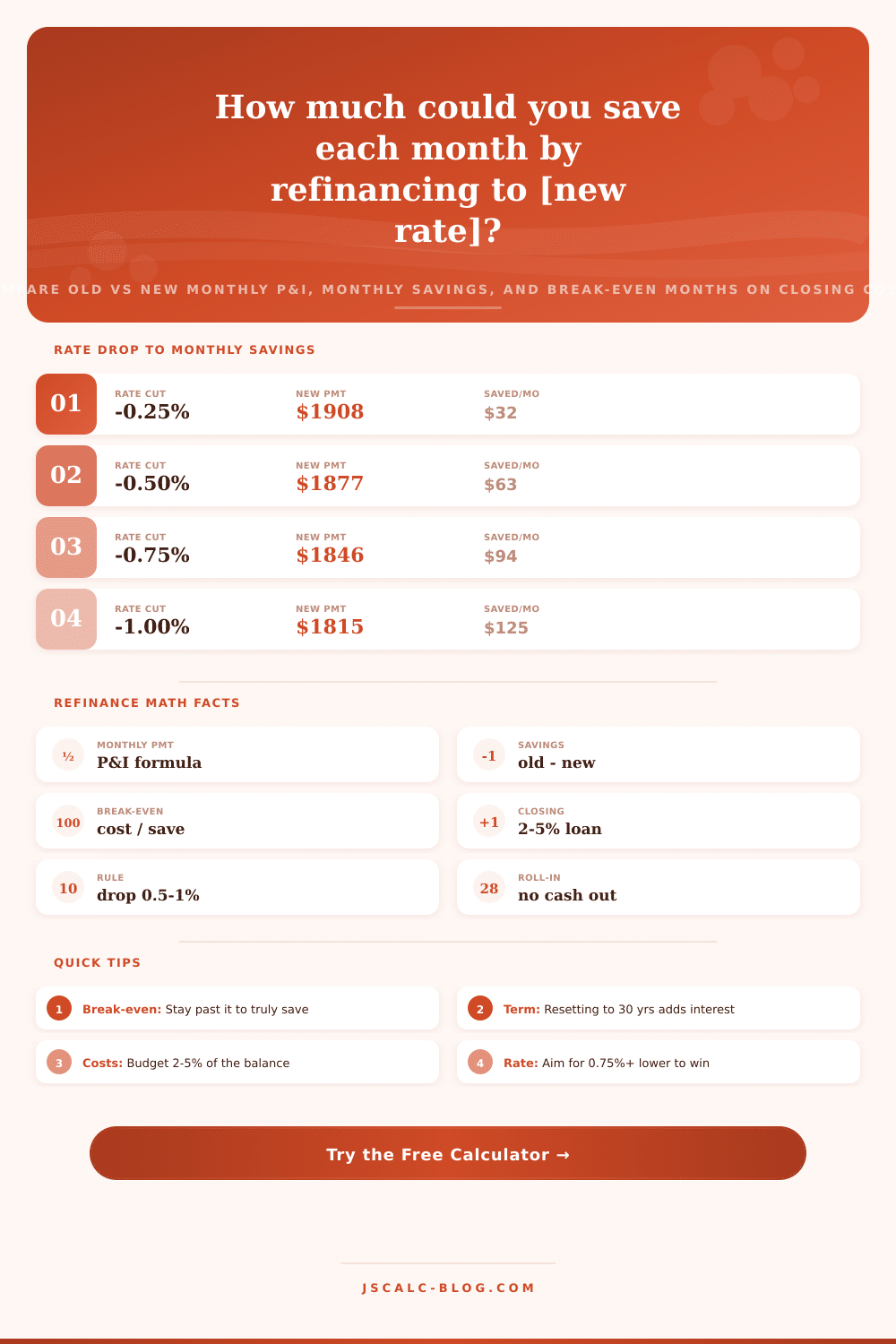
See exactly how much lower your monthly mortgage payment could be after a rate-lowering refinance, how many dollars you save each month, and how long it takes to break even on your closing costs.
🏡Real Refinance Scenarios
📝Your Current and New Loan
Amount you still owe on the existing mortgage today.
Annual rate on the loan you have now.
Years left until your existing mortgage is paid off.
Rate you are quoted on the refinanced loan.
Length of the new mortgage you are taking out.
Lender, title, and origination fees, often 2 to 5 percent.
Rolling costs in raises the new balance and payment.
Used to check that you pass the break-even point.
🔢Refinance Formula Snapshot
📊New Rate Options: Savings and Break-Even
| New Rate | Rate Cut | New Payment | Monthly Savings | Break-Even | 2-Year Net |
|---|---|---|---|---|---|
| Enter your loan details above to build this comparison. | |||||
Rows scale from a small 0.25 percent cut down to a 3 percent cut off your current rate, using your balance, remaining term, new term, and closing costs. The 2-year net column subtracts closing costs from 24 months of savings.
📈How Long Until You Break Even
| Monthly Savings | $3,000 Costs | $6,000 Costs | $9,000 Costs |
|---|---|---|---|
| $50 / mo | 60 months | 120 months | 180 months |
| $100 / mo | 30 months | 60 months | 90 months |
| $150 / mo | 20 months | 40 months | 60 months |
| $200 / mo | 15 months | 30 months | 45 months |
| $250 / mo | 12 months | 24 months | 36 months |
| $300 / mo | 10 months | 20 months | 30 months |
| $400 / mo | 8 months | 15 months | 23 months |
| $500 / mo | 6 months | 12 months | 18 months |
💰Typical Closing Cost Ranges
| Loan Balance | At 2% | At 3% | At 5% |
|---|---|---|---|
| $150,000 | $3,000 | $4,500 | $7,500 |
| $200,000 | $4,000 | $6,000 | $10,000 |
| $300,000 | $6,000 | $9,000 | $15,000 |
| $400,000 | $8,000 | $12,000 | $20,000 |
| $500,000 | $10,000 | $15,000 | $25,000 |
| $650,000 | $13,000 | $19,500 | $32,500 |
⚙Formula Breakdown
💡Smart Refinance Tips
Open your mortgage statement and read closely: the math won’t always be what you expected. Refinancing could helps; or hurt. The temptation is often immediate when rates drop, and you’ll probably want to jump right into action. But here’s the real world: that smaller percentage on paper isn’t always so simple.
Homeowners tend to focus on their monthly payment amount. They view it as an answer to every budgeting problem. That strategy rarely succeeds, however, because they ignore both up-front fees and interest over time.
When Should You Refinance Your Mortgage?
Refinancing your home is a matter of re-arranging your debt. Your mortgage should reflects where you want to be in 5 or 10 years. Amortization is the key: It divides your payment between interest and principal, spreading both across length of loan. A lower rate means less interest… Which means more of every payment will be applied to reducing balance owed.
But resetting the clock doesn’t mean you’ll save if you take a longer time to repay. If you’re half-way through repaying a 30-year mortgage and refinance with another 30-year loan, you’ve extended the time it takes for you to pay off the house … by an additional 15 years. Your payment may decrease. You feel like you have more room in your budget. Guess what? Chances are good you’ll end up paying much higher interest in total. Many folks falls into this trap. They go after low payments and ignore the future.
There’s a catch: Refinancing isn’t free. Depending on where you live, closing costs is between 2% and 5% of your loan amount. That includes lender charges, title insurance and an appraisal. Those aren’t chump change.
How do you know if your monthly savings will pay back those costs? This is your break-even point. It is the number of months it takes to get back what you spent. For instance, suppose you shell out $6,000 to save $150 per month. That’ll take you 40 months to break even. Anything beyond that represents pure profit. If you intend to sell within three years, then forget it, the reduced payment won’t help.
So do you roll this expense into new mortgage? Or will you pay cash for this expense now? Cash allows you to keep monthly payment lower and reduce the loan balance. However, you need to have liquidity present on closing day. On the flip side, if you choose to roll the fee into the loan, then you don’t bring any additional cash to the table. The downside: your principal balance rise, so your monthly payment and overall interest paid increase slightly. So it’s an apples-to-oranges decision: cash flow versus long-term cost efficiency. Which constraint are you tighter on today? Are you tight on money in your bank account or space within your month’s budget?
Headline numbers aren’t everything; it’s all about rate threshold. When the rate drops by zero point two five percent, that almost never makes sense. When the rate drops by one or more percentage points, there is typically a clear way to save money. The calculator above does the math for you. It shows you what your new payment would be, how much money you save per month, and when you’d break even (assuming you do). That gives you a way to picture if this is a deal that makes sense based off your specific circumstances.
Focus in on the change in lifetime interest. That is the real price of changing your loan length. Ultimately, refinancing should align, not reduce. And that’s because it’s most effective when you know where you’re going to settle down. It works when you can visualize beyond the break-even.
If you don’t know what to do next; or if you’re unsure of where you’ll call home within the next five years, then it may make sense to stay put. The numbers aren’t meant to be the deciding factor; they’re intended to guide your decision. Your life goals should drive the ultimate choice. A reduced payment is only valuabel if it contributes to long-term wealth. That doesn’t help if it only soothes short-term stress.