Cash-Out Refinance Calculator
Replace your existing mortgage with a larger loan and withdraw the difference as cash. Enter your home value, current payoff, LTV cap, rate, and term to see your maximum new loan, gross and net cash out, new monthly principal and interest, remaining equity, new LTV, and how your payment changes.
🏠Real Cash-Out Scenarios
📝Your Refinance Details
Appraised or estimated market value of the property.
Remaining balance that the new loan must retire first.
Maximum share of value the new loan may reach.
Pull every dollar the cap allows, or set your own.
Used only when cash-out amount is set to specific.
Rate on the new, larger mortgage.
Amortization length used for the new payment.
Fees and prepaids subtracted from net cash to you.
Old principal and interest, for payment comparison.
🔢Formula Snapshot
💰Max Cash Out by Home Value at 80% LTV
| Home Value | Current Payoff | Max Loan (80%) | Gross Cash Out |
|---|---|---|---|
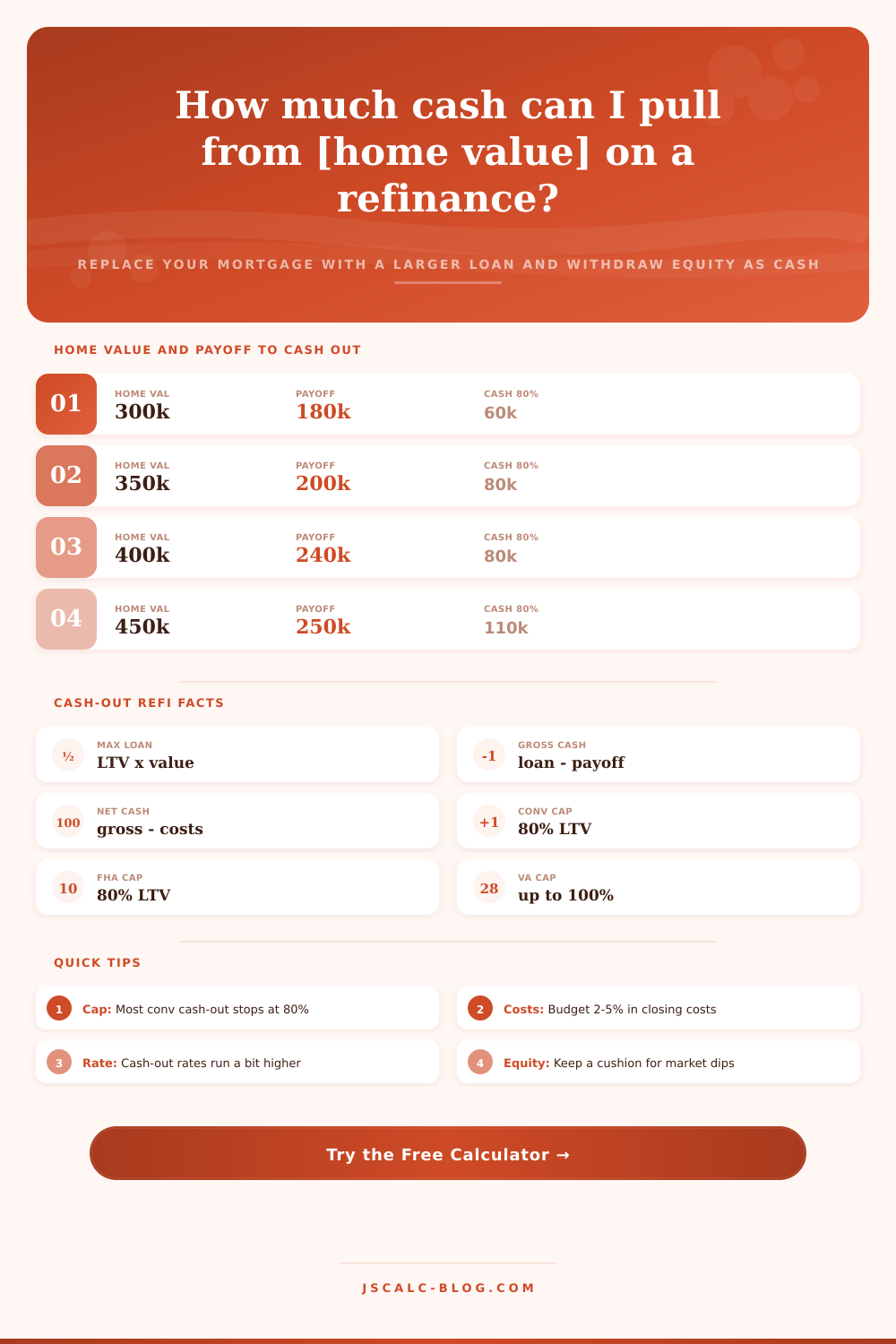
| $300,000 | $180,000 | $240,000 | $60,000 |
| $350,000 | $200,000 | $280,000 | $80,000 |
| $400,000 | $240,000 | $320,000 | $80,000 |
| $450,000 | $250,000 | $360,000 | $110,000 |
| $500,000 | $300,000 | $400,000 | $100,000 |
| $600,000 | $360,000 | $480,000 | $120,000 |
| $700,000 | $400,000 | $560,000 | $160,000 |
| $800,000 | $500,000 | $640,000 | $140,000 |
📈New Monthly P&I per $100,000 Borrowed
| Rate | 30-Year | 20-Year | 15-Year | 10-Year |
|---|---|---|---|---|
| 5.50% | $568 | $688 | $817 | $1,085 |
| 6.00% | $600 | $716 | $844 | $1,110 |
| 6.50% | $632 | $746 | $871 | $1,135 |
| 7.00% | $665 | $775 | $899 | $1,161 |
| 7.50% | $699 | $806 | $927 | $1,187 |
| 8.00% | $734 | $836 | $956 | $1,213 |
🗃Cash-Out Comparison Grid Across LTV Caps
| LTV Cap | Max New Loan | Gross Cash Out | Remaining Equity | Equity After % | Risk Profile |
|---|---|---|---|---|---|
| 70% | $315,000 | $65,000 | $135,000 | 30% | Very safe |
| 75% | $337,500 | $87,500 | $112,500 | 25% | Safe |
| 80% | $360,000 | $110,000 | $90,000 | 20% | Standard |
| 85% | $382,500 | $132,500 | $67,500 | 15% | Aggressive |
| 90% | $405,000 | $155,000 | $45,000 | 10% | Rare / FHA |
| 95% | $427,500 | $177,500 | $22,500 | 5% | VA only |
📊Cash-Out Refinance vs HELOC
| Feature | Cash-Out Refinance | HELOC | Payment | Best For |
|---|---|---|---|---|
| Structure | New larger first mortgage | Second-lien credit line | Fixed | One large need |
| Rate type | Usually fixed | Usually variable | Predictable | Rate stability |
| Closing costs | 2% to 5% of loan | Low or none | Rolled in | Big draw |
| Existing loan | Replaced entirely | Left untouched | Combined | Low old rate |
| Access | Lump sum at close | Draw as needed | Interest-only draw | Ongoing spend |
| Typical cap | 80% LTV | 85% to 90% CLTV | Varies | Max equity |
⚙Formula Breakdown
💡Cash-Out Refinance Tips
Home equity is sitting there, but it’s not liquid. Until you do something about it, it won’t be. A cash-out refi gives you access to cash. You’ll swap your existing mortgage for a bigger one and pocket the difference. It’ll calculate the math for you (see: this page).
Then you’ll weigh the tradeoffs: How much cash are you getting? What will your monthly payments looks like for years to come?
The Pros and Cons of Cash-Out Refinancing
Your house is valued by the lender. Then they apply a limit called “loan-to-value.” For example, conventional loans typically allow an 80 percent limit. That’s the highest possible amount of your new loan. First, the new loan will pay off whatever you owe on your old one. Whatever money remains overflows into your hands: that’s your cash.
This is the gross number. Next, take away closing costs. These can be paid up-front or tacked onto the loan itself. The final number is what matters to your budget: the net proceeds. A lot of folks gets excited about the gross number, because it looks so big! But the only number that actualy lands in your bank account? It is the net.
Real estate values fluctuate. Lenders restrict your ability to borrow based off those fluctuations. You might borrow too much, then the value goes down and suddenly you owe more than the house is worth. That’s a problem if you want to sell. A buffer of 20% equity protects you from falling prices. It keeps you out of private mortgage insurance on the new loan. Beyond that mark, you have more cash today. But you’ll raise your monthly payment. Plus, you increase your long-term risk. This affects your financial stability.
You’ll take out a higher principal, which means that your monthly payment is probably going to be higher. Based off your term and your rate, the calculator estimates what your new interest will be. Then it contrasts that with your old payment. At today’s interest rates, another hundred grand tacks on about six hundred sixty-five bucks per month. That doesn’t sound so bad all by itself. But remember: that’s every single month, for three decades if you opt for a traditional term.
Over time, the total interest cost grows. It’s like trading future dollars in exchange for present-day cash. The effect it has on your bottom line isn’t something homeowners typically consider. They focus on the lump sum, while ignoring its recurring price tag. Typically, consolidating high-interest credit cards makes sense. Six percent APR replaces fifteen percent APR. That additional mortgage balance will be paid back by the savings. Vacations and boats are another story. Cash flow represents a way to cash out equity without getting anything back. It shifts wealth from your future self to your present self. In the long run, that makes you poorer.
Option 2 is a Home Equity Line of Credit. This comes with variable rates and less expensive upfront costs. The HELOC also becomes a second lien to your primary mortgage. Option 3 is cash-out refinancing. This removes your original loan and replaces it with one single loan. Closing costs are higher, but interest rates is fixed.
Use each one depending on your needs: Do you need the money immediately or gradually? Is your initial interest rate unusually low? How much do you trust yourself not to overspend? If those answers lean toward “now” and “yes,” then get that HELOC. Otherwise, a second lien might be smarter.
Before you sign on the dotted line, check your existing equity. Aggressively leveraged loans have a high loan-to-value: don’t go beyond 80 percent. Have a clear reason why you’ll use the cash, something that decreases costly debt or increases value. Make sure the math supports this leverage.
Don’t treat equity like a license to spend more money. Use it as your financial safety net. Keep its buffer as a source of stability. You should of kept it for emergencies.